

Archive position — measured, not model output
0 likes on Devpost
2,263 of the 7,850 archived projects have more likes, and 5,587 share exactly 0 — so this project's #6,096 place in the like-ranked listing is a tie-break inside that group, not a ranking.
Projects (log scale)
Likes on Devpost. ▲ marks this project's group.
Show the figures
| Likes | Projects | Share of archive |
|---|---|---|
| 0 | 5,587 | 71.2% |
| 1 | 1,758 | 22.4% |
| 2 | 284 | 3.6% |
| 3–4 | 132 | 1.7% |
| 5–9 | 75 | 1.0% |
| 10+ | 14 | 0.2% |
 User Stories BotA demo video on every pull request
Get a demo video on every new feature
GitHub App that watches your pull requests and records a narrated, captioned demo.
Save time on demo prep and make informed decisions faster with a video walkthrough of every new feature.
Executive Summary
The description states that Project Stack Tracker is a website for developers to organize projects in one place, tracking services used, costs, subscriptions, and to-do lists. The author built it using ChatGPT and Codex, with no evidence of revenue, customers or adoption. The project appears to be a personal tool developed during a hackathon, with no indication of commercial traction or market validation. The single most important open question is whether the author intends to develop this into a product for others beyond their own use.
What The Product Actually Is
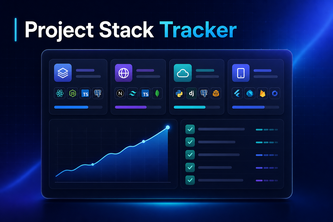
The description states that Project Stack Tracker is a website that allows users to keep track of all their projects in one place. It tracks what kind of services a user regularly uses in their projects to help with future projects. Costs and subscriptions are shown. It also has a to-do list section for tasks that need to be done on certain projects.
Positioning & Claim Evolution
The description states the product helps developers organize projects all in one place. The author's own write-up indicates it was built to track apps and websites they are building, with no evidence of positioning as a commercial tool for others or market expansion beyond personal use.
Target Customer & ICP
Not evidenced. The description does not identify a specific customer segment or target persona beyond "developers" in general.
Business Model & Pricing Evidence
Not evidenced. There is no mention of pricing, monetization strategy, or business model in the description.
Technical & Delivery Signals
The description states that the project was built with ChatGPT and Codex, using technologies including expo.io, node.js, openai, react-native, resend, supabase, typescript, vercel. The author notes they guided and debugged while the AI did most of the coding.
Traction & Maturity Signals
Not evidenced. There is no evidence of revenue, customers, user adoption, or product maturity beyond a single developer's personal project.
Competitive Context
Not evidenced. No information provided about competitors or market positioning.
Open Questions & Risks
The description indicates this was built by one person (Carson Coleman) as a hackathon project, with no evidence of commercial traction or market validation. The author notes they had to focus on making it work rather than adding features, suggesting limited development beyond basic functionality. There is no indication of any business model, pricing, or customer base.
Questions the description leaves open
- What specific problem are you solving for developers beyond personal project tracking?
- How do you plan to monetize this tool if it's not just for personal use?
- What is your roadmap for product development and user acquisition?
- Are there any existing tools in the market that solve similar problems?
- What is your timeline for moving from a personal project to a commercial offering?
Overall Assessment
Not evidenced. The description provides no information about financials, traction, or strategic fit for investment or partnership. The project appears to be a personal tool developed during a hackathon with no evidence of commercial viability or market demand.
User Stories BotA demo video on every pull request
Get a demo video on every new feature
GitHub App that watches your pull requests and records a narrated, captioned demo.
Save time on demo prep and make informed decisions faster with a video walkthrough of every new feature.
Source
Submitted to the OpenAI 2026 hackathon on Devpost. Project home on Devpost. Back to the full gallery on Devpost.
This competitive analysis was produced by top-founders.com (opens in a new tab)
Generated by a language model from this project's public Devpost page — its tagline, the author's own write-up and any built-with tags listed there — as captured in August 2026. Short quotations are the author's words. It is an opinion on the idea as a business, not on the people behind it, and it reflects the description as published then. If the project has moved on, request a correction below. The analysis is not independent research and contains no verified traction, revenue or customer data.
An independent guide by KFG International LLC — not affiliated with, endorsed by, or connected to Devpost or OpenAI.