

Archive position — measured, not model output
1 like on Devpost
505 of the 7,850 archived projects have more likes, and 1,758 share exactly 1 — so this project's #2,172 place in the like-ranked listing is a tie-break inside that group, not a ranking.
Projects (log scale)
Likes on Devpost. ▲ marks this project's group.
Show the figures
| Likes | Projects | Share of archive |
|---|---|---|
| 0 | 5,587 | 71.2% |
| 1 | 1,758 | 22.4% |
| 2 | 284 | 3.6% |
| 3–4 | 132 | 1.7% |
| 5–9 | 75 | 1.0% |
| 10+ | 14 | 0.2% |
 User Stories BotA demo video on every pull request
Get a demo video on every new feature
GitHub App that watches your pull requests and records a narrated, captioned demo.
Save time on demo prep and make informed decisions faster with a video walkthrough of every new feature.
Executive Summary
The company appears to be a single-person project named VeyaNet Decision Gate, self-described as a browser prototype for routing AI outputs through human-supervised decision gates (PASS / REVIEW / BLOCK) in high-stakes workflows. The author states this is part of a larger architecture but submitted only a demo version due to hackathon constraints.
What changed: No evidence of prior version or evolution; this is the first public manifestation of the idea as described by the author.
Single most important open question: Is there any evidence of traction, revenue, or customer adoption beyond the prototype? The description makes no claims about actual deployment or usage in real systems.
What The Product Actually Is
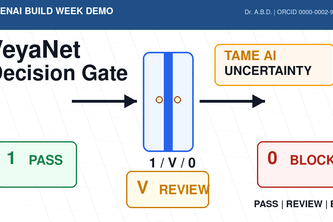
The description states that VeyaNet Decision Gate is a working browser prototype built with HTML, CSS, JavaScript and deployed via GitHub Pages. It routes AI/system outputs into three outcomes:
- 1 = PASS
- V = REVIEW
- 0 = BLOCK
It accepts scenario signals, normalizes them into a decision packet, calculates a bounded uncertainty score, identifies evidence gaps, and keeps uncertain or unsafe outputs under human review.
Inference: The prototype is not a full system but a demonstration of the core routing logic and UI. It is described as a "supervised routing layer" that does not itself make decisions but determines whether an output should proceed, be reviewed, or be blocked based on uncertainty.
Positioning & Claim Evolution
The author states that VeyaNet Decision Gate was inspired by the problem of automated systems producing outputs faster than humans can safely verify them, particularly in clinical, industrial, DevOps, or agentic workflows.
Claim: The system is designed to ensure uncertain outputs do not go straight to action but are routed through a human-supervised gate.
Inference: This suggests a positioning around safety and risk mitigation in AI deployment. It does not claim to be a complete AI governance platform, but rather a decision routing interface for uncertain AI outputs.
Target Customer & ICP
The description states that the system is intended for use in high-stakes AI workflows, including clinical, industrial, DevOps, or agentic environments.
Inference: The target customer appears to be organizations deploying AI systems where human oversight is required before action. However, no specific customer names, personas, or market segments are mentioned.
Business Model & Pricing Evidence
Not evidenced. The description does not mention any pricing model, monetization strategy, or business model.
Technical & Delivery Signals
The project was built as a browser prototype using:
- HTML
- CSS
- JavaScript
- GitHub Pages
- Codex (for code generation)
- GPT-5.6 (for framing and logic)
It is described as a lightweight demo, not a production system.
Inference: The technical stack suggests this is a proof-of-concept, not a scalable or enterprise-grade solution. It was built quickly for a hackathon submission.
Traction & Maturity Signals
Not evidenced. There is no mention of:
- Revenue
- Customers
- Adoption
- Product usage metrics
- Market traction
- Prior versions or iterations
The project is described as a single-person hackathon submission, and the author explicitly states that it is part of a larger architecture but only the final routing gate was exposed.
Competitive Context
Not evidenced. No mention of competitors, market landscape, or existing solutions in this space.
Open Questions & Risks
- Single-person project: The entire system is built by one individual (AHMET BÜLENT DEMİRBAĞ), raising questions about scalability and long-term maintenance.
- Prototype-only: The system is described as a demo, not a production-ready product. No evidence of real-world deployment or integration.
- No commercial traction: No evidence of revenue, customers, or adoption beyond the prototype.
- Unverified safety claims: The system is explicitly stated to be not a clinical diagnostic device or factory controller, but it is unclear how it would integrate into such systems in practice.
Questions the description leaves open
- What is the actual architecture of the larger VeyaNet system? Is this just a UI layer?
- Has the prototype been tested or validated in any real-world environment?
- Are there plans to move beyond the demo into production use cases?
- How does this integrate with existing AI systems or workflows?
- What is the roadmap for scaling this beyond a single-person project?
Overall Assessment
Not evidenced. No information is provided about funding, valuation, or interest from investors or partners.
Confidence: Low. The description is self-reported and unverified, and provides no evidence of traction, revenue, customers, or commercial viability beyond the prototype. It is unclear whether this represents a viable business or just an idea in early-stage development.
User Stories BotA demo video on every pull request
Get a demo video on every new feature
GitHub App that watches your pull requests and records a narrated, captioned demo.
Save time on demo prep and make informed decisions faster with a video walkthrough of every new feature.
Source
Submitted to the OpenAI 2026 hackathon on Devpost. Project home on Devpost. Back to the full gallery on Devpost.
This competitive analysis was produced by top-founders.com (opens in a new tab)
Generated by a language model from this project's public Devpost page — its tagline, the author's own write-up and any built-with tags listed there — as captured in August 2026. Short quotations are the author's words. It is an opinion on the idea as a business, not on the people behind it, and it reflects the description as published then. If the project has moved on, request a correction below. The analysis is not independent research and contains no verified traction, revenue or customer data.
An independent guide by KFG International LLC — not affiliated with, endorsed by, or connected to Devpost or OpenAI.