

Archive position — measured, not model output
3 likes on Devpost
128 of the 7,850 archived projects have more likes, and 93 share exactly 3 — so this project's #208 place in the like-ranked listing is a tie-break inside that group, not a ranking.
Projects (log scale)
Likes on Devpost. ▲ marks this project's group.
Show the figures
| Likes | Projects | Share of archive |
|---|---|---|
| 0 | 5,587 | 71.2% |
| 1 | 1,758 | 22.4% |
| 2 | 284 | 3.6% |
| 3–4 | 132 | 1.7% |
| 5–9 | 75 | 1.0% |
| 10+ | 14 | 0.2% |
 User Stories BotA demo video on every pull request
Get a demo video on every new feature
GitHub App that watches your pull requests and records a narrated, captioned demo.
Save time on demo prep and make informed decisions faster with a video walkthrough of every new feature.
Executive Summary
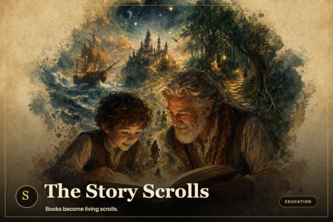
What the company appears to be: The Story Scrolls is a self-reported rights-first AI-powered platform for creating source-aware, age-adapted illustrated literature. It positions itself as an end-to-end system for adapting and publishing long-form stories with provenance, visual continuity control, and predictable costs.
What changed: During OpenAI Build Week (July 13–21, 2026), the author transformed an experimental scrollytelling reader into a working platform that supports full creative workflows from rights declaration to published scroll. The system uses GPT-5.6 for structured reasoning and story generation, and GPT Image 2 for illustration.
Single most important open question: Is there evidence of traction, revenue, or customer adoption beyond the author's own demonstration? The description states no such data exists.
What The Product Actually Is
The description states that Story Scrolls is:
- A "rights-first AI studio" for source-aware, age-adapted illustrated literature
- An immersive reading library and creator studio that turns literature into flowing, illustrated journeys
- A system enabling creators to bring authorized sources or original ideas, choose audience and treatment, approve visual continuity, generate within a visible budget, publish with provenance, and read the result as a finished living scroll
It includes:
- A six-stage workflow: Rights → Story → Shape → Art → Review → Create
- A "living scroll" format that supports continuous reading, chapter art, illuminated initials, controls, and source/provenance details
- Public-domain classics and original works available in curated story routes
- Tools for creators to control chapter and length targets, visual direction, total image budget, quality tier, and publication choices
The system is described as not being a mockup or one-prompt demonstration but a complete working platform with:
- Two completed proof scrolls (A Christmas Carol: A Clearer Road and The Lanternmaker's Map)
- Public deployment requiring no login
- Automated tests and responsive visual QA
- Deployment and release runbooks
Evidence: Self-reported by the author.
Positioning & Claim Evolution
The description states that Story Scrolls:
- Does not begin with a blank prompt and stop at generated prose
- Begins with permission and a source
- Preserves events, causality, character choices, motifs, unresolved threads, and ending state through hierarchical long-source ledgers
- Allows creators to make important adaptation decisions visible: audience, reading age, fidelity, treatment, chapter structure, length, visual direction, quality, and budget
- Pauses for human approval of visual continuity before paid image generation
- Publishes finished illustrated reading experiences carrying authorship, source, rights, transformation, model, and safety provenance
The system is described as:
- Simultaneously a source-aware adaptation engine, a story-craft studio, a rights-first publishing workflow, and a complete illustrated reading experience
- Not another chatbot that produces a disposable bedtime story
- A complete reading and publishing system where transformed stories remain traceable to their source and understandable as deliberate human choices
Evidence: Self-reported by the author.
Target Customer & ICP
The description states:
- Primary audience is young and reluctant readers who may be kept at a distance from remarkable literature by older language, long-form density, or flat screen presentation
- Families and educators need approachable ways into those works
- Authors and other authorized creators need a transparent way to adapt them without hiding the source or the choices involved
The system supports:
- Authorized creators bringing original work, public-domain material, or work they are licensed or explicitly permitted to use
- Creators choosing between faithful edition, complete-plot condensation, age adaptation, modernization, reimagining, new ending, or picture-led experience
- Control over chapter and length targets, visual direction, total image budget, quality tier, illuminated-letter family, and publication state (unlisted or public review)
Evidence: Self-reported by the author.
Business Model & Pricing Evidence
The description states:
- The system uses bounded GPT Image 2 artwork
- Moderation, request-scoped API keys, cost preflight and local spend caps, private media, durable asynchronous jobs, unlisted-by-default publishing, public review, and persistent provenance
- A creator's OpenAI API key is request-scoped: the service does not write it to browser storage, cookies, SQLite, the filesystem, logs, errors, or story records
- Before generation, the Review step shows exact planned text/image requests, a conservative dollar range, and an optional local spend cap
However, there is no evidence of:
- Pricing tiers or monetization strategy
- Revenue model or customer acquisition costs
- Subscription plans or usage-based pricing
- Customer data or sales funnel
Evidence: Self-reported by the author.
Technical & Delivery Signals
The description states:
- Built with: caddy, chatgpt, codex, css, drizzle-orm, gpt-5-6, gpt-image-2, javascript, next-js, node.js, openai-api, react, sqlite, typescript, vinext, vite
- Core pipeline lives in server/platform-server.mjs using OpenAI Responses API with strict JSON schemas, store: false, bounded inputs and outputs, moderation, structured validation, retry/error handling, and persistent provenance
- Quality ladder maps directly to an allowlisted GPT-5.6 model and reasoning level:
- Sketch: gpt-5.6-luna, low reasoning
- Storybook: gpt-5.6-terra, medium reasoning
- Crafted / Heirloom / Masterwork: gpt-5.6-sol, high reasoning, with one to three editorial refinement passes
- For long sources, GPT-5.6 first creates loss-resistant chronological source ledgers that preserve events, causality, character choices, motifs, unresolved threads, and ending state
- GPT-5.6 produces the reviewable visual continuity bible
- GPT Image 2 turns the approved bible into one private continuity reference and a bounded set of cover, chapter-hero, and inline illustrations
- Production architecture separates trust levels: static curated readers are served directly, while community creation runs through an isolated loopback Node service backed by SQLite and a private media directory outside the public web root
Codex was used as a primary engineering collaborator across every major layer of the system.
Evidence: Self-reported by the author.
Traction & Maturity Signals
The description states:
- Two completed GPT-5.6 proof scrolls: A Christmas Carol: A Clearer Road and The Lanternmaker's Map
- Public no-login deployment with automated tests, responsive visual QA, deployment and release runbooks
- Dated source freeze (tag googledevweekjul-submission-20260721-1950, commit 4029d302, timestamped 2026-07-21T23:48:49Z)
- Final pre-deadline illuminated-initial sync (commit 3ebc429, timestamped 2026-07-21T23:56:05Z)
- Judge Quick Start — No API Key Required
- Public source repository for setup, architecture, tests, the dated judging freeze, and Codex/GPT-5.6 evidence
However, there is no evidence of:
- Customer base or user engagement metrics
- Revenue or monetization data
- Product adoption beyond the author's own demonstration
- Any form of market traction or growth indicators
Evidence: Self-reported by the author.
Competitive Context
The description does not provide any information about:
- Competitors in the space
- Market positioning relative to existing tools for story creation, adaptation, or publishing
- Differentiation from similar platforms or services
Evidence: Not evidenced.
Open Questions & Risks
Inferences based on self-reported information:
- No Revenue or Traction Evidence: The system is described as a demonstration project submitted to a hackathon with no evidence of revenue, customers, or adoption beyond the author's own use.
- Single-Founder Operation: The team size is listed as one member (Cory Boehne), which may indicate limited operational capacity for scaling.
- High Dependency on AI Models: Heavy reliance on GPT-5.6 and GPT Image 2 raises concerns about model availability, cost, and potential obsolescence.
- Limited Public Availability: While the system is publicly accessible, it appears to be a prototype or demonstration rather than a production-ready product.
- Privacy and Security Concerns: The system handles API keys and user data in a complex way, which could pose risks if not fully implemented securely.
Evidence: Self-reported by the author; inferred from lack of supporting data.
Questions the description leaves open
- What is the actual business model for monetization?
- How many users have engaged with the platform beyond the author's own use?
- Are there any plans to scale beyond the current prototype or demonstration?
- What are the risks associated with dependency on specific AI models and APIs?
- How does the system handle data privacy and compliance with regulations like GDPR or CCPA?
- What is the roadmap for product development and feature enhancements?
- How do you plan to acquire customers and build a sustainable user base?
Evidence: Based on self-reported information and general due-diligence best practices.
Overall Assessment
The Story Scrolls is presented as an experimental AI-powered platform for creating source-aware, age-adapted illustrated literature. It demonstrates technical capability through its implementation during OpenAI Build Week but lacks evidence of traction, revenue, or customer adoption beyond the author's own demonstration.
Given:
- The project is a prototype submitted to a hackathon
- No revenue, customers, or market data are provided
- The system relies heavily on proprietary AI models
- Only one founder is involved
This represents a high-risk, early-stage opportunity with limited commercial viability indicators. It may be suitable for strategic partnerships or exploratory investments if the author can demonstrate traction and scalability.
Evidence: Self-reported by the author; no independent verification of commercial outcomes.
User Stories BotA demo video on every pull request
Get a demo video on every new feature
GitHub App that watches your pull requests and records a narrated, captioned demo.
Save time on demo prep and make informed decisions faster with a video walkthrough of every new feature.
Source
Submitted to the OpenAI 2026 hackathon on Devpost. Project home on Devpost. Back to the full gallery on Devpost.
This competitive analysis was produced by top-founders.com (opens in a new tab)
Generated by a language model from this project's public Devpost page — its tagline, the author's own write-up and any built-with tags listed there — as captured in August 2026. Short quotations are the author's words. It is an opinion on the idea as a business, not on the people behind it, and it reflects the description as published then. If the project has moved on, request a correction below. The analysis is not independent research and contains no verified traction, revenue or customer data.
An independent guide by KFG International LLC — not affiliated with, endorsed by, or connected to Devpost or OpenAI.