

Archive position — measured, not model output
0 likes on Devpost
2,263 of the 7,850 archived projects have more likes, and 5,587 share exactly 0 — so this project's #6,092 place in the like-ranked listing is a tie-break inside that group, not a ranking.
Projects (log scale)
Likes on Devpost. ▲ marks this project's group.
Show the figures
| Likes | Projects | Share of archive |
|---|---|---|
| 0 | 5,587 | 71.2% |
| 1 | 1,758 | 22.4% |
| 2 | 284 | 3.6% |
| 3–4 | 132 | 1.7% |
| 5–9 | 75 | 1.0% |
| 10+ | 14 | 0.2% |
 User Stories BotA demo video on every pull request
Get a demo video on every new feature
GitHub App that watches your pull requests and records a narrated, captioned demo.
Save time on demo prep and make informed decisions faster with a video walkthrough of every new feature.
Executive Summary
Project Northline is described by its author as a local-first, offline-capable AI enterprise system designed to manage institutional knowledge and corporate continuity through an autonomous Chief of Staff named Sarah. The system uses a multi-agent architecture running on standard hardware, leveraging GPT-5.6 and Codex for reasoning and execution, while avoiding telemetry or cloud-based data flows.
The author claims the project is built with zero-telemetry, full local execution, and cryptographic isolation to protect IP. It includes an interface that visualizes agent activity through interactive avatars and supports HR-related tasks via 15 offline HR agents.
Key commercial due-diligence question
Is there any evidence of real-world application or testing beyond the hackathon prototype? The description lacks any indication of customer engagement, revenue, or product-market fit beyond self-reported claims.
What The Product Actually Is
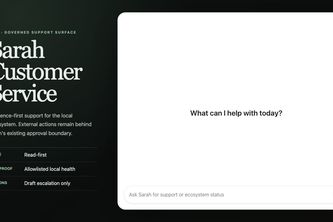
The description states that Project Northline is a local-first, offline-capable corporate cognitive ecosystem. It operates as a central nervous system for an enterprise, governed by an autonomous AI Chief of Staff named Sarah.
It features:
- A multi-agent workforce (currently 15 HR sub-agents)
- An autonomous agent orchestration layer using GPT-5.6 and Codex
- A persistent multimodal interface supporting voice, text, and recording
- A Storyline Intelligence UI that renders the AI’s internal state via interactive Claymation avatars
The system is said to be built on:
- Local execution environments (e.g., air-gapped Hugging Face ML sandbox)
- File-system ledger for agent communication
- Next.js/FastAPI interface with WebSocket connections
- SQLite for state management
Inference The product appears to be a proof-of-concept prototype, likely developed as part of a hackathon project. No evidence suggests it has been deployed or tested in production.
Positioning & Claim Evolution
The author positions Project Northline as:
- A sovereign AI workforce that you "actually own, control, and inherit"
- An answer to the problem of institutional data death, where knowledge vanishes when employees leave
- A transition from “chatting with AI” to managing a Sovereign Cognitive Enterprise
The project claims:
- To provide absolute IP security
- To enable corporate continuity regardless of human attrition
- To offer true zero-telemetry execution
- To support multi-agent workflows without exposing proprietary data
These claims are framed as responses to modern SaaS fragility and dependency on cloud providers.
Inference The positioning reflects a strong ideological stance toward data sovereignty and local AI, but lacks evidence of market validation or traction.
Target Customer & ICP
The description states that Project Northline is intended for enterprise clients, particularly those concerned with:
- Institutional knowledge retention
- Data sovereignty
- Corporate continuity
- IP protection
It mentions a current focus on HR-related tasks via 15 offline HR agents, suggesting an initial use case in human resources.
No explicit customer segments or personas are defined beyond this.
Inference The ICP seems to be large enterprises with high sensitivity around data privacy and institutional knowledge. However, no evidence of actual customers or target market research is provided.
Business Model & Pricing Evidence
There is no evidence in the description of a business model or pricing structure.
The author mentions integrating Stripe Connect for tenant provisioning and secure network node allocation, but does not elaborate on monetization strategies or pricing tiers.
Inference The project appears to be in early development with no commercialized offering. Any future monetization strategy remains speculative.
Technical & Delivery Signals
The system is described as:
- Local-first, air-gapped, and offline-capable
- Built using:
- GPT-5.6 Sol and Terra
- Codex workspace agent
- Hugging Face ML sandbox
- SQLite for state management
- Next.js/FastAPI interface
- Node.js, React, TypeScript, Python, JavaScript
It includes:
- A Provider-Neutral Agent Bus using a local file-system ledger
- An Offline ML Sandbox enforcing isolation via environment flags like
TRANSFORMERS_OFFLINE=1 - A Storyline Intelligence UI with reactive avatars and multimodal input support
Challenges addressed include:
- Concurrency issues in SQLite
- Port zombies and state lockups
- Context window optimization
Inference The technical stack suggests a complex, custom-built prototype. However, no evidence of scalability, performance testing, or deployment beyond the hackathon environment is provided.
Traction & Maturity Signals
The description states:
- The project was built for the OpenAI 2026 hackathon
- It passed 370 Python unit tests and 12 JavaScript contracts
- It includes a Storyline Intelligence UI that transforms agent processing into a narrative feed
- It achieved zero-telemetry local execution
However, there is no evidence of:
- Real-world usage or adoption
- Revenue or customer base
- Product-market fit
- Any form of commercial traction
Inference The project shows technical capability but lacks any indication of maturity or real-world application beyond a hackathon prototype.
Competitive Context
The description does not mention specific competitors. However, it implies alignment with:
- Local-first AI platforms
- Enterprise knowledge management systems
- Multi-agent AI architectures
- Data sovereignty and IP protection tools
No competitive analysis or differentiation from existing solutions is provided.
Inference The competitive landscape is unclear due to lack of evidence. The project may overlap with niche areas such as local LLMs, agent-based automation, or enterprise knowledge platforms, but no direct comparisons are made.
Open Questions & Risks
Key risks and open questions based on the description:
- No real-world testing or deployment: The system is described only as a hackathon prototype
- Unproven scalability: No evidence of performance under load or large-scale use cases
- Lack of commercial viability: No pricing, monetization, or customer engagement data
- Highly technical and niche: May not be suitable for mainstream enterprise adoption
- Unclear path to product-market fit: The author’s claims are ideological rather than grounded in market feedback
Inference Without traction, revenue, or customer validation, the project is at high risk of failing to gain commercial momentum.
Questions the description leaves open
- What specific enterprise use cases have you validated beyond the hackathon?
- How do you plan to scale this system beyond a single local machine?
- Are there any existing pilot customers or partners?
- What is your roadmap for monetization and go-to-market strategy?
- How do you intend to ensure long-term maintenance of the multi-agent architecture?
- Have you considered regulatory or legal implications of deploying such systems in enterprise settings?
Overall Assessment
Not evidenced.
The description provides no data on:
- Revenue
- Customers
- Product-market fit
- Commercial traction
- Team size or experience
- Funding history
This is a self-reported, unverified prototype, likely built for a hackathon. There is no indication of commercial viability or real-world application.
Confidence level: Low
The project’s positioning and technical claims are compelling in concept but lack any evidence of execution, traction, or market validation. Any investment or partnership decision would require further due diligence into actual usage, customer feedback, and scalability.
User Stories BotA demo video on every pull request
Get a demo video on every new feature
GitHub App that watches your pull requests and records a narrated, captioned demo.
Save time on demo prep and make informed decisions faster with a video walkthrough of every new feature.
Source
Submitted to the OpenAI 2026 hackathon on Devpost. Project home on Devpost. Back to the full gallery on Devpost.
This competitive analysis was produced by top-founders.com (opens in a new tab)
Generated by a language model from this project's public Devpost page — its tagline, the author's own write-up and any built-with tags listed there — as captured in August 2026. Short quotations are the author's words. It is an opinion on the idea as a business, not on the people behind it, and it reflects the description as published then. If the project has moved on, request a correction below. The analysis is not independent research and contains no verified traction, revenue or customer data.
An independent guide by KFG International LLC — not affiliated with, endorsed by, or connected to Devpost or OpenAI.