

Archive position — measured, not model output
0 likes on Devpost
2,263 of the 7,850 archived projects have more likes, and 5,587 share exactly 0 — so this project's #6,073 place in the like-ranked listing is a tie-break inside that group, not a ranking.
Projects (log scale)
Likes on Devpost. ▲ marks this project's group.
Show the figures
| Likes | Projects | Share of archive |
|---|---|---|
| 0 | 5,587 | 71.2% |
| 1 | 1,758 | 22.4% |
| 2 | 284 | 3.6% |
| 3–4 | 132 | 1.7% |
| 5–9 | 75 | 1.0% |
| 10+ | 14 | 0.2% |
 User Stories BotA demo video on every pull request
Get a demo video on every new feature
GitHub App that watches your pull requests and records a narrated, captioned demo.
Save time on demo prep and make informed decisions faster with a video walkthrough of every new feature.
Executive Summary
What the company appears to be
ProdPilot is a developer tool designed to detect potentially problematic database queries (specifically N+1 query issues) in code pull requests before they reach production. It integrates with GitHub, uses static analysis of Python code via AST parsing, and provides deterministic projections of query impact using synthetic data.
What changed
The project was submitted as part of the OpenAI 2026 hackathon. It is a self-reported prototype built by one developer (Devesh Yadav), not yet commercialized or deployed in production environments.
Single most important open question
Is there any evidence that this tool has been adopted or tested in real-world development workflows beyond the hackathon context?
What The Product Actually Is
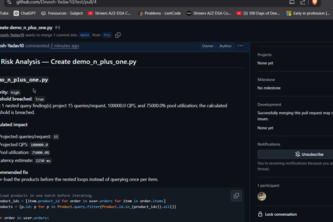
The description states that ProdPilot is a system that scans for nested-loop database calls within pull requests. It uses Python AST parsing to detect these patterns, then integrates with synthetic production telemetry data to project:
- Projected number of queries
- Projected QPS
- Pool utilization
- Latency effect
- Risk threshold breach
It outputs findings as PR comments in GitHub and stores results in a Gradio dashboard.
Evidence
- The author describes how it uses Python AST to detect database call-like expressions within nested loops.
- It integrates with GitHub via webhooks, retrieves modified files, runs the pipeline, and leaves markdown comments on PRs.
- It employs FastAPI + PyGithub + smee.io for webhook handling and Gradio for dashboard visualization.
Not evidenced
- Whether any actual production data or real-world usage exists beyond the demo setup.
- No mention of integration with CI/CD pipelines or existing developer workflows.
Positioning & Claim Evolution
The author positions ProdPilot as a tool that prevents "production-breaking N+1 queries" from reaching users by identifying them early in the development lifecycle.
Claims made
- “Catch production-breaking N+1 queries before they reach your users.”
- “Not only ‘this loop is risky’ but ‘this code could cause increased queries, saturated pools, and slower users.’”
These claims are self-reported and do not include any evidence of adoption or impact in real systems.
Inference The tool aims to reduce risk in database-heavy applications by flagging inefficient query patterns during code review.
Not evidenced
- No customer testimonials, case studies, or usage metrics.
- No indication that the tool is used beyond a hackathon prototype.
Target Customer & ICP
The description implies that ProdPilot targets developers working on backend services with database interactions, particularly those using Python and GitHub.
Evidence
- It integrates with GitHub pull requests.
- It parses Python code using AST.
- It focuses on N+1 query detection, which is a common issue in web applications with ORM-based data access.
Inference The primary user would be backend engineers or DevOps teams working in Python environments who want to prevent performance regressions during code review.
Not evidenced
- No explicit customer segmentation.
- No indication of whether it targets startups, enterprises, or specific tech stacks beyond Python and GitHub.
Business Model & Pricing Evidence
There is no evidence provided about a business model or pricing strategy.
Evidence
- The project was submitted to a hackathon and is described as a prototype.
- No mention of monetization, subscription plans, or licensing models.
Not evidenced
- No revenue streams, pricing tiers, or commercial partnerships.
- No indication if the tool will be offered as SaaS, open-source, or freemium.
Technical & Delivery Signals
The system is built using a multi-stage pipeline involving:
- Code Agent (Python AST)
- Metrics Agent (synthetic telemetry data)
- Calculator (plain Python math)
- Risk/Recommendation Agents (optional GPT-5.6 JSON output)
- FastAPI + PyGithub + smee.io for webhook handling
- Gradio dashboard
Evidence
- The author describes the architecture in detail, including tools used (e.g., fastapi, pythonast, pygithub).
- It uses deterministic calculations and falls back to non-LLM methods when needed.
Inference The tool prioritizes reliability over LLM-driven interpretation, which may appeal to teams seeking predictable behavior from AI tools.
Not evidenced
- No information on scalability or performance under load.
- No mention of deployment infrastructure or production readiness.
Traction & Maturity Signals
There is no evidence of traction or maturity beyond the hackathon submission.
Evidence
- The project was submitted to a hackathon (OpenAI 2026).
- It has only one team member: Devesh Yadav.
- No mention of users, customers, or product usage.
Not evidenced
- No revenue, ARR, or customer base.
- No product roadmap or version history.
- No integration with enterprise tools or platforms.
Competitive Context
The description does not provide any information about competitors or similar tools in the market.
Evidence
- No mention of existing tools for detecting N+1 queries or performance issues in code reviews.
- No comparison to other developer tooling ecosystems (e.g., SonarQube, Datadog, etc.).
Inference This tool may compete with static analysis tools or CI/CD integrations focused on performance and database efficiency.
Not evidenced
- No competitive landscape or differentiation strategy.
- No mention of how this compares to other solutions in the space.
Open Questions & Risks
Several risks and open questions are evident from the self-reported description:
- Prototype-only status: The tool is described as a hackathon submission with no commercialization or real-world deployment.
- Limited scope: It only supports Python code and GitHub, limiting its appeal to broader developer ecosystems.
- Fallback reliance on deterministic logic: While reliable, this may limit the tool’s ability to provide nuanced recommendations without LLMs.
- Single-person team: A lack of team size or support structure raises questions about long-term viability or scalability.
Not evidenced
- No evidence of user feedback or iteration history.
- No indication of how the tool might evolve beyond its current form.
Questions the description leaves open
- What is the intended path from prototype to product? Are there plans for commercialization?
- Has the tool been tested in real-world development environments beyond the hackathon?
- How does it handle edge cases or complex database interaction patterns not covered by its current AST logic?
- Is there a plan to support other languages or platforms beyond Python and GitHub?
- What are the long-term goals for the product, including potential monetization strategies?
Overall Assessment
Not evidenced
There is no evidence of revenue, traction, or customer adoption that would support an investment or partnership decision.
The project is described as a hackathon submission by one developer and lacks any indication of commercial viability, scalability, or real-world usage. It represents a technical proof-of-concept rather than a product in development or production.
Confidence level Low — based entirely on self-reported information with no external validation or evidence of traction.
User Stories BotA demo video on every pull request
Get a demo video on every new feature
GitHub App that watches your pull requests and records a narrated, captioned demo.
Save time on demo prep and make informed decisions faster with a video walkthrough of every new feature.
Source
Submitted to the OpenAI 2026 hackathon on Devpost. Project home on Devpost. Back to the full gallery on Devpost.
This competitive analysis was produced by top-founders.com (opens in a new tab)
Generated by a language model from this project's public Devpost page — its tagline, the author's own write-up and any built-with tags listed there — as captured in August 2026. Short quotations are the author's words. It is an opinion on the idea as a business, not on the people behind it, and it reflects the description as published then. If the project has moved on, request a correction below. The analysis is not independent research and contains no verified traction, revenue or customer data.
An independent guide by KFG International LLC — not affiliated with, endorsed by, or connected to Devpost or OpenAI.