

Archive position — measured, not model output
1 like on Devpost
505 of the 7,850 archived projects have more likes, and 1,758 share exactly 1 — so this project's #2,149 place in the like-ranked listing is a tie-break inside that group, not a ranking.
Projects (log scale)
Likes on Devpost. ▲ marks this project's group.
Show the figures
| Likes | Projects | Share of archive |
|---|---|---|
| 0 | 5,587 | 71.2% |
| 1 | 1,758 | 22.4% |
| 2 | 284 | 3.6% |
| 3–4 | 132 | 1.7% |
| 5–9 | 75 | 1.0% |
| 10+ | 14 | 0.2% |
 User Stories BotA demo video on every pull request
Get a demo video on every new feature
GitHub App that watches your pull requests and records a narrated, captioned demo.
Save time on demo prep and make informed decisions faster with a video walkthrough of every new feature.
Executive Summary
What the company appears to be
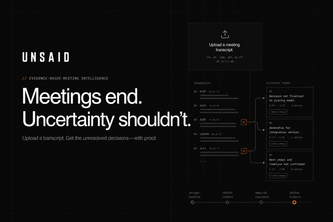
Unsaid is a self-reported tool that analyzes meeting transcripts using AI to surface gaps in understanding, such as unanswered questions, missing owners, conflicting assumptions, and unclear commitments. It claims to turn meeting transcripts into evidence-backed decisions, open questions, and clear next actions.
What changed
The author states they built Unsaid as an end-to-end application during a hackathon, with the goal of surfacing “unsaid” elements in meetings through AI analysis and structured output. The product is described as running on Cloudflare Workers and using AI models like Kimi K2.6.
Single most important open question
Is there any evidence of real-world usage or adoption beyond the author’s own development work?
What The Product Actually Is
The description states that Unsaid analyzes authorized meeting transcripts and produces:
- A concise meeting brief
- Unanswered questions
- Missing owners
- Conflicting assumptions
- Unclear commitments
- Unresolved objections
- Confirmed decisions
- An agenda for the next meeting
- Exact transcript evidence for every finding
Users can upload TXT, Markdown, JSON, SRT, or VTT files. The tool is claimed to run on Cloudflare Workers and uses Kimi K2.6 via Cloudflare AI Gateway.
Inference The product appears to be an AI-powered assistant for meeting analysis that focuses on identifying what was not said — i.e., gaps in communication — rather than summarizing content.
Positioning & Claim Evolution
The author states:
- Meeting summaries often make discussions look more complete than they really are.
- Unsaid surfaces those gaps and connects every finding to evidence from the original conversation.
- The tool is designed to give users a clear answer: “Where was this actually said?”
Inference Positioning appears to be focused on improving decision-making quality in meetings by exposing uncertainty, rather than just summarizing what happened.
Target Customer & ICP
The description does not name specific customer types or personas. It implies the tool is for teams or individuals who attend meetings and want to ensure clarity and accountability.
Inference The target audience likely includes professionals working in collaborative environments where meeting outcomes are critical, such as project managers, product leads, or team leads.
Business Model & Pricing Evidence
There is no evidence of pricing, monetization strategy, or business model in the description. The author only describes how it was built and what it does.
Not evidenced
Technical & Delivery Signals
The author states:
- Built with React, TypeScript, TanStack Start, TanStack Router
- Runs on Cloudflare Workers
- Uses Kimi K2.6 via Cloudflare AI Gateway
- Stores analysis in Cloudflare D1
- Validates structure and evidence server-side
- Original files are not retained
- Supports mobile and desktop access
Inference The technical stack suggests a modern, serverless architecture with strong emphasis on privacy and validation of outputs.
Traction & Maturity Signals
There is no evidence of revenue, customers, or usage metrics. The project is described as an end-to-end working application built during a hackathon.
Not evidenced
Competitive Context
The description does not mention competitors or similar tools. It also does not describe any market positioning relative to existing meeting intelligence or AI summarization platforms.
Not evidenced
Open Questions & Risks
- The tool is described as a single-person project built during a hackathon.
- No evidence of real-world usage, adoption, or feedback.
- The author’s own write-up suggests the core functionality was implemented in a short time frame.
- No mention of scalability, data retention policies beyond privacy boundaries, or long-term roadmap.
Inference The lack of traction and limited team size raises questions about product-market fit, sustainability, and readiness for broader deployment.
Questions the description leaves open
- What is the actual use case that drove development? Was this a problem faced by real teams?
- Have you tested this with real users or teams?
- How do you plan to scale beyond a single developer’s effort?
- Are there any plans for monetization or commercialization?
- What are the limitations of the current AI model in terms of accuracy and consistency?
Overall Assessment
The description presents Unsaid as a functional prototype built by one person during a hackathon. There is no evidence of traction, revenue, or customer adoption.
Confidence: Low
This is an early-stage idea with potential but no demonstrated commercial viability or market validation. The author’s own account indicates the tool works end-to-end, but there is no indication that it has been used beyond its creation.
User Stories BotA demo video on every pull request
Get a demo video on every new feature
GitHub App that watches your pull requests and records a narrated, captioned demo.
Save time on demo prep and make informed decisions faster with a video walkthrough of every new feature.
Source
Submitted to the OpenAI 2026 hackathon on Devpost. Project home on Devpost. Back to the full gallery on Devpost.
This competitive analysis was produced by top-founders.com (opens in a new tab)
Generated by a language model from this project's public Devpost page — its tagline, the author's own write-up and any built-with tags listed there — as captured in August 2026. Short quotations are the author's words. It is an opinion on the idea as a business, not on the people behind it, and it reflects the description as published then. If the project has moved on, request a correction below. The analysis is not independent research and contains no verified traction, revenue or customer data.
An independent guide by KFG International LLC — not affiliated with, endorsed by, or connected to Devpost or OpenAI.