

Archive position — measured, not model output
0 likes on Devpost
2,263 of the 7,850 archived projects have more likes, and 5,587 share exactly 0 — so this project's #6,075 place in the like-ranked listing is a tie-break inside that group, not a ranking.
Projects (log scale)
Likes on Devpost. ▲ marks this project's group.
Show the figures
| Likes | Projects | Share of archive |
|---|---|---|
| 0 | 5,587 | 71.2% |
| 1 | 1,758 | 22.4% |
| 2 | 284 | 3.6% |
| 3–4 | 132 | 1.7% |
| 5–9 | 75 | 1.0% |
| 10+ | 14 | 0.2% |
 User Stories BotA demo video on every pull request
Get a demo video on every new feature
GitHub App that watches your pull requests and records a narrated, captioned demo.
Save time on demo prep and make informed decisions faster with a video walkthrough of every new feature.
Executive Summary
What the company appears to be
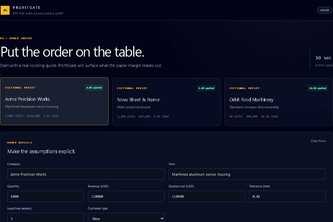
ProfitGate is a prototype decision-support tool for manufacturing companies, built by a single developer with a background in manufacturing consulting. The tool aims to reveal hidden costs in manufacturing orders before they are accepted, using AI to analyze risk factors and generate questions for human review.
What changed
The author states that the project was developed during OpenAI Build Week 2026, using Codex and GPT-5.6. It is described as a prototype built with React, TailwindCSS, TypeScript, Vercel, and Vite.
Single most important open question
Is there evidence of real-world adoption or traction from actual manufacturing customers to validate the utility of this tool in practice?
What The Product Actually Is
The description states that ProfitGate is a manufacturing decision-support prototype. It allows users to input basic order conditions (quantity, price, lead time, tolerance requirements, customer type, expected margin), and then analyzes potential hidden costs.
It does not make final decisions but instead:
- Presents a profitability range
- Explains assumptions behind the result
- Generates questions for verification with factory teams
- Proposes counter-conditions (e.g., price increase, relaxed tolerances)
- Produces a "Decision Passport" that records what was known, assumed, risks identified, conditions selected, decision-maker, and timestamp
The system is designed to support human judgment without removing accountability.
Evidence
- The author describes the tool’s functionality in detail.
- It uses AI (Codex, GPT-5.6) for risk analysis and decision support.
- The prototype was built using React, TailwindCSS, TypeScript, Vercel, and Vite.
Inference The tool is intended to bridge a gap between initial quotations and actual production outcomes by making invisible assumptions visible.
Positioning & Claim Evolution
The author positions ProfitGate as a solution to a common problem in manufacturing SMEs: accepting orders that look profitable on paper but become unprofitable due to hidden costs. The core claim is that the tool makes assumptions explicit, improves decision-making, and prevents preventable losses.
Evidence
- The author states: “Many small and medium-sized manufacturers have excellent products, strong technical capabilities, and hardworking teams. However, they sometimes accept orders that appear profitable during quotation but become unprofitable after production begins.”
- The tool is framed as a way to make "hidden assumptions visible" and to help companies avoid preventable losses.
Inference The positioning reflects an attempt to address inefficiencies in manufacturing cost estimation and decision-making processes, especially among SMEs.
Target Customer & ICP
The description states that the tool targets small and medium-sized manufacturers (SMEs) who have:
- Excellent products
- Strong technical capabilities
- Hardworking teams
- Problems with accepting unprofitable orders due to hidden costs
It is implied that these are companies where sales and production teams operate in silos, leading to decisions based on incomplete information.
Evidence
- “Many small and medium-sized manufacturers have excellent products...”
- “The problem is not always an incorrect price calculation. The real problem is that important assumptions remain invisible.”
- “I work as a manufacturing consultant and SME management consultant in Japan.”
Inference The ICP likely includes mid-tier to large SMEs in manufacturing, particularly those with complex quoting or production workflows.
Business Model & Pricing Evidence
There is no evidence of any business model or pricing structure described. The project is presented as a prototype built during a hackathon.
Evidence
- No mention of revenue streams, pricing tiers, subscriptions, or monetization strategies.
- The tool is described as a prototype with no indication of commercial deployment or customer acquisition.
Inference If this evolves into a product, it may follow a SaaS model or be sold to consulting firms or ERP vendors. However, no such plans are stated.
Technical & Delivery Signals
The project was built using:
- AI tools: Codex, GPT-5.6
- Frontend stack: React, TailwindCSS, TypeScript
- Deployment: Vercel, Vite
- Development approach: Specification-first, with clear separation of AI responsibilities and human accountability
Evidence
- “I developed the prototype using Codex and GPT-5.6 during OpenAI Build Week 2026.”
- “The prototype was built specification-first...”
- “AI analyzes and proposes. A human verifies, decides, and remains accountable.”
Inference The tool is technically feasible and uses modern development practices. The AI integration suggests a hybrid human-AI workflow.
Traction & Maturity Signals
There is no evidence of traction or maturity beyond the prototype stage. No customers, revenue, usage data, or product adoption are mentioned.
Evidence
- The project was submitted to a hackathon.
- It is described as a prototype.
- No mention of actual users, feedback loops, or production deployment.
Inference The tool has not yet entered the market or undergone real-world testing. Its maturity level is early-stage.
Competitive Context
There is no evidence provided about existing competitive tools or platforms in this space.
Evidence
- No mention of competitors.
- No reference to similar products or market positioning.
Inference It's unclear whether there are existing solutions that address the same problem. The author does not discuss how ProfitGate compares to other decision-support systems in manufacturing.
Open Questions & Risks
- No real-world validation: As a prototype, it lacks evidence of effectiveness or adoption.
- Single-person team: A solo developer may limit scalability and product development speed.
- AI dependency without verification: While the tool uses AI to analyze risks, its outputs are not validated by independent data or historical performance.
- Unclear path to monetization: No business model or customer acquisition strategy is evident.
- Limited scope of AI use: The system relies on a single developer’s domain knowledge and may lack generalizability.
Evidence
- Prototype-only development.
- No revenue, customers, or traction data.
- No indication of how the AI models will be updated or improved over time.
Questions the description leaves open
- What specific manufacturing domains or industries does this tool apply to?
- How is the risk analysis model trained or validated?
- Has the prototype been tested with actual manufacturing teams or consultants?
- Are there any plans for integrating with ERP, quotation, or production systems?
- What are the key assumptions in the current AI models, and how are they being refined?
- Is there a plan to collect data on actual vs. predicted outcomes to improve accuracy?
- How will the tool scale beyond a single developer’s expertise?
Overall Assessment
Not evidenced.
There is no evidence of revenue, customers, traction, or financial performance to support an investment or partnership decision.
The project is described as a prototype, built by one person during a hackathon, with no indication of commercial viability or market readiness.
Confidence Level Low This is a self-reported, unverified description. No third-party validation or historical data exists. The tool’s potential value is implied but not demonstrated.
User Stories BotA demo video on every pull request
Get a demo video on every new feature
GitHub App that watches your pull requests and records a narrated, captioned demo.
Save time on demo prep and make informed decisions faster with a video walkthrough of every new feature.
Source
Submitted to the OpenAI 2026 hackathon on Devpost. Project home on Devpost. Back to the full gallery on Devpost.
This competitive analysis was produced by top-founders.com (opens in a new tab)
Generated by a language model from this project's public Devpost page — its tagline, the author's own write-up and any built-with tags listed there — as captured in August 2026. Short quotations are the author's words. It is an opinion on the idea as a business, not on the people behind it, and it reflects the description as published then. If the project has moved on, request a correction below. The analysis is not independent research and contains no verified traction, revenue or customer data.
An independent guide by KFG International LLC — not affiliated with, endorsed by, or connected to Devpost or OpenAI.