

Archive position — measured, not model output
1 like on Devpost
505 of the 7,850 archived projects have more likes, and 1,758 share exactly 1 — so this project's #2,151 place in the like-ranked listing is a tie-break inside that group, not a ranking.
Projects (log scale)
Likes on Devpost. ▲ marks this project's group.
Show the figures
| Likes | Projects | Share of archive |
|---|---|---|
| 0 | 5,587 | 71.2% |
| 1 | 1,758 | 22.4% |
| 2 | 284 | 3.6% |
| 3–4 | 132 | 1.7% |
| 5–9 | 75 | 1.0% |
| 10+ | 14 | 0.2% |
 User Stories BotA demo video on every pull request
Get a demo video on every new feature
GitHub App that watches your pull requests and records a narrated, captioned demo.
Save time on demo prep and make informed decisions faster with a video walkthrough of every new feature.
Executive Summary
What the company appears to be
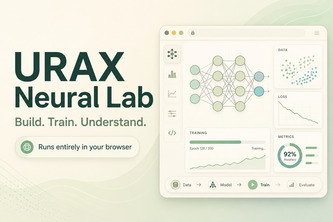
URAX Neural Lab is a browser-based tool for building, training, and evaluating neural networks without requiring backend infrastructure or cloud services. It allows users to define network topologies, input/output ranges, training data, and observe training progress—all within their browser.
What changed
The project represents a modern reimplementation of an earlier C++-based educational neural-network toolkit from 2013. It was rebuilt for the web using TypeScript and Vite, with core functionality implemented in Web Workers to maintain responsiveness during training.
Single most important open question — the commercial due-diligence read
Is there a viable market or use case beyond personal education or hobbyist experimentation? The description does not indicate any revenue, customers, or adoption beyond self-reported development and demo projects.
What The Product Actually Is
The description states that URAX Neural Lab is a browser-based neural network laboratory. It enables users to:
- Define multilayer feed-forward networks using compact notation (e.g., 2-6-4-1)
- Work with inputs and outputs in real-world units
- Add, edit, and validate training examples
- Train networks locally in a Web Worker
- Evaluate predictions using MSE, RMSE, and MAE metrics
- Import/export datasets via CSV
- Save/restore complete experiments as
.urax.jsonfiles - Switch between English and Czech
It includes two synthetic demo projects: one for estimating machine remaining life and another demonstrating addition learning.
The product is built in TypeScript with Vite, uses Web Workers for training, and avoids external ML libraries. It has over 270 automated tests covering various components.
Inference This appears to be an educational or prototyping tool rather than a production-grade platform. The focus on deterministic behavior, local execution, and transparency suggests it targets users who want to understand how neural networks work in detail.
Positioning & Claim Evolution
The description claims URAX Neural Lab is a modern continuation of a 2013 C++ toolkit. It positions itself as:
- A tool for transparent and approachable neural network experimentation
- Capable of running entirely locally, without data uploads or cloud dependencies
- Designed to make small networks understandable and inspectable
- Focused on educational use cases
It does not claim to be a commercial product, nor does it describe any target business users beyond personal learning.
Inference The positioning reflects an emphasis on accessibility and reproducibility over scalability or enterprise adoption. The evolution from C++ to browser-based tooling indicates a shift toward broader accessibility but not necessarily toward monetization or large-scale deployment.
Target Customer & ICP
The description does not identify specific customer segments or personas. However, it implies the following potential users:
- Educators and students interested in understanding neural networks
- Hobbyists or researchers exploring small-scale experiments
- Developers learning ML concepts through hands-on practice
There is no indication of enterprise customers, commercial users, or B2B applications.
Inference The lack of explicit customer targeting suggests the tool may be intended for individual use rather than a formalized ICP. The inclusion of localization (English/Czech) and educational demos supports this inference.
Business Model & Pricing Evidence
There is no evidence of pricing, monetization strategy, or business model in the description.
Inference Given that the tool is self-hosted and designed for local execution, it likely does not have a direct revenue model. Any commercial application would require additional infrastructure or licensing, which is not mentioned.
Technical & Delivery Signals
The project is built using:
- Technology stack: TypeScript, Vite, Web Workers, HTML5/CSS3
- Core features:
- Deterministic neural network training
- Local execution (no backend/cloud)
- CSV import/export
- JSON serialization of experiments
- Support for multiple activation functions and optimizers (implied)
- Testing: Over 270 automated tests covering mathematical core, dataset validation, worker communication, etc.
- Design approach:
- Staged development using Codex and GPT-5.6
- Modular architecture with clear separation of concerns
- Responsive UI for desktop and mobile
Inference The technical implementation shows a strong focus on correctness, testability, and user experience. The use of Web Workers and deterministic training suggests attention to performance and reproducibility.
Traction & Maturity Signals
There is no evidence of traction, revenue, or customer adoption beyond the author’s own development efforts.
Inference The project appears to be a prototype or proof-of-concept built for a hackathon. There are no signs of ongoing usage, user feedback, or product-market fit indicators.
Competitive Context
The description does not mention competitors or similar tools in the market.
Inference Without competitive references, it's unclear whether URAX Neural Lab fills an unmet need or competes with existing browser-based ML tools. The educational focus may overlap with platforms like TensorFlow.js or various online ML playgrounds, but no direct comparison is made.
Open Questions & Risks
- No commercial traction: No evidence of users, customers, or revenue.
- Limited scope: Focused on small, deterministic networks; not scalable for complex models.
- Educational bias: Designed for learning rather than production use.
- Unclear monetization path: No indication of how the tool might generate value beyond personal use.
- Self-reported only: All claims are unverified and based solely on author’s account.
Inference The tool lacks commercial viability or scalability without further development, partnerships, or a defined market need.
Questions the description leaves open
- What specific educational or research problems does URAX Neural Lab aim to solve?
- Are there any plans to expand beyond small-scale experiments into larger models or datasets?
- Has the tool been tested by educators or students outside of your own development?
- How would you envision monetizing this product if it were extended for commercial use?
- What are the limitations of local execution that prevent broader adoption?
- Have you considered integrating with other ML frameworks or platforms?
Overall Assessment
There is no evidence of a viable business model, revenue, or customer base beyond the author’s own development and demo projects.
Inference At this stage, URAX Neural Lab appears to be an experimental educational tool. It lacks commercial traction, scalability, or clear monetization paths. While technically impressive, it does not yet demonstrate readiness for investment or partnership unless there is a plan to evolve into a more scalable or market-driven offering.
User Stories BotA demo video on every pull request
Get a demo video on every new feature
GitHub App that watches your pull requests and records a narrated, captioned demo.
Save time on demo prep and make informed decisions faster with a video walkthrough of every new feature.
Source
Submitted to the OpenAI 2026 hackathon on Devpost. Project home on Devpost. Back to the full gallery on Devpost.
This competitive analysis was produced by top-founders.com (opens in a new tab)
Generated by a language model from this project's public Devpost page — its tagline, the author's own write-up and any built-with tags listed there — as captured in August 2026. Short quotations are the author's words. It is an opinion on the idea as a business, not on the people behind it, and it reflects the description as published then. If the project has moved on, request a correction below. The analysis is not independent research and contains no verified traction, revenue or customer data.
An independent guide by KFG International LLC — not affiliated with, endorsed by, or connected to Devpost or OpenAI.