

Archive position — measured, not model output
1 like on Devpost
505 of the 7,850 archived projects have more likes, and 1,758 share exactly 1 — so this project's #2,153 place in the like-ranked listing is a tie-break inside that group, not a ranking.
Projects (log scale)
Likes on Devpost. ▲ marks this project's group.
Show the figures
| Likes | Projects | Share of archive |
|---|---|---|
| 0 | 5,587 | 71.2% |
| 1 | 1,758 | 22.4% |
| 2 | 284 | 3.6% |
| 3–4 | 132 | 1.7% |
| 5–9 | 75 | 1.0% |
| 10+ | 14 | 0.2% |
 User Stories BotA demo video on every pull request
Get a demo video on every new feature
GitHub App that watches your pull requests and records a narrated, captioned demo.
Save time on demo prep and make informed decisions faster with a video walkthrough of every new feature.
Executive Summary
What the company appears to be
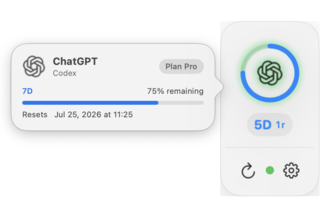
usAIge is a self-reported macOS-native mission-control HUD for Codex agents, designed to show live usage limits, agent status, and enable one-click task reopening. It was built during OpenAI Build Week 2026 and includes companion apps for iOS, iPadOS, Apple Watch, and widgets.
What changed
Before the hackathon, usAIge was a compact macOS Codex quota HUD. During Build Week, it evolved into a full agent mission-control product with live task monitoring, priority-based status indicators, one-click deep links, remote usage adapters, and cross-platform support.
Single most important open question
Is there any evidence of actual user adoption or revenue generation beyond the author's self-reported development work?
What The Product Actually Is
The description states that usAIge is a native Apple-platform mission-control layer for Codex, running on macOS. It:
- Shows real-time Codex limits (short-window and weekly).
- Monitors up to 100 recent tasks.
- Displays task status via a "breathing light" based on priority.
- Allows one-click reopening of the exact task responsible for current status.
- Warns when quota is low, refreshes after wake/connectivity changes.
- Connects optional read-only team usage sources over HTTPS, keeping credentials in Keychain.
It also includes companion apps for iPhone, iPad, Apple Watch, and widgets that make remote usage glanceable away from the Mac.
Inference The product appears to be a lightweight, local-first interface tool for managing Codex agent workloads, built using SwiftUI/AppKit and communicating with a local Codex app-server via JSON-RPC.
Positioning & Claim Evolution
The author claims usAIge addresses the problem of human bottlenecks in AI coding agents — specifically, how users lose track of running, completed, or interrupted tasks. It positions itself as a solution that turns these questions into “one quiet, always-visible native rail.”
Before Build Week:
- The product was described as a compact macOS Codex quota HUD.
During Build Week:
- It evolved into a full agent mission-control product, adding:
- Live task monitoring.
- Lifecycle decoding.
- Priority-based status system.
- One-click deep links.
- Remote usage adapters.
- Cross-platform support (iOS, WatchOS, widgets).
Inference The positioning shifted from a simple quota tracker to a full agent management interface. However, this evolution is self-reported and lacks independent verification or evidence of traction.
Target Customer & ICP
The description does not explicitly name target customers or define an ideal customer profile (ICP). It implies the product is aimed at users who:
- Use Codex agents.
- Work on macOS.
- May be managing multiple concurrent tasks.
- Want to monitor agent status without switching contexts.
Inference The likely ICP includes developers or engineers using AI coding tools like Codex, particularly those working in environments where task visibility and management are critical. But no explicit customer segmentation or persona data is provided.
Business Model & Pricing Evidence
There is no evidence of pricing, monetization strategy, or business model in the description.
Inference The product appears to be a prototype or early-stage tool built during a hackathon. No indication exists whether it will be sold, offered as freemium, or monetized in any way.
Technical & Delivery Signals
The author states:
- The macOS app is written in SwiftUI and AppKit.
- It communicates with the local Codex app-server via newline-delimited JSON-RPC.
- Domain models normalize quota windows and task lifecycle events before publishing them to a floating HUD.
- It launches the documented local codex app-server process.
- Features include automatic updates, public product site, DMG release, and expanded automated coverage.
Inference The technical stack is consistent with Apple platform development. The architecture suggests a lightweight, local-first approach that integrates closely with Codex’s existing infrastructure. However, no evidence of scalability or production-grade deployment exists.
Traction & Maturity Signals
There is no evidence of traction, revenue, customer adoption, or usage metrics beyond the author's own description.
Inference The product has been built and tested during a hackathon, with some automated coverage and release artifacts (DMG, website). But there are no signs of real-world usage or market validation.
Competitive Context
The description does not mention competitors or provide context about existing solutions in the AI agent management space.
Inference It is unclear whether similar tools exist for managing Codex agents or if usAIge fills a niche. No competitive analysis or differentiation strategy is evident.
Open Questions & Risks
- No traction or revenue: The product appears to be an early-stage prototype with no evidence of adoption.
- Single founder team: Only one member (Richard Zheng) is listed, which may limit execution capacity.
- Self-reported only: All claims are unverified and based on the author’s own account.
- Limited scope: The tool is focused on macOS and Codex, limiting its potential market reach.
- No monetization strategy: No indication of how the product will be monetized or scaled.
Questions the description leaves open
- What specific user pain points did you identify that led to building this?
- Have you tested this with real users beyond yourself?
- How do you plan to scale beyond a single developer’s use case?
- Are there any known limitations or edge cases in how the product handles task lifecycle events?
- Do you have plans for monetization or distribution beyond the current prototype?
- What is your long-term vision for this tool, and how does it fit into the broader AI agent ecosystem?
Overall Assessment
Not evidenced
There is no evidence of revenue, customer traction, or market validation to support an investment or partnership decision.
The product is described as a self-contained prototype built during a hackathon, with no indication of commercial viability or scalability. While the idea has potential, it lacks any measurable progress toward becoming a viable product or business.
Confidence level Low This analysis is based entirely on self-reported information and does not reflect actual market performance or user behavior.
User Stories BotA demo video on every pull request
Get a demo video on every new feature
GitHub App that watches your pull requests and records a narrated, captioned demo.
Save time on demo prep and make informed decisions faster with a video walkthrough of every new feature.
Source
Submitted to the OpenAI 2026 hackathon on Devpost. Project home on Devpost. Back to the full gallery on Devpost.
This competitive analysis was produced by top-founders.com (opens in a new tab)
Generated by a language model from this project's public Devpost page — its tagline, the author's own write-up and any built-with tags listed there — as captured in August 2026. Short quotations are the author's words. It is an opinion on the idea as a business, not on the people behind it, and it reflects the description as published then. If the project has moved on, request a correction below. The analysis is not independent research and contains no verified traction, revenue or customer data.
An independent guide by KFG International LLC — not affiliated with, endorsed by, or connected to Devpost or OpenAI.