

Archive position — measured, not model output
0 likes on Devpost
2,263 of the 7,850 archived projects have more likes, and 5,587 share exactly 0 — so this project's #4,116 place in the like-ranked listing is a tie-break inside that group, not a ranking.
Projects (log scale)
Likes on Devpost. ▲ marks this project's group.
Show the figures
| Likes | Projects | Share of archive |
|---|---|---|
| 0 | 5,587 | 71.2% |
| 1 | 1,758 | 22.4% |
| 2 | 284 | 3.6% |
| 3–4 | 132 | 1.7% |
| 5–9 | 75 | 1.0% |
| 10+ | 14 | 0.2% |
 User Stories BotA demo video on every pull request
Get a demo video on every new feature
GitHub App that watches your pull requests and records a narrated, captioned demo.
Save time on demo prep and make informed decisions faster with a video walkthrough of every new feature.
Executive Summary
What the company appears to be
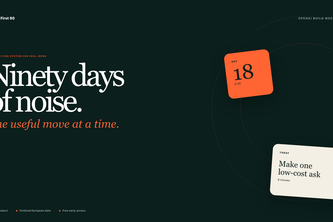
First 90 is a self-reported AI-powered onboarding tool for new managers, designed to guide them through their first 90 days with personalized daily touchpoints — focus, action, and reflection — delivered via web or Telegram. It includes a privacy-safe coach and team dashboard.
What changed
The project was built as part of the OpenAI 2026 hackathon. The author states it is a modular Python application with a focus on privacy, reproducibility, and judgeability. It uses GPT-5.6 for coaching but avoids embedding private journal history in prompts.
Single most important open question
Is there evidence of traction or commercial adoption beyond the hackathon demo? The description does not state whether the product is live, monetized, or used by any organization beyond its author’s own testing and demonstration.
What The Product Actually Is
The description states that First 90 is a personalized 90-day transition journey for new or transitioning managers. It delivers daily capsules with:
- Focus: one idea to notice.
- Action: one concrete move to make.
- Reflection: one private prompt to learn from the day.
It includes a People Manager journey with 270 touchpoints across three phases: Listen & orient, Align & deliver, and Scale & sustain. The product supports different work modes (office, hybrid, remote) and transitions (new company, new city).
Participants can use either:
- A responsive web interface, or
- A Telegram bot for onboarding, daily capsules, mood input, private journaling, and coach interaction.
The system uses a delivery worker to select and send touchpoints at local hours. It includes a Team Studio for people teams to view aggregate progress and engagement without seeing private content.
It is built with:
- FastAPI (web API)
- SQLAlchemy + PostgreSQL (data store)
- Telegram Bot API
- Docker + Caddy (deployment)
- OpenAI API (GPT-5.6 for coaching)
- Playwright, FFmpeg, TypeScript (demo pipeline)
The author states that the product is modular, with domain rules independent of framework and AI integration.
Positioning & Claim Evolution
The description states that First 90 was built to address a behavioral problem in onboarding — not just information delivery but helping new managers build trust, read the organization, make decisions, and preserve energy without feeling overwhelmed or watched.
It positions itself as:
- A personalized coaching tool, not a generic checklist.
- A privacy-safe experience, where private journal entries and coach conversations are not shared with teams.
- A deterministic and testable product, designed for judges in a hackathon setting.
The author claims that AI is most useful when it helps interpret a specific moment — not replace the journey. The system is built to maintain domain rules, reviewed content, and explicit privacy boundaries, while GPT-5.6 adds value at the point of synthesis.
Target Customer & ICP
The description states that First 90 targets:
- New or transitioning managers
- Who are joining a new company or changing cities
- Working in office, hybrid, or remote environments
It is designed to support people teams by offering a Team Studio with aggregate insights and engagement metrics — but without leaking private journal content.
The ICP appears to be:
- People teams in organizations that want to support new managers.
- New managers themselves, who want structured, personalized guidance.
- Organizations seeking to reduce onboarding overwhelm while maintaining privacy.
No explicit customer segmentation beyond role or work mode is described.
Business Model & Pricing Evidence
The description states:
- The product is currently in a free early access phase.
- Payments are intended for Phase 2, after the experience is validated.
- Next steps include:
- Hosted secure checkout
- Entitlements and idempotent webhooks
- Cancellation and refunds
No pricing details, revenue model, or monetization strategy are provided. The author states that payments are deliberately delayed until the free experience is proven.
Technical & Delivery Signals
The system is built as a modular Python application with:
- FastAPI for API and web delivery
- SQLAlchemy + PostgreSQL for data storage
- Telegram Bot API for bot functionality
- Docker + Caddy for deployment
- Playwright, FFmpeg, TypeScript for demo video pipeline
Key technical features include:
- Timezone-aware delivery of touchpoints
- Idempotent completion logic
- Private journaling and coach history isolated from team views
- Deterministic fallback for AI responses (no API key required for demo)
- Public, reproducible Docker deployment
- Automated tests covering domain rules, APIs, privacy, and deployment
The author notes that the system was built in a Build Week, using Codex to accelerate development from scratch.
Traction & Maturity Signals
The description states:
- The product includes:
- 90 complete days and 270 daily touchpoints
- Real web and Telegram participant flows
- A public demo with reset control
- A deterministic, validated 2:42 demo video
- Automated tests for domain rules, APIs, privacy, and deployment
However, there is no evidence of:
- Live users or customers
- Revenue or monetization
- Adoption beyond the author’s own testing
- Any traction metrics (e.g., active users, engagement rates)
The product is described as a hackathon submission, not a commercial product in use.
Competitive Context
The description does not mention any competitors. It does not state whether similar products exist in the market or how First 90 differentiates from them.
No competitive positioning, market size, or competitive landscape data is provided.
Open Questions & Risks
- No commercial traction or adoption beyond a hackathon demo.
- No revenue model or monetization strategy described.
- No evidence of customer feedback or product-market fit.
- No indication of team size or ongoing development beyond the author.
- The product is built as a demo, not a production-ready service.
- No data on user retention, engagement, or outcomes.
Questions the description leaves open
- What is the current status of the product — is it live, in beta, or still in prototype?
- Has there been any customer feedback or pilot testing beyond the author’s own use?
- How does the privacy boundary between individual and team views work in practice?
- Are there plans to expand beyond People Manager journeys?
- What are the key assumptions about user behavior that underpin the product design?
- Is there a plan for monetization, and how is it tied to the current free experience?
- How does the author intend to scale the content creation process for new roles or industries?
Overall Assessment
The description states that First 90 is a self-reported hackathon project with no evidence of commercial traction, revenue, or adoption beyond its own demo.
It is not evidenced that:
- The product is live or used by any organization
- There is a monetization strategy in place
- There are customers or users beyond the author’s own testing
The product is described as free early access, with payments planned for Phase 2 after validation. It is built to be judgeable and reproducible, not necessarily scalable or commercial.
Assessment Not evidenced as a viable investment or partnership opportunity at this time. The project is in an early prototype phase, with no commercial signals.
User Stories BotA demo video on every pull request
Get a demo video on every new feature
GitHub App that watches your pull requests and records a narrated, captioned demo.
Save time on demo prep and make informed decisions faster with a video walkthrough of every new feature.
Source
Submitted to the OpenAI 2026 hackathon on Devpost. Project home on Devpost. Back to the full gallery on Devpost.
This competitive analysis was produced by top-founders.com (opens in a new tab)
Generated by a language model from this project's public Devpost page — its tagline, the author's own write-up and any built-with tags listed there — as captured in August 2026. Short quotations are the author's words. It is an opinion on the idea as a business, not on the people behind it, and it reflects the description as published then. If the project has moved on, request a correction below. The analysis is not independent research and contains no verified traction, revenue or customer data.
An independent guide by KFG International LLC — not affiliated with, endorsed by, or connected to Devpost or OpenAI.