

Archive position — measured, not model output
0 likes on Devpost
2,263 of the 7,850 archived projects have more likes, and 5,587 share exactly 0 — so this project's #6,074 place in the like-ranked listing is a tie-break inside that group, not a ranking.
Projects (log scale)
Likes on Devpost. ▲ marks this project's group.
Show the figures
| Likes | Projects | Share of archive |
|---|---|---|
| 0 | 5,587 | 71.2% |
| 1 | 1,758 | 22.4% |
| 2 | 284 | 3.6% |
| 3–4 | 132 | 1.7% |
| 5–9 | 75 | 1.0% |
| 10+ | 14 | 0.2% |
 User Stories BotA demo video on every pull request
Get a demo video on every new feature
GitHub App that watches your pull requests and records a narrated, captioned demo.
Save time on demo prep and make informed decisions faster with a video walkthrough of every new feature.
Executive Summary
What the company appears to be
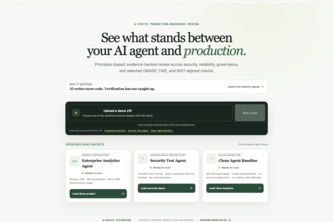
Production Lens is a self-reported tool that scans code repositories for security gaps and provides deterministic remediation guidance. The author states it is a principles-based, deterministic review system that partially aligns with OWASP, CWE, and NIST concerns. It is built using GPT-5.6 and other technologies, and the project is described as a hackathon submission.
What changed
The author reports having completed a functional demo of the tool, including scanning, evidence reporting, remediation workflows, and adversarial testing. The tool supports a workflow from scan → evidence → remediation approval → rescan → comparison → reset. It also includes support for secret redaction, line-level evidence, and principle mapping.
Single most important open question
Is the product's deterministic approach to scanning and remediation reproducible in real-world enterprise environments, or is it limited to controlled demo conditions?
What The Product Actually Is
The description states that Production Lens is a principles-based deterministic review tool, not a certification product. It scans code repositories for high-signal patterns with file-and-line evidence, explicit applicability states, and tested remediation for bundled findings.
It currently supports:
- Deterministic enterprise findings (11)
- Evaluated injection findings (7)
- Line-level evidence
- Secret redaction
- Principle mapping
The tool is described as being built using:
- Cloudflare
- Codex
- GPT-5.6
- Next.js, Node.js, React, TypeScript
- Vinext
It also supports scanning ZIP files and includes a self-scan feature for release-blocking adversarial tests.
Inference The product appears to be a developer tool focused on code security scanning and remediation, with an emphasis on deterministic outputs and reproducibility. It is not described as a hosted SaaS offering or a commercial product.
Positioning & Claim Evolution
The author states that Production Lens is:
- A principles-based deterministic review tool
- Not a certification product
- Partially aligned with OWASP, CWE, and NIST concerns
- Designed to help teams move AI pilots into production by identifying gaps in code
The roadmap shows an intent to:
- Publish a framework crosswalk for current deterministic catalog
- Map rules to CWE, OWASP Top 10, ASVS, and NIST outcomes
- Expand injection rule packs through various waves (parser, template, protocol, identity, advanced-AI)
- Implement deployment-backed ingestion and operational controls before enabling arbitrary uploads
Inference The positioning is evolving from a hackathon demo to a more structured tool with defined frameworks and expansion plans. However, the current claims are limited to what is demonstrated in the demo.
Target Customer & ICP
The description states that Production Lens helps teams move AI pilots into production by identifying gaps in code. It targets enterprises that struggle with moving AI pilots from development to production.
It also mentions:
- Teams building AI systems
- Developers and security engineers who need to validate code for compliance with frameworks like OWASP, CWE, and NIST
The author does not specify a clear ICP beyond enterprises using AI systems and needing code-level validation.
Inference The target customer is likely enterprise developers or security teams working on AI projects. However, no explicit segmentation or persona data is provided.
Business Model & Pricing Evidence
No information is provided about pricing, monetization, or business model in the description.
Not evidenced
Technical & Delivery Signals
The tool:
- Is built with Node.js 22.13+, npm, and runs on macOS, Linux, or Windows
- Uses GPT-5.6 for design and architecture decisions (not as a production boundary)
- Implements secure ZIP inspection without executing repository code
- Supports bounded materialization
- Includes authorization, admission, audit, alert, and adversarial-evaluation boundaries
- Has a self-scan feature that blocks releases
Inference The tool is technically sophisticated and designed with security in mind. However, no evidence of production deployment or scalability beyond the demo environment.
Traction & Maturity Signals
The author reports:
- A complete scan → evidence → remediation approval → rescan → comparison → reset workflow
- Eleven deterministic enterprise findings and seven evaluated injection findings
- A private live deployment judges can use without rebuilding
- Security design that keeps scanned content inert and capability-bounded
There is no mention of:
- Customers
- Revenue
- Usage metrics
- Product adoption
- Market traction
Inference The product is at a demo or early-stage prototype level. No evidence of real-world usage or commercial traction.
Competitive Context
The author states that Production Lens partially overlaps with concerns from:
- OWASP
- CWE
- NIST
It is described as a deterministic review tool, not a certification product, and does not claim complete coverage of these frameworks.
No direct competitors are named in the description.
Inference The competitive space includes other code scanning tools, but no specific positioning or competitive differentiation is provided.
Open Questions & Risks
- The tool is described as a hackathon submission, with no evidence of commercial viability or traction.
- It uses GPT-5.6 for design and architecture decisions, but not as a production boundary — this may raise concerns about reproducibility or reliability.
- No evidence of real-world enterprise deployment or adoption.
- The author states that the tool is not treated as a production security boundary, which raises questions about its practical use in production environments.
- The roadmap shows a phased approach to expansion, but no clear timeline or progress indicators.
Inference The product is at an early stage and lacks commercial evidence. Its deterministic claims may not translate into real-world utility without further validation.
Questions the description leaves open
- What are the actual use cases for Production Lens in enterprise environments?
- How does the tool handle false positives or missed findings in real-world codebases?
- Is there any evidence of how it performs on large-scale, complex repositories?
- What is the plan to scale beyond the current demo environment?
- How does the team intend to monetize or commercialize this product?
- What are the limitations of the deterministic approach when applied to real-world AI systems?
Overall Assessment
The description states that Production Lens is a self-reported hackathon submission and not independently verified. It is described as a principles-based, deterministic review tool with a demo workflow but no evidence of commercial traction or product-market fit.
Not evidenced
The author does not provide any information on:
- Revenue
- Customers
- Market size
- Competitive landscape
- Go-to-market strategy
Inference The project is at an early stage and lacks the commercial due-diligence signals required for investment or partnership consideration. It may be a promising idea, but there is no evidence of traction, adoption, or scalability.
User Stories BotA demo video on every pull request
Get a demo video on every new feature
GitHub App that watches your pull requests and records a narrated, captioned demo.
Save time on demo prep and make informed decisions faster with a video walkthrough of every new feature.
Source
Submitted to the OpenAI 2026 hackathon on Devpost. Project home on Devpost. Back to the full gallery on Devpost.
This competitive analysis was produced by top-founders.com (opens in a new tab)
Generated by a language model from this project's public Devpost page — its tagline, the author's own write-up and any built-with tags listed there — as captured in August 2026. Short quotations are the author's words. It is an opinion on the idea as a business, not on the people behind it, and it reflects the description as published then. If the project has moved on, request a correction below. The analysis is not independent research and contains no verified traction, revenue or customer data.
An independent guide by KFG International LLC — not affiliated with, endorsed by, or connected to Devpost or OpenAI.