

Archive position — measured, not model output
0 likes on Devpost
2,263 of the 7,850 archived projects have more likes, and 5,587 share exactly 0 — so this project's #5,958 place in the like-ranked listing is a tie-break inside that group, not a ranking.
Projects (log scale)
Likes on Devpost. ▲ marks this project's group.
Show the figures
| Likes | Projects | Share of archive |
|---|---|---|
| 0 | 5,587 | 71.2% |
| 1 | 1,758 | 22.4% |
| 2 | 284 | 3.6% |
| 3–4 | 132 | 1.7% |
| 5–9 | 75 | 1.0% |
| 10+ | 14 | 0.2% |
 User Stories BotA demo video on every pull request
Get a demo video on every new feature
GitHub App that watches your pull requests and records a narrated, captioned demo.
Save time on demo prep and make informed decisions faster with a video walkthrough of every new feature.
Executive Summary
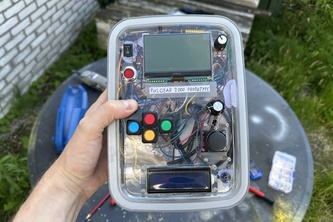
What the company appears to be: PixlGear2000 (Prototype) is a self-reported personal project by one individual, Jeff Zeitzen, aimed at building a retro-style handheld gaming console using an ESP32 microcontroller and Arduino-based development tools. The author states that it is currently a working prototype under construction.
What changed: There is no evidence of prior version or evolution — this is described as a new project beginning with a prototype.
Single most important open question: Is there any indication of commercial intent, traction, or scalability beyond the single developer's personal use and prototype?
What The Product Actually Is
The description states that PixlGear2000 (Prototype) is a retro-style handheld console built on an ESP32 microcontroller. It is described as currently being a working prototype under construction.
- The author reports building around 20–30 games, including small ones like Snake, Breakout, and Pong, and larger story-driven games with save functions.
- Casino games are included to earn or spend credits that can be used across different games.
- A user system allows account creation, credit interchangeability between games, and a global highscore system.
- The final product is intended to support physical connection via link cable or Bluetooth for multiplayer features.
Evidence: Self-reported by the author; no independent verification.
Positioning & Claim Evolution
The project is positioned as a personal hobbyist endeavor to build a retro handheld console using modern AI-assisted coding tools (ChatGPT, Codex). The author emphasizes that this was inspired by fixing an old Gameboy and learning new programming skills through books and AI assistance.
- The author claims the use of AI tools like Codex and ChatGPT allowed them to avoid years of learning C++.
- There is no indication of a commercial or market positioning beyond personal interest and sharing with friends.
- No claims about scalability, monetization, or broader adoption are made.
Evidence: Self-reported; no external validation or prior versions cited.
Target Customer & ICP
The author states that the goal is to build around 10 consoles for friends to play and connect with each other. The current prototype is being tested by the developer and their friends.
- No formal customer segmentation or target market defined.
- The intended audience appears to be personal friends, not a broader consumer base.
- There is no evidence of any identified persona beyond "friends" or "family members".
Evidence: Self-reported; no data on actual users or personas.
Business Model & Pricing Evidence
There is no evidence of a business model or pricing strategy in the description. The author mentions that the final product will be shared among friends, and that credits can be earned and spent across games.
- No revenue streams, monetization plans, or pricing models are described.
- The project is framed as a personal hobby rather than a commercial venture.
- No indication of whether the device will be sold, rented, or offered for free.
Evidence: Not evidenced; self-reported only.
Technical & Delivery Signals
The author reports using:
- Arduino IDE
- C++ programming
- AI tools like Codex and ChatGPT
- Excel for project information
- Physical build work including sprite creation and testing
- The prototype is reportedly functional, though limited in scope.
- The author uses a workflow involving notepad notes, Codex code generation, device testing, and bug tracking.
Evidence: Self-reported; no third-party validation or technical audits provided.
Traction & Maturity Signals
There is no evidence of traction or maturity beyond the prototype stage:
- The project is described as "under construction" and not yet complete.
- Only 4 games are playable at present, out of an estimated 20–30.
- No customers, users, or adoption metrics are mentioned.
- No sales, usage data, or feedback from others are provided.
Evidence: Not evidenced; self-reported only.
Competitive Context
No competitive analysis or market context is provided in the description. The author does not reference existing handheld consoles, retro gaming platforms, or similar projects.
- No mention of competitors or substitutes.
- No indication of how this project compares to other retro handhelds or DIY solutions.
Evidence: Not evidenced; self-reported only.
Open Questions & Risks
Several risks and open questions emerge from the self-reported description:
- The project is entirely driven by one person (1-person team), which raises concerns about scalability and long-term viability.
- The author states that the prototype has physical limitations and issues, suggesting potential technical hurdles in scaling to a full product.
- No evidence of any business model, monetization strategy, or commercial intent beyond personal use.
- The project is described as a "hobbyist" effort with no indication of market demand or traction.
Inference: This appears to be a one-off personal project without commercial ambition or scalability.
Questions the description leaves open
- What is the timeline for completing the full product (PixlGear 3000)?
- Are there any plans to scale beyond the prototype and personal use?
- Has there been any interest from users outside of friends/family?
- How will the project be monetized if at all?
- What are the technical limitations that could prevent mass production or distribution?
Overall Assessment
There is no evidence of a commercial product, traction, or scalable business model in the description. The project is described as a personal hobbyist effort with no indication of intent to build a marketable product or generate revenue.
- No revenue, customer base, or funding history.
- The author is working alone and has not yet completed the prototype.
- The project lacks any commercial or strategic positioning beyond personal interest.
Assessment: Not suitable for investment or partnership at this stage. This appears to be an early-stage prototype with no demonstrated traction or business intent.
User Stories BotA demo video on every pull request
Get a demo video on every new feature
GitHub App that watches your pull requests and records a narrated, captioned demo.
Save time on demo prep and make informed decisions faster with a video walkthrough of every new feature.
Source
Submitted to the OpenAI 2026 hackathon on Devpost. Project home on Devpost. Back to the full gallery on Devpost.
This competitive analysis was produced by top-founders.com (opens in a new tab)
Generated by a language model from this project's public Devpost page — its tagline, the author's own write-up and any built-with tags listed there — as captured in August 2026. Short quotations are the author's words. It is an opinion on the idea as a business, not on the people behind it, and it reflects the description as published then. If the project has moved on, request a correction below. The analysis is not independent research and contains no verified traction, revenue or customer data.
An independent guide by KFG International LLC — not affiliated with, endorsed by, or connected to Devpost or OpenAI.