

Archive position — measured, not model output
5 likes on Devpost
54 of the 7,850 archived projects have more likes, and 35 share exactly 5 — so this project's #71 place in the like-ranked listing is a tie-break inside that group, not a ranking.
Projects (log scale)
Likes on Devpost. ▲ marks this project's group.
Show the figures
| Likes | Projects | Share of archive |
|---|---|---|
| 0 | 5,587 | 71.2% |
| 1 | 1,758 | 22.4% |
| 2 | 284 | 3.6% |
| 3–4 | 132 | 1.7% |
| 5–9 | 75 | 1.0% |
| 10+ | 14 | 0.2% |
 User Stories BotA demo video on every pull request
Get a demo video on every new feature
GitHub App that watches your pull requests and records a narrated, captioned demo.
Save time on demo prep and make informed decisions faster with a video walkthrough of every new feature.
Executive Summary
What the company appears to be
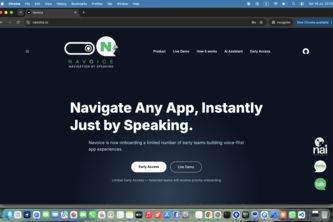
Navoice is a self-reported AI-powered voice navigation platform that enables websites or native applications to become voice-enabled using GPT-5.6, semantic search, and vector similarity. It claims to resolve user intent with minimal AI cost by using deterministic routing for clear requests and activating GPT-5.6 only when needed.
What changed
The author states they built a platform that allows any website or app to become voice-enabled without requiring full UI rebuilds or placing an LLM in every interaction. They claim to have implemented a semantic tie-disambiguation layer using GPT-5.6 that activates only during ambiguous cases, and designed a production-safe fail-open architecture.
Single most important open question
Is there evidence of real-world usage, customer feedback, or integration with actual applications beyond the author’s own development?
What The Product Actually Is
The description states:
- Navoice is an AI-powered voice navigation platform.
- It combines deterministic routing, semantic search, vector similarity, and GPT-5.6 reasoning to map user requests to application actions.
- It supports natural language input like “I want to see pricing” and navigates to the relevant page.
- It also allows users to search catalogs with voice using semantic search.
- The platform can scan any website or native app and suggest navigation specifications.
- When intent is ambiguous, GPT-5.6 generates intelligent clarifications instead of incorrect decisions.
Inference The product appears to be a middleware or SDK that integrates into existing apps or websites to enable voice-based navigation and search.
Positioning & Claim Evolution
The description states:
- Voice interfaces are difficult and expensive to add to existing applications.
- Navoice allows any website or app to become voice-enabled without rebuilding UI or placing an LLM in every interaction.
- The platform uses AI only when it truly adds value.
- It aims to minimize AI cost while maintaining accuracy.
Inference Navoice positions itself as a lightweight, cost-efficient solution for adding voice navigation to existing platforms, using a hybrid approach of embeddings and GPT-5.6.
Target Customer & ICP
The description states:
- Navoice is built for developers or businesses that want to enable voice navigation on websites or native applications.
- It supports any website or native application.
- The author mentions “my clients” can scan any website and suggest navigation specifications.
Inference The primary customer segment appears to be developers or product teams working with existing web/native apps who want to add voice capabilities without major rework.
Business Model & Pricing Evidence
Not evidenced.
The description does not mention pricing, monetization strategy, or business model. It only describes the technical architecture and functionality.
Technical & Delivery Signals
The description states:
- Built with Node.js, Supabase, pgvector, OpenAI Responses API.
- Uses GPT-5.6 for semantic reasoning.
- Uses text-embedding-3-small for semantic search.
- Uses pgvector for vector similarity search.
- Implements feature flags and fail-open architecture for safe production deployment.
- Added a new GPT-5.6 semantic tie-disambiguation layer that activates only when embeddings cannot confidently distinguish between two candidate actions.
Inference The platform uses a hybrid AI architecture with selective LLM usage, aiming to reduce cost and latency while maintaining accuracy.
Traction & Maturity Signals
Not evidenced.
There is no mention of revenue, customers, user adoption, or product maturity beyond the author’s own development efforts. The project was submitted to a hackathon, suggesting it is in an early stage.
Competitive Context
Not evidenced.
The description does not reference competitors, market size, or competitive positioning beyond its own claims.
Open Questions & Risks
- Unverified claims: The description states use of GPT-5.6, which is not a publicly released model; this may be an error or misrepresentation.
- No traction evidence: No customers, revenue, or usage data are provided.
- Single-person team: The project is built by one person (Yagil Cohen), raising questions about scalability and long-term maintenance.
- Hackathon origin: Submitted to a hackathon; no indication of commercial viability or product-market fit beyond the author’s own use case.
Questions the description leaves open
- What is the actual model version being used? Is GPT-5.6 real, or is this a misstatement?
- How does Navoice integrate with existing applications — what is the developer experience like?
- Are there any early adopters or customers using the platform in production?
- What are the performance and cost trade-offs of using GPT-5.6 selectively versus embedding-only approaches?
- Is there a plan to monetize this product, and how does it intend to scale beyond a single developer’s use case?
Overall Assessment
Not evidenced.
There is no evidence of revenue, customers, or traction to assess commercial viability. The project appears to be an early-stage prototype or proof-of-concept submitted for a hackathon. It lacks the signals typically required for investment or partnership consideration.
User Stories BotA demo video on every pull request
Get a demo video on every new feature
GitHub App that watches your pull requests and records a narrated, captioned demo.
Save time on demo prep and make informed decisions faster with a video walkthrough of every new feature.
Source
Submitted to the OpenAI 2026 hackathon on Devpost. Project home on Devpost. Back to the full gallery on Devpost.
This competitive analysis was produced by top-founders.com (opens in a new tab)
Generated by a language model from this project's public Devpost page — its tagline, the author's own write-up and any built-with tags listed there — as captured in August 2026. Short quotations are the author's words. It is an opinion on the idea as a business, not on the people behind it, and it reflects the description as published then. If the project has moved on, request a correction below. The analysis is not independent research and contains no verified traction, revenue or customer data.
An independent guide by KFG International LLC — not affiliated with, endorsed by, or connected to Devpost or OpenAI.