

Archive position — measured, not model output
5 likes on Devpost
54 of the 7,850 archived projects have more likes, and 35 share exactly 5 — so this project's #73 place in the like-ranked listing is a tie-break inside that group, not a ranking.
Projects (log scale)
Likes on Devpost. ▲ marks this project's group.
Show the figures
| Likes | Projects | Share of archive |
|---|---|---|
| 0 | 5,587 | 71.2% |
| 1 | 1,758 | 22.4% |
| 2 | 284 | 3.6% |
| 3–4 | 132 | 1.7% |
| 5–9 | 75 | 1.0% |
| 10+ | 14 | 0.2% |
 User Stories BotA demo video on every pull request
Get a demo video on every new feature
GitHub App that watches your pull requests and records a narrated, captioned demo.
Save time on demo prep and make informed decisions faster with a video walkthrough of every new feature.
Executive Summary
What the company appears to be
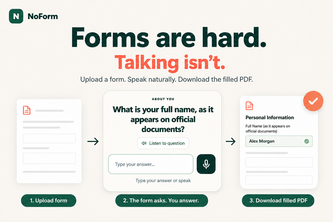
NoForm, as described by its author, is a self-reported AI-powered tool that converts PDF or image-based forms into guided multilingual voice conversations. The author states it uses GPT-5.6 for form analysis and field extraction, OpenAI speech models for audio transcription and synthesis, and Next.js with React for frontend development. It allows users to answer questions via voice or text, review their responses, and download a completed version of the original form with answers placed correctly.
What changed
The project is presented as a working prototype built during OpenAI Build Week by a 12-year-old developer. The author claims it evolved from an idea to a functional app through iterative testing and AI agent use (specifically Codex). It was submitted to the OpenAI 2026 hackathon.
Single most important open question
Is there any evidence of real-world usage, customer feedback, or product-market fit beyond the author’s own description? The project is self-reported, unverified, and lacks any traction data.
What The Product Actually Is
The description states that NoForm is an AI-assisted tool that turns uploaded PDF or image-based forms into guided multilingual voice conversations. It extracts form fields using GPT-5.6, asks questions aloud via speech models, accepts answers through voice or text, and places the responses back onto the original form while preserving layout.
It uses:
- GPT-5.6 for form analysis and field extraction
- OpenAI speech models for transcription and synthesis
- Next.js, React, TypeScript, Tailwind CSS for frontend development
The author says it supports PDF, PNG, and JPG formats and can handle multilingual responses.
Inference NoForm appears to be a proof-of-concept or prototype built using AI agents (specifically Codex) rather than a commercial product. It is not evidenced to have been used by others beyond the creator’s own testing.
Positioning & Claim Evolution
The author positions NoForm as a solution for people who struggle with filling out complex forms—especially PDFs, which are hard to edit and often require manual input. The tool aims to simplify form completion by turning it into an interactive voice conversation.
Claims made
- Makes forms easier to complete
- Works with voice or text input
- Supports multilingual responses
- Preserves original form layout and formatting
Inference The positioning is framed as solving a real-world problem (form complexity, language barriers), but the author does not claim any market traction or adoption. The evolution of the idea seems to be from concept to prototype within a hackathon context.
Target Customer & ICP
The description states that NoForm targets individuals who struggle with complex forms—particularly those involving legal documents, registration forms, and PDFs. It also mentions support for multilingual users and potential use cases in schools, GP surgeries, and councils.
Inference The target customer is likely a general user base with limited technical ability or language fluency when completing forms. However, there is no evidence of specific personas, segmentation, or early adopter feedback.
Business Model & Pricing Evidence
There is no mention of pricing, monetization strategy, or business model in the description. The author does not state whether NoForm will be offered as a freemium service, paid subscription, or one-time purchase.
Inference No evidence exists to suggest any commercial structure beyond the prototype’s existence.
Technical & Delivery Signals
The project was built using:
- Next.js, React, TypeScript, Tailwind CSS
- GPT-5.6 for form field detection and extraction
- OpenAI speech models for audio transcription and synthesis
- Codex as a developer agent
Challenges mentioned include:
- Upload functionality issues due to API key conflicts
- Voice recognition accuracy problems (browser-based vs OpenAI)
- PDF formatting preservation
Inference The technical stack is standard for modern web apps, but the reliance on AI agents and specific models like GPT-5.6 suggests a prototype or experimental nature. The author’s iterative fixes imply ongoing development rather than a stable product.
Traction & Maturity Signals
There is no evidence of revenue, customers, user engagement, or adoption beyond the author's own testing and submission to a hackathon. The project is described as a working prototype built in one week.
Inference No signs of traction, growth, or market validation are evident. It remains at the idea/prototype stage.
Competitive Context
The description does not mention competitors or similar tools. The author does not reference existing solutions for form automation or voice-based data entry.
Inference There is no evidence of competitive analysis or awareness of prior art in this space.
Open Questions & Risks
- Unverified claims: All statements are self-reported and unverified.
- No traction or revenue: No evidence of users, customers, or monetization.
- Prototype nature: Built as a hackathon project; no indication of scalability or long-term viability.
- AI dependency risks: Heavy reliance on AI models (GPT-5.6, OpenAI speech) may pose future technical or cost risks.
- Lack of team structure: Only one member listed, suggesting limited development capacity.
Questions the description leaves open
- Has NoForm been tested with real users beyond the creator’s own experience?
- What is the current state of the product—how close is it to being production-ready?
- Are there any plans for monetization or commercialization?
- How does the system handle edge cases like handwritten forms or non-standard layouts?
- What are the technical limitations of using GPT-5.6 and OpenAI speech models at scale?
Overall Assessment
Not evidenced.
There is no evidence of revenue, customer base, traction, or business model beyond the author’s own description. The project is presented as a prototype built during a hackathon by a single developer. NoForm lacks commercial due-diligence signals such as user feedback, market validation, or scalability indicators.
Confidence level Low This analysis is based entirely on self-reported information and does not reflect any independent verification or historical data.
User Stories BotA demo video on every pull request
Get a demo video on every new feature
GitHub App that watches your pull requests and records a narrated, captioned demo.
Save time on demo prep and make informed decisions faster with a video walkthrough of every new feature.
Source
Submitted to the OpenAI 2026 hackathon on Devpost. Project home on Devpost. Back to the full gallery on Devpost.
This competitive analysis was produced by top-founders.com (opens in a new tab)
Generated by a language model from this project's public Devpost page — its tagline, the author's own write-up and any built-with tags listed there — as captured in August 2026. Short quotations are the author's words. It is an opinion on the idea as a business, not on the people behind it, and it reflects the description as published then. If the project has moved on, request a correction below. The analysis is not independent research and contains no verified traction, revenue or customer data.
An independent guide by KFG International LLC — not affiliated with, endorsed by, or connected to Devpost or OpenAI.