

Archive position — measured, not model output
5 likes on Devpost
54 of the 7,850 archived projects have more likes, and 35 share exactly 5 — so this project's #74 place in the like-ranked listing is a tie-break inside that group, not a ranking.
Projects (log scale)
Likes on Devpost. ▲ marks this project's group.
Show the figures
| Likes | Projects | Share of archive |
|---|---|---|
| 0 | 5,587 | 71.2% |
| 1 | 1,758 | 22.4% |
| 2 | 284 | 3.6% |
| 3–4 | 132 | 1.7% |
| 5–9 | 75 | 1.0% |
| 10+ | 14 | 0.2% |
 User Stories BotA demo video on every pull request
Get a demo video on every new feature
GitHub App that watches your pull requests and records a narrated, captioned demo.
Save time on demo prep and make informed decisions faster with a video walkthrough of every new feature.
Executive Summary
Project: Oikos Automation
Self-reported basis: The analysis is based entirely on the author-supplied project description from Devpost, including the name, tagline, write-up, and technology stack. No external verification or historical data are available.
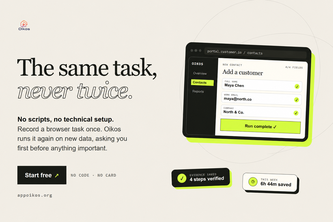
Commercial due-diligence read: Oikos appears to be a browser automation tool that allows users to record tasks once and replay them with AI assistance, incorporating human approval checkpoints for sensitive actions. The author states the product is designed to reduce repetitive work while preserving human control. The most important open question is whether this approach can scale beyond a single user or team and whether it addresses a real market need beyond the hackathon context.
What The Product Actually Is
The description states that Oikos is a browser automation agent that allows users to:
- Record browser tasks using a browser extension
- Convert those recordings into reusable AI workflows
- Run workflows in a cloud-hosted browser environment
- Pause before sensitive actions (e.g., payments, deletions)
- Use AI to interpret page context and intent rather than fixed coordinates or selectors
The system is built with:
- Browser extension for recording
- Cloud-hosted browser using Playwright or similar
- AI agent to interpret and execute steps
- Manual approval checkpoints for critical actions
Inference: The product is a hybrid automation tool combining user-recorded workflows with AI interpretation, designed to reduce manual repetition in browser-based tasks.
Positioning & Claim Evolution
The author states that Oikos was inspired by the problem of people spending hours repeating simple tasks in browsers. It positions itself as:
- A simpler alternative to traditional browser automation
- An AI-driven system that adapts to minor interface changes
- A tool that preserves human judgment in critical steps
Claim: The product is designed to automate repetition while leaving final responsibility with the user.
Inference: This positioning reflects a shift from fully automated systems toward semi-automated workflows, emphasizing control and adaptability over full autonomy.
Target Customer & ICP
The description does not explicitly name target customers or define an ideal customer profile (ICP). It implies:
- Users who perform repetitive browser-based tasks
- Businesses or individuals managing data entry, form filling, or system transfers
- Teams looking for a less technical alternative to traditional automation tools
Inference: The tool likely targets non-technical users or small teams with limited access to automation infrastructure.
Business Model & Pricing Evidence
No evidence of pricing, monetization strategy, or business model is provided in the description. The author does not state:
- How the product will be sold
- Whether it's a SaaS offering
- If there are tiers or usage-based pricing
- Any revenue streams or customer acquisition plans
Not evidenced: Business model and pricing.
Technical & Delivery Signals
The description indicates that Oikos uses:
- Browser extension (Chrome/Chromium-based)
- Playwright for browser automation
- AI agent for interpretation of actions
- Cloud-hosted browser environment
- Structured workflow conversion from recordings
- Manual approval checkpoints before sensitive actions
Inference: The tool is built with modern web technologies and aims to bridge the gap between user interaction and AI-driven execution.
Traction & Maturity Signals
The description does not provide any evidence of:
- Revenue or monetization
- Customers or user base
- Product usage metrics
- Product maturity beyond a hackathon prototype
- Any traction indicators such as downloads, active users, or retention
Not evidenced: Traction or maturity.
Competitive Context
No mention is made of competitors or market positioning. The author does not reference:
- Existing browser automation tools (e.g., Selenium, Puppeteer, UiPath)
- AI-powered workflow tools
- Marketplace or SaaS platforms in the automation space
Not evidenced: Competitive landscape.
Open Questions & Risks
- Unproven market need: No evidence of real-world adoption or customer demand beyond a hackathon.
- Limited team size: Only one team member is mentioned, raising questions about execution capacity.
- Unclear monetization path: No business model or pricing strategy described.
- AI dependency risk: Reliance on AI interpretation may not scale reliably across complex interfaces.
- Technical feasibility: The claim that workflows adapt to interface changes without frequent updates is unverified.
Questions the description leaves open
- What specific browser-based tasks are you targeting, and how do you know they are worth automating?
- How does the AI agent interpret actions when page elements change? Is there a fallback mechanism?
- What is your plan for customer acquisition and monetization beyond the hackathon?
- Have you tested the system with real users or in production environments?
- What are the technical limitations of the current prototype that would need to be addressed for scalability?
Overall Assessment
Not evidenced: No basis for investment or partnership decision.
The description is self-reported and unverified, and there is no evidence of traction, revenue, customers, or a clear business model. The product appears to be a hackathon prototype with a concept that may have potential but lacks validation in the market. Any commercial viability or scalability remains unproven.
User Stories BotA demo video on every pull request
Get a demo video on every new feature
GitHub App that watches your pull requests and records a narrated, captioned demo.
Save time on demo prep and make informed decisions faster with a video walkthrough of every new feature.
Source
Submitted to the OpenAI 2026 hackathon on Devpost. Project home on Devpost. Back to the full gallery on Devpost.
This competitive analysis was produced by top-founders.com (opens in a new tab)
Generated by a language model from this project's public Devpost page — its tagline, the author's own write-up and any built-with tags listed there — as captured in August 2026. Short quotations are the author's words. It is an opinion on the idea as a business, not on the people behind it, and it reflects the description as published then. If the project has moved on, request a correction below. The analysis is not independent research and contains no verified traction, revenue or customer data.
An independent guide by KFG International LLC — not affiliated with, endorsed by, or connected to Devpost or OpenAI.