

Archive position — measured, not model output
5 likes on Devpost
54 of the 7,850 archived projects have more likes, and 35 share exactly 5 — so this project's #75 place in the like-ranked listing is a tie-break inside that group, not a ranking.
Projects (log scale)
Likes on Devpost. ▲ marks this project's group.
Show the figures
| Likes | Projects | Share of archive |
|---|---|---|
| 0 | 5,587 | 71.2% |
| 1 | 1,758 | 22.4% |
| 2 | 284 | 3.6% |
| 3–4 | 132 | 1.7% |
| 5–9 | 75 | 1.0% |
| 10+ | 14 | 0.2% |
 User Stories BotA demo video on every pull request
Get a demo video on every new feature
GitHub App that watches your pull requests and records a narrated, captioned demo.
Save time on demo prep and make informed decisions faster with a video walkthrough of every new feature.
Executive Summary
What the company appears to be
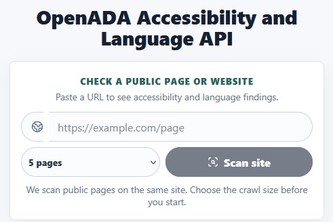
OpenADA.US is a self-reported public-interest service that provides free accessibility and language-quality scanning for websites. The author states it uses axe-core, GPT-5.6 Luna, OpenAI Codex, and other tools to scan websites, generate HTML fixes, and archive scan results over time. It offers both a browser UI and API access, including an MCP endpoint for AI agents.
What changed
The project was built in two days during the OpenAI 2026 hackathon, with the author stating that it began as a contest submission and evolved into a public service. The description indicates a shift from a one-time score to a browsable archive of scan history, and includes support for asynchronous crawling, multiple deployment paths (public, private ECS, AWS Marketplace), and integration with AI tools via MCP.
The single most important open question
Is there any evidence of actual usage or adoption by users beyond the author’s own development and testing? The description states no revenue, customers, or traction data are available. The service is described as a public tool, but its real-world impact or user base is not evidenced.
What The Product Actually Is
The description states that OpenADA.US is a free accessibility and language API that scans websites. It uses:
- axe-core for accessibility checks;
- LanguageTool-compatible language checks;
- GPT-5.6 Luna and OpenAI Codex for development;
- Playwright-based crawling;
- Redis/BullMQ for asynchronous job handling;
- DynamoDB for data persistence;
- Next.js, React, TypeScript for UI/API;
- Model Context Protocol (MCP) for AI agent integration.
It offers:
- HTML or URL input;
- Accessibility and language scores with letter grades;
- Sorted page-level findings;
- Scan history and comparison across dates;
- Printable reports and PDF saving;
- Public directory of sites, scans, pages, and findings;
- REST API, OpenAPI documentation, and MCP endpoint.
The author states that the service is available at openada.us and can be run locally using Docker Compose.
Inference The product appears to be a web-based scanning tool with an archive feature, designed for public use. It supports both human and AI interaction via API or MCP.
Positioning & Claim Evolution
The author states that OpenADA was created to make the first step of accessibility remediation open and practical. The goal was to provide a free, accessible infrastructure for nonprofits, schools, municipalities, and small businesses that lack enterprise-level tools.
It evolved from a contest project into a public service with:
- A browsable archive instead of one-time scores;
- Asynchronous crawling and durable scan history;
- Support for AI agents via MCP;
- Deployment paths for both public and private use (ECS, AWS Marketplace).
The author claims that the product helps teams decide what to do next, keeps work visible over time, and makes progress measurable.
Inference The positioning is that of a public-interest accessibility tool, aimed at democratizing access to web compliance scanning. It positions itself as a developer-friendly, open-source-like service with AI integration capabilities.
Target Customer & ICP
The description states that OpenADA targets:
- Nonprofits;
- Schools;
- Municipalities;
- Special districts;
- Small businesses;
These groups are described as lacking the budget or staff for enterprise accessibility platforms.
It also mentions public agencies and AI assistants as potential users, especially in the long-term vision.
The author states that the service is designed to help teams decide what to do next, keep work visible, and make progress measurable.
Inference The ICP appears to be small public or non-commercial organizations with limited resources for accessibility compliance. The long-term vision includes broader adoption by developers and AI agents.
Business Model & Pricing Evidence
The description states that OpenADA is a free public service. It offers:
- A public-facing UI;
- REST API access;
- MCP endpoint for AI tools;
- Public directory of scan results;
It also mentions two private deployment paths:
- Private OpenADA (customer-owned ECS deployment);
- OpenADA MCP AgentCore (AWS Marketplace product).
However, there is no evidence of pricing, monetization, or revenue streams. The author states that the public service is free and that the private paths are for customers who want more control.
Inference The business model appears to be free public access with optional paid private deployment options, but no commercial traction or pricing data is provided.
Technical & Delivery Signals
The project uses:
- axe-core for accessibility checks;
- GPT-5.6 Luna and OpenAI Codex for development;
- Playwright for browser automation;
- Redis/BullMQ for asynchronous job handling;
- DynamoDB for durable storage;
- Next.js, React, TypeScript for UI/API;
- Docker Compose for local deployment;
- AWS ECS, CloudFormation, IAM, Bedrock AgentCore for hosted deployment.
It supports:
- Asynchronous crawling with bounded scope;
- Public archive of scan history;
- MCP endpoint for AI agents;
- REST API and OpenAPI documentation;
- Local development with one command (
docker compose up --build); - Deployment options for public and private use.
Inference The technical stack is well-integrated, using modern tools for web scraping, asynchronous processing, and cloud deployment. It supports both public and private hosting, suggesting a scalable architecture.
Traction & Maturity Signals
The author states that the project was built in two days during a hackathon. It includes:
- A live checker;
- Public directory;
- API reference;
- MCP connection guide;
- Source repository;
- AWS Marketplace approval for AgentCore product.
However, there is no evidence of:
- User adoption or engagement;
- Revenue;
- Customer base;
- Usage metrics;
- Product maturity beyond the initial build.
The author notes that they are proud of:
- Building and deploying a working public service;
- Creating a public archive;
- Supporting asynchronous crawls and durable history;
- Exposing REST, OpenAPI, and MCP endpoints;
- Preparing private deployment paths.
Inference There is no traction or adoption data. The project appears to be in an early development or launch phase with no verified user base or commercial activity.
Competitive Context
The description does not mention specific competitors. However, it implies a space that includes:
- Accessibility scanning tools (e.g., axe-core-based platforms);
- Language-quality checking tools (e.g., LanguageTool);
- AI-assisted compliance tools;
- Public and private web accessibility services.
It positions itself as a free public service with AI integration via MCP, which may differentiate it from traditional enterprise tools.
Inference The competitive landscape is not clearly defined. It likely competes with existing accessibility scanning platforms but is positioned as a public-interest, open-access tool.
Open Questions & Risks
- No evidence of traction or adoption: The project is described as a hackathon build and lacks any data on usage or user base.
- Unverified claims: All statements are self-reported; no independent verification or third-party validation.
- Unclear monetization strategy: While private deployment paths exist, there is no evidence of revenue or pricing.
- Limited commercial viability: The free public service may not scale into a sustainable business without additional monetization.
- AI dependency: Heavy reliance on GPT-5.6 and Codex for development raises questions about scalability and control.
Inference The project is in an early stage with no commercial traction or verified user base, and its long-term viability depends on future adoption or monetization strategies.
Questions the description leaves open
- What is the actual usage of the public service? Are there any metrics or logs showing how many sites have been scanned?
- How are you planning to monetize the private deployment paths (ECS, AWS Marketplace)?
- What are the technical limitations or risks of relying on GPT-5.6 and Codex for development?
- Have you tested the service with real users from your target segments (nonprofits, schools, etc.)?
- How do you plan to ensure data privacy and compliance in private deployments?
- Are there any legal or compliance concerns around presenting automated findings as engineering guidance rather than legal certification?
Overall Assessment
The project is described as a self-reported public-interest tool built during a hackathon, with no verified traction, revenue, or user base. It offers a free public service and supports private deployment paths, but lacks evidence of commercial viability or adoption.
Confidence Low
Assessment Not ready for investment or partnership without further evidence of traction, usage, or monetization strategy.
User Stories BotA demo video on every pull request
Get a demo video on every new feature
GitHub App that watches your pull requests and records a narrated, captioned demo.
Save time on demo prep and make informed decisions faster with a video walkthrough of every new feature.
Source
Submitted to the OpenAI 2026 hackathon on Devpost. Project home on Devpost. Back to the full gallery on Devpost.
This competitive analysis was produced by top-founders.com (opens in a new tab)
Generated by a language model from this project's public Devpost page — its tagline, the author's own write-up and any built-with tags listed there — as captured in August 2026. Short quotations are the author's words. It is an opinion on the idea as a business, not on the people behind it, and it reflects the description as published then. If the project has moved on, request a correction below. The analysis is not independent research and contains no verified traction, revenue or customer data.
An independent guide by KFG International LLC — not affiliated with, endorsed by, or connected to Devpost or OpenAI.