

Archive position — measured, not model output
1 like on Devpost
505 of the 7,850 archived projects have more likes, and 1,758 share exactly 1 — so this project's #2,038 place in the like-ranked listing is a tie-break inside that group, not a ranking.
Projects (log scale)
Likes on Devpost. ▲ marks this project's group.
Show the figures
| Likes | Projects | Share of archive |
|---|---|---|
| 0 | 5,587 | 71.2% |
| 1 | 1,758 | 22.4% |
| 2 | 284 | 3.6% |
| 3–4 | 132 | 1.7% |
| 5–9 | 75 | 1.0% |
| 10+ | 14 | 0.2% |
 User Stories BotA demo video on every pull request
Get a demo video on every new feature
GitHub App that watches your pull requests and records a narrated, captioned demo.
Save time on demo prep and make informed decisions faster with a video walkthrough of every new feature.
Executive Summary
What the company appears to be
TaskMedAlert is an Android-based medication reminder and intake-tracking application, as described by its author. The app allows users to configure schedules for medications, receive notifications with actions (Taken/Snooze), track intakes (pending, taken, snoozed, missed), and view a privacy-conscious home screen widget. It was built using Flutter, Dart, Kotlin, and leverages GPT-5.6 and Codex for development support.
What changed
The project evolved from a personal problem-solving effort into a functional Android app during a hackathon. The author reports that it went beyond a prototype to become an end-to-end working solution with configurable schedules, actionable notifications, repeat logic, and manual correction features.
Single most important open question
Is there any evidence of user adoption or market traction beyond the author’s personal use case?
Note: This analysis is based entirely on self-reported information from the project description. No external verification, revenue data, customer base, or independent sources are available.
What The Product Actually Is
The description states that TaskMedAlert is an Android medication reminder and intake-tracking application. It includes:
- Ability to add medicine name, dosage, and optional comment
- Configurable schedules (daily, weekly, every-N-days/hours)
- Multiple intake times per day
- Android notifications with Taken/Snooze actions
- Repeat reminders after snoozing or dismissing
- Automatic marking of intakes as missed after configured repeat limit
- Manual status correction capability
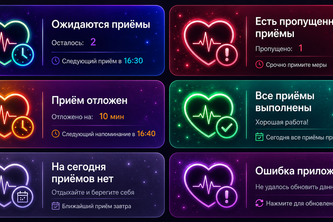
- Home screen widget showing remaining intakes and nearest unfinished time without revealing medicine details
- Support for Russian and English UI
- Core features are intended to be free and ad-free
Inference: The app appears to function as a personal health tool focused on medication adherence, with no indication of enterprise or B2B functionality.
Positioning & Claim Evolution
The author describes TaskMedAlert as solving a simple but common problem: remembering whether one has taken their medication. It positions itself as a reliable reminder system that also tracks intake behavior.
Claim: The app aims to help users follow schedules, confirm doses, snooze alerts, and track intakes.
Inference: This is a self-contained personal productivity tool for individuals managing medications, not a platform or service for healthcare providers or institutions.
Target Customer & ICP
The description does not specify target customers beyond the author’s own use case. However, it implies that users are likely people who take regular medication and need reminders to stay on schedule.
Claim: The app targets individuals who need to manage daily medication intake.
Inference: There is no evidence of segmentation by age group, condition type, or healthcare provider involvement.
Business Model & Pricing Evidence
The description states that the core medication reminder and intake-tracking features are intended to remain free and without advertising. No pricing model or monetization strategy beyond this is mentioned.
Claim: Core features will be free and ad-free.
Inference: There is no evidence of paid tiers, subscriptions, or in-app purchases.
Technical & Delivery Signals
The app was built using Flutter (Dart) with native Android components implemented in Kotlin. It uses local persistence, Android notifications, exact alarms, notification actions, background receivers, and a home screen widget.
GPT-5.6 and Codex were used for architecture planning, UX design, application logic, task decomposition, test planning, and interpretation of results.
Claim: Built with Flutter, Dart, Kotlin; uses local storage, Android notifications, exact alarms, background receivers, and a Home Screen Widget.
Inference: The use of AI tools like GPT-5.6 and Codex suggests an experimental or developer-focused approach to development rather than a scalable product lifecycle.
Traction & Maturity Signals
There is no evidence of user adoption, revenue, customer base, or market traction beyond the author’s personal experience during a hackathon.
Claim: The app was completed during Build Week and includes end-to-end functionality.
Inference: No data on downloads, active users, retention, or usage metrics are provided. The project is described as a prototype that became functional, not as a product with traction.
Competitive Context
The description does not mention competitors or market positioning relative to existing apps. It is unclear whether TaskMedAlert competes with other medication reminder apps or fills a niche in the health tech space.
Claim: No mention of competitive landscape.
Inference: The lack of competitive context makes it difficult to assess differentiation or market opportunity.
Open Questions & Risks
- No evidence of user adoption or market traction — the only data point is personal use.
- Single-person team — limited capacity for scaling or iteration.
- Self-reported features without validation — no third-party testing or feedback.
- Use of AI tools (GPT-5.6, Codex) — while innovative, this raises questions about long-term maintainability and scalability if not properly integrated into a development process.
- No monetization strategy beyond free core features — unclear path to revenue generation.
Inference: The project lacks commercial viability indicators such as user feedback, market demand, or business model traction.
Questions the description leaves open
- What is the actual problem you're solving for users? Is there evidence of widespread need?
- How many people have tried this app outside of your own use case?
- Are you planning to monetize beyond the free core features? If so, how?
- Have you considered privacy and data security implications of storing medication intake data?
- What is your plan for ongoing maintenance and updates?
- Do you have any plans to expand beyond Android or add new features like cloud sync?
Overall Assessment
Not evidenced.
Inference: There is insufficient evidence to assess whether TaskMedAlert has investment potential or strategic value for partnership. The project remains in early-stage development with no demonstrated traction, revenue, or clear path to market adoption.
User Stories BotA demo video on every pull request
Get a demo video on every new feature
GitHub App that watches your pull requests and records a narrated, captioned demo.
Save time on demo prep and make informed decisions faster with a video walkthrough of every new feature.
Source
Submitted to the OpenAI 2026 hackathon on Devpost. Project home on Devpost. Back to the full gallery on Devpost.
This competitive analysis was produced by top-founders.com (opens in a new tab)
Generated by a language model from this project's public Devpost page — its tagline, the author's own write-up and any built-with tags listed there — as captured in August 2026. Short quotations are the author's words. It is an opinion on the idea as a business, not on the people behind it, and it reflects the description as published then. If the project has moved on, request a correction below. The analysis is not independent research and contains no verified traction, revenue or customer data.
An independent guide by KFG International LLC — not affiliated with, endorsed by, or connected to Devpost or OpenAI.