

Archive position — measured, not model output
1 like on Devpost
505 of the 7,850 archived projects have more likes, and 1,758 share exactly 1 — so this project's #2,040 place in the like-ranked listing is a tie-break inside that group, not a ranking.
Projects (log scale)
Likes on Devpost. ▲ marks this project's group.
Show the figures
| Likes | Projects | Share of archive |
|---|---|---|
| 0 | 5,587 | 71.2% |
| 1 | 1,758 | 22.4% |
| 2 | 284 | 3.6% |
| 3–4 | 132 | 1.7% |
| 5–9 | 75 | 1.0% |
| 10+ | 14 | 0.2% |
 User Stories BotA demo video on every pull request
Get a demo video on every new feature
GitHub App that watches your pull requests and records a narrated, captioned demo.
Save time on demo prep and make informed decisions faster with a video walkthrough of every new feature.
Executive Summary
What the company appears to be
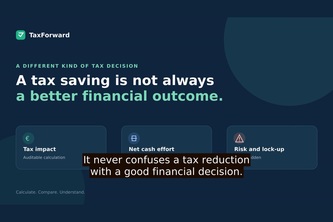
TaxForward is a self-reported decision-support application for individual households in metropolitan France, designed to help users make tax-related decisions before year-end, rather than waiting until after the tax year ends.
What changed
The project was built from scratch during OpenAI Build Week using Codex and GPT-5.6, with a focus on separating deterministic tax calculation from AI-generated explanations. It is positioned as a tool that helps users understand financial implications of tax decisions without hiding uncertainty or risk.
Single most important open question
Is there any evidence of real-world usage, customer feedback, or traction beyond the author’s own account?
Note: This analysis is based entirely on the self-reported description provided by the author. No external verification, revenue data, customer names, or adoption metrics are available.
What The Product Actually Is
The description states that TaxForward is a decision-support application for individual households in metropolitan France. It collects household composition, income sources (salaries, pensions, investment gains, crypto), and deductions to calculate tax outcomes.
It includes:
- Employment expense calculations per person;
- Comparison of flat-tax vs progressive-scale options;
- Scenario cards showing cash committed, net financial effort, liquidity, fees, capital loss, legal ceilings, and official sources;
- A radar covering additional tax regimes like Girardin, Malraux, Denormandie;
- Integration of GPT-5.6 for explanations only after deterministic calculations are complete.
The product uses a deterministic engine and a constrained AI layer, with no financial product promotion or recalculations by the AI.
Inference: The product is not a tax-return simulator but a decision-support tool that emphasizes transparency over simplification.
Positioning & Claim Evolution
The author claims TaxForward addresses an earlier, more useful question than traditional simulators: “What can I still decide before December 31, and what will that decision really cost me?”
It positions itself as:
- A year-end decision tool, not a post-year-end calculator;
- A transparent system that shows financial consequences of decisions, not just tax savings;
- An application that does not hide uncertainty or risk, even when using AI.
The author also states that the product is built on 26 years of accounting and tax experience, suggesting it aims to bridge professional-level insight with consumer accessibility.
Claim vs Fact: The positioning is self-described. No evidence of market testing or user validation is provided.
Target Customer & ICP
The description states that TaxForward targets:
- Individual households in metropolitan France;
- Specifically, standard households (not complex situations like foreign income, real estate, or event years such as marriage or divorce).
It does not appear to target:
- Professionals or businesses;
- Non-standard tax cases;
- Users outside of France.
Inference: The ICP is narrow — individuals with standard French tax profiles who want to make informed decisions before year-end.
Business Model & Pricing Evidence
The description does not state anything about:
- Revenue model;
- Pricing structure;
- Monetization strategy;
- Subscription or one-time payment plans.
Not evidenced: No information on how the product will generate income or whether it is monetized at all.
Technical & Delivery Signals
Key technical elements mentioned:
- Built with React, TypeScript, Next.js, Vitest;
- Uses Codex and GPT-5.6 for explanation layer only;
- Tax engine passes 27 regression tests;
- Separation of deterministic calculation from AI explanation;
- Uses a versioned rule pack for country-and-year tax rules;
- Includes official legal sources and update controls.
Inference: The architecture is designed to be auditable, transparent, and resilient to AI unavailability.
Traction & Maturity Signals
The description states:
- The project was built during a single hackathon event (OpenAI Build Week);
- It includes 27 regression tests;
- It is limited to France-only and standard cases;
- No mention of users, customers, or real-world usage.
Not evidenced: No evidence of traction, adoption, or user feedback beyond the author’s own account.
Competitive Context
The description does not reference:
- Competitors;
- Existing tools in the French tax decision-support space;
- Market size or competitive positioning.
Not evidenced: No competitive landscape is described.
Open Questions & Risks
Key risks and open questions based on the self-reported account:
- The product is limited to France and standard cases only;
- It is a single-person project, with no team or external validation;
- It does not yet support complex tax situations (e.g., foreign income, real estate);
- It is not monetized, raising questions about long-term viability;
- The use of GPT-5.6 is constrained but still introduces AI-related risks if misused;
- No evidence of user testing or feedback.
Inference: The product is in early development and lacks commercial traction or scalability beyond its current scope.
Questions the description leaves open
- What is the source of your tax rule data, and how do you ensure it stays up to date?
- How are you planning to expand beyond France and standard cases?
- Are there any plans for monetization or revenue generation?
- Have you tested the product with real users or households?
- How do you plan to handle legal changes in tax law that may not be reflected in your rule pack?
- What is the timeline for adding support for complex situations (e.g., foreign income, real estate)?
- How do you intend to scale beyond a single-person development team?
Overall Assessment
The project is a self-reported prototype built during a hackathon, with no evidence of revenue, customers, or traction.
It demonstrates:
- A clear understanding of French tax rules;
- A well-thought-out technical architecture that separates deterministic and AI components;
- A strong focus on transparency and risk awareness.
However, it is:
- Not yet commercialized;
- Limited in scope (France-only, standard cases only);
- Unproven in real-world usage;
- Lacks any financial or user validation.
Assessment: Not ready for investment or partnership at this stage. It may be a promising idea with potential, but the current evidence is insufficient to assess commercial viability or scalability.
User Stories BotA demo video on every pull request
Get a demo video on every new feature
GitHub App that watches your pull requests and records a narrated, captioned demo.
Save time on demo prep and make informed decisions faster with a video walkthrough of every new feature.
Source
Submitted to the OpenAI 2026 hackathon on Devpost. Project home on Devpost. Back to the full gallery on Devpost.
This competitive analysis was produced by top-founders.com (opens in a new tab)
Generated by a language model from this project's public Devpost page — its tagline, the author's own write-up and any built-with tags listed there — as captured in August 2026. Short quotations are the author's words. It is an opinion on the idea as a business, not on the people behind it, and it reflects the description as published then. If the project has moved on, request a correction below. The analysis is not independent research and contains no verified traction, revenue or customer data.
An independent guide by KFG International LLC — not affiliated with, endorsed by, or connected to Devpost or OpenAI.