

Archive position — measured, not model output
0 likes on Devpost
2,263 of the 7,850 archived projects have more likes, and 5,587 share exactly 0 — so this project's #4,001 place in the like-ranked listing is a tie-break inside that group, not a ranking.
Projects (log scale)
Likes on Devpost. ▲ marks this project's group.
Show the figures
| Likes | Projects | Share of archive |
|---|---|---|
| 0 | 5,587 | 71.2% |
| 1 | 1,758 | 22.4% |
| 2 | 284 | 3.6% |
| 3–4 | 132 | 1.7% |
| 5–9 | 75 | 1.0% |
| 10+ | 14 | 0.2% |
 User Stories BotA demo video on every pull request
Get a demo video on every new feature
GitHub App that watches your pull requests and records a narrated, captioned demo.
Save time on demo prep and make informed decisions faster with a video walkthrough of every new feature.
Executive Summary
EvolAstra is a self-reported local-first observatory that visualizes AI agent activity as units in a space RTS game map, where agents perform scientific data analysis tasks. The project was built by one developer over a few days using ChatGPT and Codex for development assistance. It is described as an experimental tool for computational biologists to explore research workflows through an interactive galaxy interface.
The author states that EvolAstra turns scientific exploration into a strategy-game universe, with agents represented as ships, hypotheses as star systems, and evidence as planets or orbital objects. The system supports mission-based research, interactive exploration of findings, and replay functionality.
Key commercial due-diligence read: There is no evidence of revenue, customers, or product-market fit beyond the author’s own use case and experimental development. The project is described as a proof-of-concept with bugs and not yet deployed for public use. It remains unclear whether this represents a viable product or service.
What The Product Actually Is
The description states that EvolAstra is:
- A local-first observatory
- That visualizes Codex agents on a space RTS game map
- While they perform scientific data analysis
- With agents represented as ships, research tasks as missions, hypotheses as star systems, and evidence as planets or orbital objects
- Supporting mission-based research, interactive exploration of findings, and replay functionality
The product is built using:
- FastAPI backend
- React/TypeScript frontend
- Canvas-based renderer
- 3D visualizations
- Codex for development assistance
It uses an append-only local event log and deterministic semantic projection to power the live galaxy, system views, and portable exports.
Inference: The product appears to be a prototype or proof-of-concept tool designed for personal use by a computational biologist. It is not described as having any commercial deployment or user base.
Positioning & Claim Evolution
The author claims that EvolAstra:
- Visualizes AI agent activity in a way that moves beyond logs and chat messages
- Turns scientific analysis into an interactive strategy-game universe
- Enables exploration of research workflows through an immersive interface
- Supports both individual and collaborative data analysis
It is positioned as a tool for computational biologists to visualize their analytical processes, turning them into a "living strategy-game universe."
Inference: The positioning reflects an experimental approach to visualizing AI-driven scientific workflows. It does not claim to be a mainstream product or platform but rather a personal development effort with potential future collaboration features.
Target Customer & ICP
The description states:
- EvolAstra was inspired by the author’s experience as a computational biologist postdoc
- It is intended for users who perform scientific data analysis
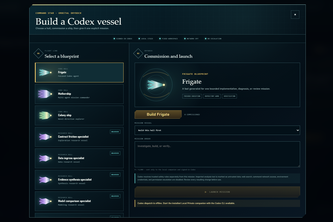
- The tool supports commissioning different types of ships (frigates, motherships, colony ships) to handle various research tasks
Inference: The target customer appears to be researchers or scientists working with complex datasets and analytical workflows. However, there is no evidence of a defined ICP beyond the author’s own use case.
Business Model & Pricing Evidence
The description does not provide any information about:
- Revenue streams
- Pricing models
- Monetization strategy
- Customer acquisition plans
Not evidenced: No commercial business model or pricing structure is described.
Technical & Delivery Signals
The project was built in under 3 days using:
- ChatGPT and Codex for development guidance
- FastAPI backend
- React/TypeScript frontend
- Canvas-based renderer
- 3D visualizations
- Netlify deployment
It includes features such as:
- Append-only local event log
- Deterministic semantic projection
- Replay functionality
- Interactive galaxy view with system-level exploration
Inference: The technical delivery shows rapid prototyping and integration of AI tools. However, the project is described as having bugs and not yet deployed for public use.
Traction & Maturity Signals
The description states:
- The app works but has bugs
- It was built in under 3 days
- It is intended to be open-sourced
- The author plans to make it collaborative and multiplayer
- The project was submitted to the OpenAI 2026 hackathon
Not evidenced: No evidence of revenue, customers, user adoption, or product-market fit. The tool is described as experimental and not yet publicly available.
Competitive Context
The description does not mention:
- Competitors
- Market positioning relative to existing tools
- Prior art in scientific data visualization or AI agent monitoring platforms
Not evidenced: No competitive landscape or differentiation analysis is provided.
Open Questions & Risks
Key risks and open questions include:
- The project is described as experimental, buggy, and not yet publicly deployed
- It was built by a single developer over a short time period
- There is no evidence of commercial traction or user feedback
- No clear monetization strategy or business model is evident
- The tool is intended for personal use and not yet scalable or collaborative
Inference: The lack of product-market fit, revenue, or customer data raises concerns about viability as a commercial offering.
Questions the description leaves open
- What specific scientific workflows does EvolAstra aim to support?
- How does the tool handle data privacy and security in local-first environments?
- Are there any plans for monetization or commercial deployment beyond open-sourcing?
- Has the tool been tested with other researchers or teams?
- What are the technical limitations of the current implementation, and how do they plan to address them?
- How does EvolAstra integrate with existing research tools or platforms?
Overall Assessment
Assessment: Not evidenced.
The project is described as a personal prototype built in a short timeframe, intended for open-sourcing and future collaboration. There is no evidence of commercial traction, revenue, or product-market fit. It remains unclear whether this represents a viable business opportunity or a research experiment with limited commercial potential.
The author’s own account indicates that the tool works but has bugs and is not yet deployed for public use. The project does not appear to be ready for investment or partnership at this stage.
User Stories BotA demo video on every pull request
Get a demo video on every new feature
GitHub App that watches your pull requests and records a narrated, captioned demo.
Save time on demo prep and make informed decisions faster with a video walkthrough of every new feature.
Source
Submitted to the OpenAI 2026 hackathon on Devpost. Project home on Devpost. Back to the full gallery on Devpost.
This competitive analysis was produced by top-founders.com (opens in a new tab)
Generated by a language model from this project's public Devpost page — its tagline, the author's own write-up and any built-with tags listed there — as captured in August 2026. Short quotations are the author's words. It is an opinion on the idea as a business, not on the people behind it, and it reflects the description as published then. If the project has moved on, request a correction below. The analysis is not independent research and contains no verified traction, revenue or customer data.
An independent guide by KFG International LLC — not affiliated with, endorsed by, or connected to Devpost or OpenAI.