

Archive position — measured, not model output
0 likes on Devpost
2,263 of the 7,850 archived projects have more likes, and 5,587 share exactly 0 — so this project's #4,002 place in the like-ranked listing is a tie-break inside that group, not a ranking.
Projects (log scale)
Likes on Devpost. ▲ marks this project's group.
Show the figures
| Likes | Projects | Share of archive |
|---|---|---|
| 0 | 5,587 | 71.2% |
| 1 | 1,758 | 22.4% |
| 2 | 284 | 3.6% |
| 3–4 | 132 | 1.7% |
| 5–9 | 75 | 1.0% |
| 10+ | 14 | 0.2% |
 User Stories BotA demo video on every pull request
Get a demo video on every new feature
GitHub App that watches your pull requests and records a narrated, captioned demo.
Save time on demo prep and make informed decisions faster with a video walkthrough of every new feature.
Executive Summary
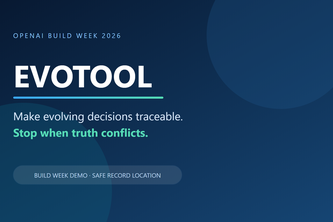
What the company appears to be: EVOTOOL: Traceable Evolution is a command-line tool designed to locate and validate formal records of document evolution in a workspace, with a focus on safety, traceability, and preventing incorrect AI-generated outputs due to ambiguous or outdated sources. It operates as a read-only system that identifies unique formal records for a given "evolution line" and halts execution if ambiguity arises.
What changed: The project evolved from an internal inventory management challenge into a tool focused on decision traceability and safety in document evolution, particularly for human-AI collaboration. A Build Week submission added a CLI layer to an existing read-only core, emphasizing reproducibility, privacy, and deterministic behavior.
The single most important open question: Is there a real-world use case or market need for this type of formal record validation and traceability in document evolution workflows? The description does not indicate any customers, revenue, or adoption beyond the author’s own development and testing.
What The Product Actually Is
The description states that EVOTOOL is a command-line tool that locates unique formal records of document evolution within a workspace. It uses a CLI interface with parameters --workspace and --line, returning canonical paths and SHA-256 fingerprints when exactly one valid record matches.
It does not modify files; it is read-only. The evaluator stops execution if the record is missing, duplicated, unreadable, or resolves outside allowed root, returning exit codes to indicate safety outcomes rather than errors.
The tool is built with Python and uses GPT-5.6 via Codex for parts of its implementation during Build Week. It has no third-party runtime dependencies.
Evidence: The author describes the core functionality, CLI behavior, output format, and safety mechanisms in detail.
Inference: EVOTOOL appears to be a developer-facing tool aimed at ensuring traceability and correctness in document evolution workflows, especially when AI agents are involved.
Positioning & Claim Evolution
The description states that EVOTOOL was inspired by a real inventory project where product revisions outpaced document maintenance. The author claims that decisions should be recorded not only in their latest wording but also in how they evolve over time.
It positions itself as a solution to prevent AI agents from producing confident but incorrect outputs due to missing, outdated, or duplicated sources of truth.
The tool is described as being grounded in concrete evidence and designed to surface conflicts rather than invent continuity. It emphasizes explicit stopping behavior as a product capability, allowing the system to say “There is not enough evidence to continue safely.”
Evidence: The author's own write-up describes the inspiration, purpose, and design philosophy behind EVOTOOL.
Inference: EVOTOOL is positioned as a safety layer for document evolution in environments where AI agents interact with evolving documentation. It aims to reduce human effort in reconstructing context while preserving authority over meaning and decisions.
Target Customer & ICP
The description does not name specific customers or target personas. However, it implies that the tool is aimed at teams or individuals working in environments where document evolution is critical—especially those using AI agents who must avoid incorrect outputs due to ambiguous sources.
It may appeal to developers, technical writers, or product managers working with evolving specifications and documentation.
Evidence: The author describes a use case involving product revisions and AI agents but does not identify specific customer segments.
Inference: Likely targets include software teams, technical documentation teams, or AI-assisted development environments where traceability and correctness are important. Not evidenced: actual customers or user groups.
Business Model & Pricing Evidence
There is no evidence of a business model or pricing structure in the description. The tool is presented as a read-only CLI utility built during a hackathon event.
Evidence: No mention of monetization, licensing, or commercial use cases.
Inference: If EVOTOOL becomes a product, it might be offered as open-source or part of an enterprise platform. Not evidenced: any revenue model or pricing strategy.
Technical & Delivery Signals
EVOTOOL is built using Python and integrates with GPT-5.6 via Codex during Build Week. It uses Git for version control and supports command-line interaction through a minimal installable package entry point.
It includes 112 tests, of which 111 pass, and has deterministic output behavior including relative paths and SHA-256 fingerprints. It avoids exposing private workspace data and prevents absolute path disclosure.
The tool does not modify files; it is read-only. It also handles Windows path behavior carefully and skips certain tests under specific conditions.
Evidence: The author describes the technical stack, testing practices, output formats, and safety features.
Inference: EVOTOOL shows a strong focus on correctness, determinism, and privacy in its implementation. It suggests a mature engineering approach for a tool that could scale into more complex workflows.
Traction & Maturity Signals
There is no evidence of traction or adoption beyond the author’s own development and testing. The team size is listed as zero, and there are no mentions of users, customers, revenue, or usage metrics.
The project was submitted to a hackathon (OpenAI 2026), indicating early-stage development and experimental nature.
Evidence: No data on user base, revenue, or product adoption.
Inference: EVOTOOL is at an early stage—likely prototype or proof-of-concept. It has not yet demonstrated real-world traction or commercial viability.
Competitive Context
The description does not mention competitors or similar tools in the market. It focuses on EVOTOOL’s unique approach to traceability and safety in document evolution, particularly for AI-assisted workflows.
It is unclear whether there are existing tools addressing the same problem space—document evolution tracking with formal record validation.
Evidence: No competitive analysis or references to other tools.
Inference: EVOTOOL may address a niche market or unmet need in AI-assisted documentation and decision traceability. Not evidenced: any direct competitors or market positioning relative to others.
Open Questions & Risks
- No customers or revenue: The tool is not demonstrated in production use, nor does it show evidence of traction.
- Limited scope: Currently read-only; future features like preview, adjudication, and writeback are planned but unimplemented.
- Unclear market demand: No indication that there is a real-world need for this type of formal record validation beyond the author’s own context.
- Hackathon origin: Submitted to a hackathon suggests it is experimental and not yet ready for enterprise deployment.
- No third-party dependencies: While this may be a strength, it also implies limited extensibility or integration capabilities.
Evidence: The description does not provide any data on adoption, market demand, or competitive landscape.
Inference: EVOTOOL is an early-stage idea with potential but lacks validation in real-world use cases. Risk of misalignment between perceived and actual need.
Questions the description leaves open
- What specific workflows or teams are you targeting with EVOTOOL? Are there any existing adopters?
- How does EVOTOOL integrate into current development or documentation processes?
- What is the plan for expanding beyond read-only functionality (e.g., preview, human adjudication, safe writeback)?
- How do you envision monetizing this tool—open-source, SaaS, or embedded in larger platforms?
- What are the main challenges in scaling EVOTOOL to support larger workspaces or more complex document structures?
- Can you describe how EVOTOOL handles conflicts between different versions of documents or code?
- How does EVOTOOL ensure that its safety mechanisms do not become a bottleneck in fast-paced environments?
Overall Assessment
EVOTOOL is an early-stage, hackathon-derived tool focused on traceability and safety in document evolution. It has strong technical foundations and shows attention to correctness, privacy, and deterministic behavior.
However, there is no evidence of traction, customers, or commercial viability. The tool is read-only and currently limited to a narrow use case. Its future direction involves expanding into preview, adjudication, and writeback capabilities, which are not yet implemented.
Assessment: Not ready for investment or partnership at this time. It may have potential as a foundational tool in AI-assisted documentation workflows, but lacks demonstrated market need or product-market fit.
Confidence Level: Low — based entirely on self-reported evidence with no external validation or traction data.
User Stories BotA demo video on every pull request
Get a demo video on every new feature
GitHub App that watches your pull requests and records a narrated, captioned demo.
Save time on demo prep and make informed decisions faster with a video walkthrough of every new feature.
Source
Submitted to the OpenAI 2026 hackathon on Devpost. Project home on Devpost. Back to the full gallery on Devpost.
This competitive analysis was produced by top-founders.com (opens in a new tab)
Generated by a language model from this project's public Devpost page — its tagline, the author's own write-up and any built-with tags listed there — as captured in August 2026. Short quotations are the author's words. It is an opinion on the idea as a business, not on the people behind it, and it reflects the description as published then. If the project has moved on, request a correction below. The analysis is not independent research and contains no verified traction, revenue or customer data.
An independent guide by KFG International LLC — not affiliated with, endorsed by, or connected to Devpost or OpenAI.