

Archive position — measured, not model output
0 likes on Devpost
2,263 of the 7,850 archived projects have more likes, and 5,587 share exactly 0 — so this project's #5,965 place in the like-ranked listing is a tie-break inside that group, not a ranking.
Projects (log scale)
Likes on Devpost. ▲ marks this project's group.
Show the figures
| Likes | Projects | Share of archive |
|---|---|---|
| 0 | 5,587 | 71.2% |
| 1 | 1,758 | 22.4% |
| 2 | 284 | 3.6% |
| 3–4 | 132 | 1.7% |
| 5–9 | 75 | 1.0% |
| 10+ | 14 | 0.2% |
 User Stories BotA demo video on every pull request
Get a demo video on every new feature
GitHub App that watches your pull requests and records a narrated, captioned demo.
Save time on demo prep and make informed decisions faster with a video walkthrough of every new feature.
Executive Summary
PlanCut is a developer tool that allows teams to review and approve AI agent plans before execution, turning those approvals into server-enforced contracts. The description states it uses a "PolicyGate" to block unsafe actions, supports recovery from failed steps, and maintains evidence of what was proposed, approved, and executed. It is built as a modular Next.js application with TypeScript, SQLite persistence, and integrates with OpenAI's GPT-5.6 via an SDK.
The author claims the tool enforces plans through server-side policies, prevents forbidden writes, and supports recovery from failed steps without restarting the entire process. The demo uses deterministic fixtures to show safety and verification features without requiring API keys or paid model calls.
Key open question
What is the actual commercial viability of enforcing AI agent execution through a developer tool? Is there evidence that developers are willing to adopt such a system, or is this primarily a proof-of-concept for a hackathon?
What The Product Actually Is
The description states:
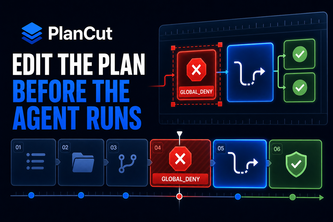
- PlanCut turns AI-generated plans into editable "work clips"
- Developers can reorder steps, narrow scope, lock files/tools, define expected outcomes, and require approvals
- After approval, it compiles the plan into "immutable execution contracts"
- It uses a "server-side, default-deny PolicyGate" to block unsafe actions
- Failed clips can be recut independently, with execution resuming from a trusted checkpoint
- Execution history includes evidence of what was proposed, approved, and completed
The product is described as a modular Next.js application built with:
- Strict TypeScript schemas
- Server-enforced PolicyGate authorization
- Bounded filesystem and code-editing tools
- SQLite persistence via better-sqlite3
- Append-only runtime events, checkpoints, and evidence
- Playwright-based browser verification
- React/Tailwind workbench for editing/reviewing plans
- Guarded OpenAI Agents SDK integration configured for GPT-5.6
Inferred: The tool appears to be a developer-facing interface for managing AI agent workflows with safety enforcement.
Positioning & Claim Evolution
The description states:
- The inspiration was that "AI agents are excellent at executing tasks, but a misunderstood plan can create expensive rework"
- The goal is to let developers "review an agent’s intended workflow before execution and make those decisions enforceable"
- It aims to turn AI plans into "server-enforced contracts" that block unsafe actions, recover failed steps, verify results, and show what happened
The positioning has evolved from a general safety concern (misunderstood plans causing rework) to a specific technical solution: turning AI-generated workflows into enforceable execution contracts with policy gates.
Inferred: The product positions itself as a safety layer for AI agents, particularly in development environments where control over execution is critical.
Target Customer & ICP
The description states:
- PlanCut is aimed at developers who want to review and approve AI agent plans before execution
- It uses "server-enforced PolicyGate" which implies enterprise or high-security use cases
- The tool supports "recovery of only the failed clip instead of restarting the entire run"
- It allows "locking files or tools" and defining "expected outcomes"
Inferred: The primary customer is likely developers working in environments where AI agent execution needs to be controlled, possibly in enterprise settings with compliance requirements.
Not evidenced: No explicit mention of specific industries, team sizes, or use cases beyond general developer workflows.
Business Model & Pricing Evidence
The description states:
- There is no mention of pricing or business model
- The demo uses a "deterministic Northstar Billing Portal fixture" so judges can reproduce the journey without API keys or model spend
- The tool is described as built for an OpenAI hackathon, suggesting it's not yet commercialized
Not evidenced: No information about monetization strategy, pricing tiers, or revenue streams.
Technical & Delivery Signals
The description states:
- Built with Azure Container Apps, Docker, Next.js, React, TypeScript, Tailwind CSS, Vitest, Zod
- Uses a long-lived Node process
- Server-enforced PolicyGate authorization
- Bounded filesystem and code-editing tools
- SQLite persistence through better-sqlite3
- Append-only runtime events, checkpoints, and evidence
- Playwright-based browser verification
- Guarded OpenAI Agents SDK integration configured for GPT-5.6
Inferred: The tool is built with modern web technologies and includes strong security features like bounded environments and policy enforcement.
Traction & Maturity Signals
The description states:
- This was submitted to the OpenAI 2026 hackathon
- The public demo uses deterministic fixtures so judges can reproduce the journey without API keys or model spend
- The tool is described as a "complete modular architecture with extensive automated verification"
- It includes "durable activity history showing the rough plan, approved plan, and actual execution"
Not evidenced: No information about users, customers, revenue, or adoption beyond the hackathon submission.
Competitive Context
The description states:
- There is no mention of competitors
- The tool addresses a problem with AI agents executing tasks without proper oversight
- It focuses on "server-enforced contracts" and "PolicyGate" enforcement
Not evidenced: No information about existing tools, market players, or competitive landscape.
Open Questions & Risks
The description states:
- The biggest challenge was ensuring that the plan was a real runtime contract rather than just a visual plan
- Model output can suggest an action, but it must never be allowed to authorize itself
- They had to make blocked actions provable, preserve workspace state across recuts, prevent forbidden writes before they occurred, and separate trusted evidence from model claims
Inferred risks:
- The tool may not yet be production-ready or scalable beyond a hackathon demo
- The "PolicyGate" concept is described as novel but unproven in practice
- There's no evidence of real-world adoption or feedback from developers
- The demo uses deterministic fixtures, which may not reflect actual usage
Questions the description leaves open
- What specific use cases are you targeting for PlanCut?
- How does the PolicyGate mechanism differ from existing access control systems?
- What is your strategy for scaling beyond a hackathon prototype?
- Have you identified any real-world developers who would adopt this tool?
- How do you plan to integrate with existing CI/CD or development workflows?
- What are the technical limitations of the current architecture that might prevent production use?
Overall Assessment
The description states:
- PlanCut is a hackathon submission for the OpenAI 2026 hackathon
- It is built as a modular Next.js application with TypeScript and integrates with OpenAI's GPT-5.6
- The public demo uses deterministic fixtures to show safety features without requiring API keys or model spend
Not evidenced: No information about commercial viability, traction, or market demand.
Inferred: This appears to be a proof-of-concept tool for a hackathon, not yet ready for investment or partnership consideration. The technical approach shows promise but lacks evidence of real-world adoption or scalability.
User Stories BotA demo video on every pull request
Get a demo video on every new feature
GitHub App that watches your pull requests and records a narrated, captioned demo.
Save time on demo prep and make informed decisions faster with a video walkthrough of every new feature.
Source
Submitted to the OpenAI 2026 hackathon on Devpost. Project home on Devpost. Back to the full gallery on Devpost.
This competitive analysis was produced by top-founders.com (opens in a new tab)
Generated by a language model from this project's public Devpost page — its tagline, the author's own write-up and any built-with tags listed there — as captured in August 2026. Short quotations are the author's words. It is an opinion on the idea as a business, not on the people behind it, and it reflects the description as published then. If the project has moved on, request a correction below. The analysis is not independent research and contains no verified traction, revenue or customer data.
An independent guide by KFG International LLC — not affiliated with, endorsed by, or connected to Devpost or OpenAI.