

Archive position — measured, not model output
0 likes on Devpost
2,263 of the 7,850 archived projects have more likes, and 5,587 share exactly 0 — so this project's #4,004 place in the like-ranked listing is a tie-break inside that group, not a ranking.
Projects (log scale)
Likes on Devpost. ▲ marks this project's group.
Show the figures
| Likes | Projects | Share of archive |
|---|---|---|
| 0 | 5,587 | 71.2% |
| 1 | 1,758 | 22.4% |
| 2 | 284 | 3.6% |
| 3–4 | 132 | 1.7% |
| 5–9 | 75 | 1.0% |
| 10+ | 14 | 0.2% |
 User Stories BotA demo video on every pull request
Get a demo video on every new feature
GitHub App that watches your pull requests and records a narrated, captioned demo.
Save time on demo prep and make informed decisions faster with a video walkthrough of every new feature.
Executive Summary
What the company appears to be
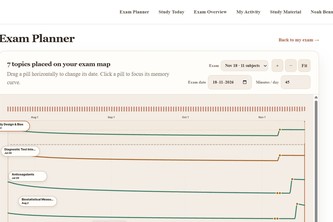
ExamTime App is a self-study and teacher-facing tool built around spaced-repetition memory models (specifically FSRS) to help students and teachers plan study time more effectively by mapping topic memory decay against an exam date. It aims to reduce anxiety caused by time pressure in exams, not just by providing content but by showing what can realistically be studied in time.
What changed
The project description is a self-reported submission for the OpenAI 2026 hackathon. It presents a novel approach to study planning using deterministic memory models and scheduling logic, with an emphasis on honesty about time constraints and teacher judgment shaping student plans.
Single most important open question
Is there any evidence of real usage or adoption beyond the author's own development? The description contains no data on users, revenue, traction, or market validation — only claims about how it works and what it aims to solve.
What The Product Actually Is
The description states that ExamTime App is a study planning tool built around:
- A spaced-repetition memory model (FSRS)
- A deadline-aware scheduler
- An engine that forecasts memory decay toward an exam date
- A system for both solo learners and teachers to plan study time
- A visual interface for drag-and-drop topic scheduling with real-time impact on the forecast
It is described as:
- Not a chatbot or content generator, but a deterministic engine calculating study plans
- Designed to show what topics won’t fit in time, rather than just giving more material
- Built using Django (backend) and React (frontend)
Inference The app appears to be a planning tool for exam preparation that uses memory science to optimize study schedules.
Positioning & Claim Evolution
The description states:
- The app addresses the root cause of exam stress: time pressure, not lack of content.
- It shifts from “more content” tools to “smart scheduling” based on memory decay.
- It positions itself as a tool that helps students and teachers make informed decisions about what to study when — not just how much.
Claims made
- Stress in exams is a time problem.
- Current tools add more content instead of solving time allocation.
- The app solves the “memory & time sense collapse” by projecting memory decay toward exam day.
- It gives users permission to stop studying, which is calming for anxious students.
Inference The positioning is centered on reducing anxiety through transparency and realistic planning — not just productivity or learning gains.
Target Customer & ICP
The description states:
- Designed for self-study and teachers
- Works whether you study solo or your teacher builds the material for a class
- Teachers can author real study material, set parameters per topic (time to cover, importance, revisions), and generate personalized plans for students
Inference The primary ICP includes:
- Students preparing for exams (especially under time pressure)
- Educators who want to personalize student study plans without manual scheduling
- Users who value deterministic planning over guesswork or AI-generated content
Business Model & Pricing Evidence
Not evidenced.
The description does not mention any pricing model, monetization strategy, or business model. It only describes the product and its features.
Technical & Delivery Signals
The description states:
- Built with Django (backend) and React (frontend)
- Uses FSRS as a spaced-repetition algorithm
- Memory engine is isolated in one service
- Engine is deterministic, immutable, auditable
- Supports both flashcards and multiple-choice questions via shared schedulable units
- Includes a “what-if” simulator that re-runs the engine with changed inputs
Inference The technical stack suggests a modern web application built on established frameworks. The use of FSRS implies a focus on scientific memory models, and the deterministic nature indicates a strong emphasis on reliability and traceability.
Traction & Maturity Signals
Not evidenced.
There is no mention of:
- Users or customers
- Revenue or funding
- Product adoption or usage metrics
- Market traction or growth indicators
The project is described as a hackathon submission, with no evidence of prior user testing or product-market fit.
Competitive Context
Not evidenced.
The description does not reference competitors, nor does it describe how the app compares to existing tools in the study or education space. It only explains what the app does differently — not how it fits into the broader market landscape.
Open Questions & Risks
Risks
- No evidence of real-world usage or adoption.
- The app is described as a hackathon project, suggesting early-stage development and lack of commercial viability.
- The description lacks any mention of monetization, pricing, or business model.
- The focus on honesty and transparency may be perceived negatively by users expecting more encouragement or gamification.
Open Questions
- No data on user behavior, retention, or satisfaction.
- No evidence of product-market fit or customer validation.
- The app is presented as a solution to a problem, but no proof of traction exists.
- The team size is listed as one member (K S), which may indicate limited development capacity.
Questions the description leaves open
- What is the current stage of product development? Is it in beta or production?
- Have you conducted any user testing with students or teachers?
- How do you plan to monetize this tool?
- Are there any existing partnerships or integrations with schools or educational platforms?
- What are your plans for scaling beyond a single developer?
- How do you intend to validate the effectiveness of the FSRS implementation in real-world use?
Overall Assessment
Not evidenced.
There is no evidence of:
- Revenue or financial performance
- Customer base or user engagement
- Market traction or competitive positioning
- Team experience or track record
- Product-market fit or scalability
The description is entirely self-reported and unverified. It presents a concept with potential, but without any demonstration of viability or commercial traction.
Confidence Level Low — this analysis is based solely on the author's own account, which contains no verifiable data about users, customers, or business outcomes.
User Stories BotA demo video on every pull request
Get a demo video on every new feature
GitHub App that watches your pull requests and records a narrated, captioned demo.
Save time on demo prep and make informed decisions faster with a video walkthrough of every new feature.
Source
Submitted to the OpenAI 2026 hackathon on Devpost. Project home on Devpost. Back to the full gallery on Devpost.
This competitive analysis was produced by top-founders.com (opens in a new tab)
Generated by a language model from this project's public Devpost page — its tagline, the author's own write-up and any built-with tags listed there — as captured in August 2026. Short quotations are the author's words. It is an opinion on the idea as a business, not on the people behind it, and it reflects the description as published then. If the project has moved on, request a correction below. The analysis is not independent research and contains no verified traction, revenue or customer data.
An independent guide by KFG International LLC — not affiliated with, endorsed by, or connected to Devpost or OpenAI.