

Archive position — measured, not model output
0 likes on Devpost
2,263 of the 7,850 archived projects have more likes, and 5,587 share exactly 0 — so this project's #4,000 place in the like-ranked listing is a tie-break inside that group, not a ranking.
Projects (log scale)
Likes on Devpost. ▲ marks this project's group.
Show the figures
| Likes | Projects | Share of archive |
|---|---|---|
| 0 | 5,587 | 71.2% |
| 1 | 1,758 | 22.4% |
| 2 | 284 | 3.6% |
| 3–4 | 132 | 1.7% |
| 5–9 | 75 | 1.0% |
| 10+ | 14 | 0.2% |
 User Stories BotA demo video on every pull request
Get a demo video on every new feature
GitHub App that watches your pull requests and records a narrated, captioned demo.
Save time on demo prep and make informed decisions faster with a video walkthrough of every new feature.
Executive Summary
What the company appears to be
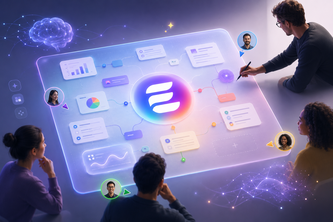
EvoDeck is an AI-native collaborative canvas for making decisions, built as a hackathon project by one person (Shayan A Pahlavan). It allows users to describe needs in natural language and generates interactive visual widgets such as charts, checklists, and decision matrices. The system supports @mention targeting of individual widgets, timeline revisions, and scenario branching without overwriting original reasoning.
What changed
This is a self-reported project description from a hackathon submission. No evidence of prior development, traction, or commercial activity exists beyond the author's account.
The single most important open question
Is there any evidence of product-market fit, user adoption, or revenue generation that would validate this concept beyond a proof-of-concept?
What The Product Actually Is
- The description states EvoDeck is an "AI-native collaborative canvas for making decisions"
- It generates interactive visual widgets including charts, benchmarks, checklists, decision matrices, risk tables, forms, controls, flowcharts, and live-data dashboards
- Users can target individual widgets with @mentions (e.g., "@launch-benchmark update support readiness to 78%")
- Every meaningful change becomes a timeline revision that supports rewinding and branching
- The AI does not directly rewrite the canvas but produces validated operations like add_widget, update_widget, and move_widget
- It uses Next.js, React, TypeScript, PostgreSQL, Drizzle ORM, and OpenUI for building
Evidence strength Self-reported only. No independent verification or demonstration of actual functionality beyond the author's account.
Positioning & Claim Evolution
- The description states EvoDeck "turns AI prompts into living visual workspaces"
- It positions itself as an alternative to text-based AI responses, aiming to make AI output more useful through visual interfaces
- The author claims it explores a "different interaction model" where every AI prompt becomes a "useful visual object that could evolve over time"
- EvoDeck is described as enabling teams to "edit, rewind, and branch decisions to compare alternate futures without losing the original reasoning"
Inference This suggests a shift from traditional text-based AI tools toward visual decision-making platforms.
Target Customer & ICP
- The description states EvoDeck is for "teams" working on making decisions
- It targets users who want to translate conversational intent into interactive UI rather than static text
- The system supports collaboration features like presence and shared workspaces
- It appears aimed at decision-makers in business contexts where visual planning, scenario exploration, and historical tracking are valuable
Evidence strength Not evidenced. No specific customer segments or personas identified beyond "teams."
Business Model & Pricing Evidence
- Not evidenced.
Inference The description does not mention any pricing model, monetization strategy, or business model.
Technical & Delivery Signals
- Built with Next.js, React, TypeScript, PostgreSQL, Drizzle ORM, and OpenUI
- Architecture includes:
- Visual canvas for interactive widgets
- Structured AI operations (add_widget, update_widget, move_widget)
- OpenUI-generated interfaces
- @mention targeting system
- Append-only timeline for preserving decision history
- In-workspace scenario branches
- Optional live-data integrations via ClickHouse and external source adapters
- Presence and collaboration features
Evidence strength Self-reported. No evidence of deployment, performance metrics, or production usage.
Traction & Maturity Signals
- Not evidenced.
Inference The project is described as a hackathon submission (OpenAI 2026) with no mention of users, customers, revenue, or adoption beyond the author's account.
Competitive Context
- Not evidenced.
Inference No comparison to existing tools or market positioning provided. The description does not reference competitors or similar products in the marketplace.
Open Questions & Risks
- Single founder: Only one team member listed (Shayan A Pahlavan)
- No traction evidence: No revenue, customers, or usage data
- Unverified claims: All descriptions are self-reported and unverified
- Limited scope: Built for a hackathon; no indication of scalability or long-term viability
- Unclear commercialization path: No mention of monetization or go-to-market strategy
Questions the description leaves open
- What specific problems are teams solving with EvoDeck that they couldn't solve before?
- How does the team plan to scale beyond a single developer and hackathon prototype?
- Are there any early adopters or pilot users who have tested this concept?
- What is the roadmap for monetization and customer acquisition?
- How do you intend to compete with existing decision-making tools or AI interfaces?
Overall Assessment
- Not evidenced.
Inference There is insufficient evidence to assess whether EvoDeck has investment potential or strategic value as a partnership target. The project remains at the idea/prototype stage, lacking any demonstrated traction, revenue, or customer validation.
User Stories BotA demo video on every pull request
Get a demo video on every new feature
GitHub App that watches your pull requests and records a narrated, captioned demo.
Save time on demo prep and make informed decisions faster with a video walkthrough of every new feature.
Source
Submitted to the OpenAI 2026 hackathon on Devpost. Project home on Devpost. Back to the full gallery on Devpost.
This competitive analysis was produced by top-founders.com (opens in a new tab)
Generated by a language model from this project's public Devpost page — its tagline, the author's own write-up and any built-with tags listed there — as captured in August 2026. Short quotations are the author's words. It is an opinion on the idea as a business, not on the people behind it, and it reflects the description as published then. If the project has moved on, request a correction below. The analysis is not independent research and contains no verified traction, revenue or customer data.
An independent guide by KFG International LLC — not affiliated with, endorsed by, or connected to Devpost or OpenAI.