

Archive position — measured, not model output
1 like on Devpost
505 of the 7,850 archived projects have more likes, and 1,758 share exactly 1 — so this project's #2,034 place in the like-ranked listing is a tie-break inside that group, not a ranking.
Projects (log scale)
Likes on Devpost. ▲ marks this project's group.
Show the figures
| Likes | Projects | Share of archive |
|---|---|---|
| 0 | 5,587 | 71.2% |
| 1 | 1,758 | 22.4% |
| 2 | 284 | 3.6% |
| 3–4 | 132 | 1.7% |
| 5–9 | 75 | 1.0% |
| 10+ | 14 | 0.2% |
 User Stories BotA demo video on every pull request
Get a demo video on every new feature
GitHub App that watches your pull requests and records a narrated, captioned demo.
Save time on demo prep and make informed decisions faster with a video walkthrough of every new feature.
Executive Summary
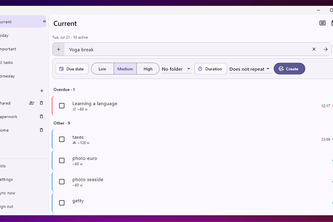
The description states that "Task Manager" is a cross-platform task manager for Windows and Android, built in under a day using tools like C++, Codex, Dart, Riverpod, SQLite, and Supabase. The author, Mr. Einhorn, claims to have built it to meet personal needs, finding existing solutions either too limited or overly complex. There is no evidence of revenue, customers, or traction beyond the self-reported project submission.
Key insight: The product appears to be a personal-side-project with no demonstrated commercial traction or market validation.
Most important open question: Is this a prototype or a product intended for launch? If it's a prototype, what is the path to commercialization?
What The Product Actually Is
The description states that "Task Manager" is a network-enabled, cross-platform task manager for Windows and Android. It supports localization and was built in under a day using C++, Codex, Dart, Riverpod, SQLite, and Supabase.
Inference: Based on the technology stack (e.g., Codex, Riverpod, Supabase), this may be a modern, developer-built prototype or proof-of-concept rather than a polished commercial product.
Positioning & Claim Evolution
The author states that they built the app because existing task managers were either too limited or too complex. The positioning is self-described as a simple and convenient solution tailored to personal needs.
Claim: The app is built for users who want something straightforward, without unnecessary features.
Inference: This is a personal project with no evidence of market research or user feedback beyond the author’s own experience.
Target Customer & ICP
The description does not state any specific customer segments or ideal customer profile (ICP). It only mentions that the app was built to meet the author's own needs.
Inference: The target customer is likely the author themselves, or a small group of users with similar preferences. No evidence of broader market targeting.
Business Model & Pricing Evidence
There is no evidence in the description of any pricing model, monetization strategy, or business model. The project is described as a personal build and not as a commercial product.
Claim: The app was built for personal use, not for sale or distribution.
Technical & Delivery Signals
The project was built using C++, Codex, Dart, Riverpod, SQLite, and Supabase. It is cross-platform and network-enabled with localization support. It was completed in under a day.
Inference: The app is likely a prototype or MVP, not a full-fledged product. The use of tools like Codex suggests rapid development, but also implies limited testing or scalability.
Traction & Maturity Signals
There is no evidence of traction, adoption, or user engagement beyond the author’s own account. No metrics, customer data, or usage statistics are provided.
Claim: This is a self-reported personal project with no external validation.
Competitive Context
The description does not mention any competitors or market context. The author only states that existing solutions were either too limited or too complex.
Inference: There is no evidence of competitive analysis or awareness of the broader task management market.
Open Questions & Risks
- No commercial traction: The project is described as a personal build with no evidence of users or revenue.
- No clear path to monetization: No pricing, business model, or go-to-market strategy is evident.
- Prototype nature: Built in under a day, likely not production-ready.
- Unclear intent: It's unclear whether this is intended for launch or just a hackathon submission.
Questions the description leaves open
- What is the intended commercialization path for this product?
- Is there any user feedback or testing beyond your own experience?
- Are you planning to iterate on this project, and if so, what are the next steps?
- Do you have a plan for scaling or monetizing this app?
- How does this differ from existing task managers in the market?
Overall Assessment
The description states that this is a personal project built in under a day, submitted to a hackathon. There is no evidence of commercial traction, revenue, customers, or a clear business model.
Inference: This is likely a prototype or proof-of-concept with no demonstrated commercial viability or market readiness.
Assessment: Not evidenced as a viable investment or partnership opportunity at this stage.
User Stories BotA demo video on every pull request
Get a demo video on every new feature
GitHub App that watches your pull requests and records a narrated, captioned demo.
Save time on demo prep and make informed decisions faster with a video walkthrough of every new feature.
Source
Submitted to the OpenAI 2026 hackathon on Devpost. Project home on Devpost. Back to the full gallery on Devpost.
This competitive analysis was produced by top-founders.com (opens in a new tab)
Generated by a language model from this project's public Devpost page — its tagline, the author's own write-up and any built-with tags listed there — as captured in August 2026. Short quotations are the author's words. It is an opinion on the idea as a business, not on the people behind it, and it reflects the description as published then. If the project has moved on, request a correction below. The analysis is not independent research and contains no verified traction, revenue or customer data.
An independent guide by KFG International LLC — not affiliated with, endorsed by, or connected to Devpost or OpenAI.