

Archive position — measured, not model output
1 like on Devpost
505 of the 7,850 archived projects have more likes, and 1,758 share exactly 1 — so this project's #2,035 place in the like-ranked listing is a tie-break inside that group, not a ranking.
Projects (log scale)
Likes on Devpost. ▲ marks this project's group.
Show the figures
| Likes | Projects | Share of archive |
|---|---|---|
| 0 | 5,587 | 71.2% |
| 1 | 1,758 | 22.4% |
| 2 | 284 | 3.6% |
| 3–4 | 132 | 1.7% |
| 5–9 | 75 | 1.0% |
| 10+ | 14 | 0.2% |
 User Stories BotA demo video on every pull request
Get a demo video on every new feature
GitHub App that watches your pull requests and records a narrated, captioned demo.
Save time on demo prep and make informed decisions faster with a video walkthrough of every new feature.
Executive Summary
What the company appears to be: TaskFence Ai is a self-reported enforcement gateway for AI assistants that limits their actions in terms of scope, time, money, and provider access. It claims to offer "agentic autonomy with controlled, auditable delegation" by enforcing user-defined boundaries on AI agents before they can execute consequential actions.
What changed: The project description indicates a shift from general AI assistant capabilities to a specific safety layer that controls what an AI agent can do — particularly in terms of financial or provider-based actions. It was built as part of the OpenAI 2026 hackathon and is presented as a working vertical slice with demonstrable enforcement logic.
Single most important open question: Does TaskFence Ai actually enforce boundaries, or does it merely present a visual demonstration that an AI agent cannot act outside its defined limits? The description states that real money does not move in the demo, but it does not clarify whether this is a limitation of the demo or a feature of the system itself.
What The Product Actually Is
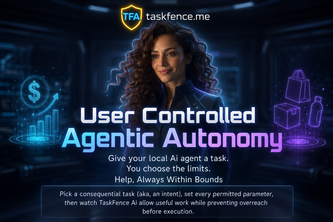
The description states that TaskFence Ai is an enforcement gateway for user-controlled agentic autonomy. It allows users to define a "Fence" containing parameters such as spending limits, scope, deadline, provider, and number of actions. An AI agent may propose actions but cannot authorize itself or directly access provider credentials.
It uses:
- OpenAI agents for structured action proposals
- Deterministic policy enforcement
- Atomic SQLite authority ledger
- Stripe test mode for provider execution
- Ed25519 signed receipts
- Cloudflare Turnstile, rate limits, and circuit breakers
- n8n and email alerts
The system evaluates every proposal against user-defined rules. If permitted, it reserves authority before calling the provider; if not, the action is stopped before provider execution.
Inference: The product appears to be a technical prototype built for demonstration purposes, with modular components including a UI (Next.js), backend enforcement logic (TypeScript/Bun), and security layers (Docker, Cloudflare, SQLite). It is not evidenced to have real-world deployment or production usage.
Positioning & Claim Evolution
The description states that TaskFence Ai began with the question: "how can we let an AI agent be genuinely useful without giving it unlimited power?" Its guiding principle is “Help, Always Within Bounds.”
It positions itself as a system where:
- AI agents can reason and recommend freely
- Consequential actions must remain within defined boundaries
- Users control what the agent may do, including money, time, scope, merchant, and action limits
The project evolved from a hackathon submission into a working vertical slice with demonstrable enforcement logic. It claims to be a “protocol-level” enforcement system that can be extended into a developer platform.
Inference: The positioning is focused on safety and control in AI agent use — particularly around financial or provider-based actions. It is not yet positioned as a commercial product but rather as a prototype with future scalability plans.
Target Customer & ICP
The description does not explicitly state target customers or personas. However, it implies that the primary users are individuals who want to delegate tasks to AI agents while maintaining control over what those agents can do — especially in financial or provider contexts.
It suggests a use case for:
- Users who want to allow AI assistants to shop, book travel, transfer assets, etc.
- Developers or organizations looking to build systems that enforce boundaries on AI agents
- Anyone seeking to limit the autonomy of AI agents without sacrificing utility
Inference: The ICP appears to be early adopters or developers interested in AI safety and control. It is not evidenced whether there are specific customer segments beyond this.
Business Model & Pricing Evidence
There is no evidence of pricing, revenue, or business model in the description. The project is described as a hackathon submission that has been turned into a working vertical slice with plans to become a reusable protocol and developer platform.
It mentions:
- A public SDK
- Expanded MCP tool surface
- Provider adapters for flight, money transfer, stock trading
- Organization policies, shared budgets, operator dashboards
Inference: The business model is inferred to be a developer platform or SaaS offering with potential monetization through usage-based pricing or licensing. However, no concrete evidence of pricing or revenue exists.
Technical & Delivery Signals
The system is built using:
- TypeScript monorepo with Bun
- Next.js for UI (deployed via Vercel)
- Docker containers on Hostinger VPS
- Cloudflare for DNS, TLS, proxy protection, and Turnstile
- SQLite for authority ledger
- Stripe test mode for provider execution
- Ed25519 signed receipts
- HMAC-verified alerts through n8n
It includes:
- 135 automated tests with 658 assertions
- Atomic reservations of authority
- Output filtering
- Signed receipts and tamper detection
- Circuit breakers, rate limits, and daily usage limits
- Adversarial testing scenarios
Inference: The technical stack is modular and includes strong security features. However, it is not evidenced that the system has been deployed in production or scaled beyond a demo.
Traction & Maturity Signals
The project is described as a working vertical slice with:
- A public interface at TaskFence.me
- 135 automated tests with 658 assertions
- Demonstrated enforcement logic in a shopping scenario
- Adversarial demonstration showing denial of unauthorized actions
- Deployment across multiple platforms (Vercel, Cloudflare, Docker, Hostinger)
It is not evidenced to have:
- Real-world customers or users
- Revenue or monetization
- Production-scale usage
- Any form of traction beyond the demo
Inference: The project shows maturity in prototype form but lacks evidence of real-world adoption or commercial traction.
Competitive Context
The description does not mention competitors. However, it positions itself as a solution to the growing problem of AI agents acting with unlimited authority — particularly in financial or provider-based contexts.
It implies that its competitive advantage lies in:
- Independent enforcement
- Atomic reservations and deterministic rules
- Auditable delegation
- Protocol-level control
Inference: The competitive space is likely related to AI safety, agent control, and enterprise AI governance. However, no specific competitors are named or described.
Open Questions & Risks
Key risks include:
- Demo vs. Real Deployment: The description states that no real money moves in the demo; it's unclear whether this is a limitation of the demo or a feature of the system.
- No Production Evidence: There is no evidence of production deployment, scaling, or customer adoption.
- Single Developer Team: The team size is listed as one (1), which may limit development velocity and scalability.
- Unverified Claims: All claims are self-reported and unverified; there is no third-party validation of the system’s effectiveness.
Inference: The project is in a very early stage, with no evidence of commercial viability or real-world use. It is not yet proven to be a scalable or secure solution beyond the demo.
Questions the description leaves open
- Is the system currently enforcing actions in production, or is it limited to demos?
- What are the actual limitations of the current implementation? Are there known edge cases?
- How does TaskFence handle concurrent access and replay attempts?
- Has the system undergone any independent security review?
- What is the plan for transitioning from a demo to a production-ready product?
- How will the system scale beyond its current single-developer team?
- Are there any real-world integrations or partnerships in progress?
Overall Assessment
The project is described as a working vertical slice built during a hackathon, with strong technical design and clear intent around AI safety and control.
However:
- No revenue, customers, or traction are evidenced.
- The system has not been deployed in production.
- It is unclear whether the demo reflects real-world enforcement or just a visual presentation.
- The team size is small (1 person), which may limit scalability.
- All claims are self-reported and unverified.
Assessment: Not ready for investment or partnership at this stage. The project shows potential as a prototype but lacks evidence of commercial viability, traction, or real-world deployment. It would require significant further development and validation before it could be considered a viable product or platform.
User Stories BotA demo video on every pull request
Get a demo video on every new feature
GitHub App that watches your pull requests and records a narrated, captioned demo.
Save time on demo prep and make informed decisions faster with a video walkthrough of every new feature.
Source
Submitted to the OpenAI 2026 hackathon on Devpost. Project home on Devpost. Back to the full gallery on Devpost.
This competitive analysis was produced by top-founders.com (opens in a new tab)
Generated by a language model from this project's public Devpost page — its tagline, the author's own write-up and any built-with tags listed there — as captured in August 2026. Short quotations are the author's words. It is an opinion on the idea as a business, not on the people behind it, and it reflects the description as published then. If the project has moved on, request a correction below. The analysis is not independent research and contains no verified traction, revenue or customer data.
An independent guide by KFG International LLC — not affiliated with, endorsed by, or connected to Devpost or OpenAI.