

Archive position — measured, not model output
0 likes on Devpost
2,263 of the 7,850 archived projects have more likes, and 5,587 share exactly 0 — so this project's #5,868 place in the like-ranked listing is a tie-break inside that group, not a ranking.
Projects (log scale)
Likes on Devpost. ▲ marks this project's group.
Show the figures
| Likes | Projects | Share of archive |
|---|---|---|
| 0 | 5,587 | 71.2% |
| 1 | 1,758 | 22.4% |
| 2 | 284 | 3.6% |
| 3–4 | 132 | 1.7% |
| 5–9 | 75 | 1.0% |
| 10+ | 14 | 0.2% |
 User Stories BotA demo video on every pull request
Get a demo video on every new feature
GitHub App that watches your pull requests and records a narrated, captioned demo.
Save time on demo prep and make informed decisions faster with a video walkthrough of every new feature.
Executive Summary
What the company appears to be
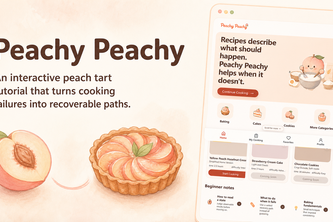
Peachy Peachy is a self-reported mobile-first interactive dessert guide designed for beginners. It models cooking as an interactive process with observable states and recovery actions, rather than a linear sequence. The system pauses at key recipe checkpoints to evaluate user observations and offers vetted recovery paths based on identified states.
What changed
The project was submitted as part of the OpenAI 2026 hackathon. It represents a prototype built over a short timeframe (Build Week) with a focus on demonstrating core functionality for two components of a French peach tart: dough and roasted peaches.
Single most important open question
Is there evidence that this concept can scale beyond a single demo or narrow use case, or does it remain limited to the specific scope described?
Note: This analysis is based entirely on the self-reported description provided by the authors. No independent verification, traction data, revenue figures, customer names, or third-party corroboration are available.
What The Product Actually Is
The description states that Peachy Peachy is a mobile-first interactive tutorial for making a French peach tart. It focuses on two critical parts of the recipe: tart dough and roasted peaches.
At key moments in the recipe, the tutorial pauses at checkpoints where users evaluate what they can observe. For example, it assesses whether the dough is firm and workable, too soft and sticky, or too cold and cracked.
Each recognized state connects to a vetted recovery response — such as full recovery, continuation with reduced quality, repurposing ingredients, or restarting when recovery is no longer responsible.
The demo includes hand-drawn illustrations and an animation showing the shallow press response of properly prepared dough.
Inference: The product appears to be a prototype built for demonstration purposes, not a production-ready service. It uses a closed-state system where AI classifies observations but does not generate new states or advice freely.
Positioning & Claim Evolution
The description claims that Peachy Peachy models cooking as an interactive process with observable states and recovery actions instead of a single linear sequence.
It positions itself around the idea that "a failed checkpoint should not be the end of a tutorial. It should become another designed path."
This suggests a shift from traditional recipe instruction to one that embraces failure as part of learning, offering structured guidance through unexpected outcomes.
Inference: The positioning reflects an attempt to solve a common problem in beginner cooking — lack of support during failures — by reimagining how tutorials behave when things go wrong. However, this is a self-described intent, not validated behavior or outcome.
Target Customer & ICP
The description states that Peachy Peachy targets beginners who struggle with recipes that don't account for real-world variability in ingredients and techniques.
It aims to help users identify common mistakes and follow verified recovery paths instead of abandoning the recipe.
Inference: The target customer is likely someone new to baking or cooking, particularly those who feel discouraged by failed attempts. However, no explicit segmentation or persona data is provided beyond this general characterization.
Business Model & Pricing Evidence
No evidence of pricing, monetization strategy, or business model is present in the description.
The project is described as a demo submitted for a hackathon and not as a commercial offering.
Finding: Not evidenced. No indication of how the product would be sold, priced, or funded beyond its development context.
Technical & Delivery Signals
The system separates into two layers:
- A closed set of checkpoints and observable state IDs.
- A curated knowledge manifest containing corresponding recovery nodes.
AI (MiniMax) classifies user observations; a local knowledge base provides guidance.
The application was built using React and TypeScript with a mobile-first interface.
It includes:
- An English demo path
- Integrated state media
- A root README with setup instructions and architecture documentation
- 30 passing automated tests
- A successful production build
Inference: The technical stack supports rapid prototyping and delivery, but there is no evidence of scalability, performance metrics, or long-term infrastructure planning.
Traction & Maturity Signals
There is no evidence of traction, adoption, or usage beyond the demo submission for a hackathon event.
The team size is listed as three members (Maren Vigneron, wei uou, Maka Draw).
No customer data, revenue figures, user feedback, or product metrics are reported.
Finding: Not evidenced. No signs of market traction or product maturity outside of the prototype phase.
Competitive Context
The description does not mention any competitors or direct substitutes.
It implies a niche in interactive cooking tutorials that account for failure states — but no comparison to existing tools or platforms is made.
Finding: Not evidenced. No competitive landscape or differentiation analysis provided.
Open Questions & Risks
- Limited scope: The demo focuses only on one dessert and two components, suggesting limited applicability.
- Closed-state design: While intended for safety, this may limit flexibility and scalability.
- No commercial viability: No evidence of monetization, pricing, or customer acquisition strategy.
- Dependency on human curation: Recovery paths are curated by humans, which could be a bottleneck at scale.
- Unproven market demand: No indication that users actually want or need this type of tool beyond the demo context.
Inference: The project lacks commercial readiness and appears to exist primarily as a proof-of-concept rather than a scalable product.
Questions the description leaves open
- How would you expand this concept beyond one dessert and two components?
- What are your plans for scaling the curated knowledge base?
- Have you tested the system with actual users, or is it based solely on internal assumptions?
- Is there a plan to move beyond the hackathon demo into a full product?
- How do you intend to monetize this tool if at all?
Overall Assessment
There is no evidence of traction, revenue, or commercial viability.
The project is described as a prototype built for a hackathon and not intended for production use.
Assessment: Not evidenced. No basis for investment or partnership consideration based on the provided information. The concept shows potential but lacks validation in real-world usage or business execution.
User Stories BotA demo video on every pull request
Get a demo video on every new feature
GitHub App that watches your pull requests and records a narrated, captioned demo.
Save time on demo prep and make informed decisions faster with a video walkthrough of every new feature.
Source
Submitted to the OpenAI 2026 hackathon on Devpost. Project home on Devpost. Back to the full gallery on Devpost.
This competitive analysis was produced by top-founders.com (opens in a new tab)
Generated by a language model from this project's public Devpost page — its tagline, the author's own write-up and any built-with tags listed there — as captured in August 2026. Short quotations are the author's words. It is an opinion on the idea as a business, not on the people behind it, and it reflects the description as published then. If the project has moved on, request a correction below. The analysis is not independent research and contains no verified traction, revenue or customer data.
An independent guide by KFG International LLC — not affiliated with, endorsed by, or connected to Devpost or OpenAI.