

Archive position — measured, not model output
0 likes on Devpost
2,263 of the 7,850 archived projects have more likes, and 5,587 share exactly 0 — so this project's #5,870 place in the like-ranked listing is a tie-break inside that group, not a ranking.
Projects (log scale)
Likes on Devpost. ▲ marks this project's group.
Show the figures
| Likes | Projects | Share of archive |
|---|---|---|
| 0 | 5,587 | 71.2% |
| 1 | 1,758 | 22.4% |
| 2 | 284 | 3.6% |
| 3–4 | 132 | 1.7% |
| 5–9 | 75 | 1.0% |
| 10+ | 14 | 0.2% |
 User Stories BotA demo video on every pull request
Get a demo video on every new feature
GitHub App that watches your pull requests and records a narrated, captioned demo.
Save time on demo prep and make informed decisions faster with a video walkthrough of every new feature.
Executive Summary
What the company appears to be
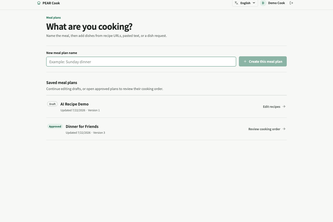
PEAR Cook is an AI-powered cooking assistant that helps users coordinate multiple dishes in a single meal, adapting to delays, limited equipment, and timing constraints. It allows users to import recipes from URLs or text, review and edit them, and generate a synchronized cooking plan designed to finish all dishes at the same time.
What changed
The project is a self-contained prototype built for the OpenAI 2026 hackathon. It includes a full-stack implementation using React, TypeScript, Cloudflare Workers, and Gemini AI, with support for voice guidance via Gemini Live and multi-language UI (Japanese/English). The author emphasizes that it is not a commercial product but a proof-of-concept.
Single most important open question
Is there evidence of user adoption or traction beyond the hackathon submission? The description does not indicate any revenue, customers, or usage metrics beyond its own self-reporting.
What The Product Actually Is
The description states that PEAR Cook is an AI cooking assistant designed to coordinate multiple dishes in a single meal. It enables users to:
- Import recipes from public URLs or paste text
- Describe dishes in natural language
- Provide ingredients, dietary restrictions, equipment constraints, and target serving time
- Review and edit extracted ingredients and instructions
- Ask AI to modify recipes (e.g., change serving size or remove ingredients)
- Generate a synchronized cooking plan that ensures all dishes finish at the same time
- Follow a focused “Do this now” interface during execution
- Use voice guidance from Gemini Live without compromising session durability
It is built on a Plan → Execute → Assess → Replan architecture, with durable execution sessions stored in Cloudflare D1 and R2.
Evidence
- The author describes the functionality in detail.
- The system uses structured inputs, AI interpretation, and deterministic domain rules.
- It separates AI-generated outputs from runtime state through typed events.
Inference The product is a prototype for a kitchen orchestration tool that integrates AI with human control.
Positioning & Claim Evolution
The author positions PEAR Cook as an assistant that reduces cognitive load during multi-dish cooking, not as a replacement for the cook’s judgment. It aims to make complex meal planning and execution more manageable by coordinating timelines and tasks.
Claims made
- Helps users plan and execute entire meals from start to finish.
- Reduces the need to switch between tabs, timers, or notes.
- Keeps the user fully in control while automating coordination logic.
- Uses AI to interpret recipes and generate structured plans.
- Provides hands-free voice guidance without making voice authoritative.
Evidence All claims are self-reported by the author and not independently verified.
Inference The positioning suggests a niche market for home cooks who want structured support during complex meals, rather than a broad consumer or enterprise solution.
Target Customer & ICP
The description does not explicitly define a target customer segment or ideal customer profile (ICP). However, the author implies that PEAR Cook is intended for individuals who cook multiple dishes simultaneously and value organization and coordination.
Claims made
- Designed for people who struggle with managing overlapping cooking timelines.
- Intended to reduce cognitive load during meal preparation.
- Supports both Japanese and English users.
Evidence No explicit customer personas or market segmentation data provided.
Inference The likely audience includes home cooks, especially those preparing elaborate meals or hosting gatherings. It may appeal to tech-savvy individuals familiar with tools like GitHub OAuth and AI assistants.
Business Model & Pricing Evidence
There is no evidence of a business model or pricing strategy in the description. The project was submitted as part of a hackathon and lacks any indication of monetization plans, subscriptions, or paid features.
Evidence
- No mention of revenue streams.
- No pricing information.
- No indication of commercial intent beyond prototype development.
Inference The system appears to be non-commercial at this stage. If it were to evolve into a product, the business model would likely involve either freemium or subscription-based access, but that is speculative.
Technical & Delivery Signals
The project uses modern web technologies including:
- Frontend: React + shadcn/ui
- Backend: Cloudflare Workers (API hosting), D1 (database), R2 (storage)
- AI integration: Gemini for recipe interpretation and plan generation
- Authentication: GitHub OAuth with PKCE
- Voice assistance: Gemini Live
- Localization: Japanese and English UI support
Evidence
- The author lists all technical components.
- The system is described as having a layered architecture with clear separation of concerns.
Inference The tech stack indicates a scalable, serverless approach suitable for rapid iteration. The use of durable objects and typed events suggests robustness in handling concurrent sessions.
Traction & Maturity Signals
There is no evidence of traction or maturity beyond the hackathon submission. No users, customers, or usage data are mentioned.
Evidence
- The project was submitted to a hackathon.
- No mention of active users, downloads, or engagement metrics.
- No production deployment details beyond local development and Cloudflare resources.
Inference This is a prototype with no demonstrated market traction. It has not moved past the experimental phase.
Competitive Context
The description does not provide any information about competitors or competitive positioning. There is no mention of existing solutions in the space of AI-coordinated cooking or meal planning tools.
Evidence
- No competitor analysis.
- No reference to similar products or services.
Inference It's unclear whether PEAR Cook addresses a gap in the market or competes with existing tools. The author does not discuss alternatives or differentiation strategies.
Open Questions & Risks
Several risks and open questions are present based on the self-reported nature of the description:
- No commercial traction or revenue: As a hackathon project, it lacks any evidence of real-world adoption.
- Unproven AI reliability: The system treats AI output as a proposal rather than trusted state, which is good design but implies that AI accuracy may be variable.
- Limited scalability assumptions: The architecture assumes single-user sessions and does not address multi-user collaboration or large-scale use cases.
- Self-reported security fixes: The author mentions fixing an open redirect vulnerability, suggesting potential security gaps in early versions.
- No monetization strategy: No indication of how the product would generate value or revenue.
Evidence
- All points are based on self-reporting and lack external validation.
Questions the description leaves open
- What is your plan for transitioning from a hackathon prototype to a viable product?
- Have you tested PEAR Cook with real users beyond the development phase?
- How do you intend to scale this system for more complex or collaborative cooking scenarios?
- What are the key assumptions about user behavior and AI performance that underpin the current design?
- Are there any known limitations in how well the AI interprets recipes from different sources?
- How would you handle situations where a dish fails or needs replanning mid-execution?
Overall Assessment
At this stage, PEAR Cook is a hackathon prototype with no demonstrated traction, revenue, or customer base. While it shows promising technical execution and thoughtful design around AI integration and user control, there is insufficient evidence to support an investment or partnership decision.
Confidence level Low
Reasoning
The description is entirely self-reported and lacks any external validation, usage data, or commercial indicators. It remains a conceptual prototype with no clear path to market traction or monetization.
Conclusion
This project does not meet the criteria for due-diligence evaluation as a business opportunity at this time. Further evidence of user adoption, product-market fit, or commercial viability would be required before considering deeper analysis.
User Stories BotA demo video on every pull request
Get a demo video on every new feature
GitHub App that watches your pull requests and records a narrated, captioned demo.
Save time on demo prep and make informed decisions faster with a video walkthrough of every new feature.
Source
Submitted to the OpenAI 2026 hackathon on Devpost. Project home on Devpost. Back to the full gallery on Devpost.
This competitive analysis was produced by top-founders.com (opens in a new tab)
Generated by a language model from this project's public Devpost page — its tagline, the author's own write-up and any built-with tags listed there — as captured in August 2026. Short quotations are the author's words. It is an opinion on the idea as a business, not on the people behind it, and it reflects the description as published then. If the project has moved on, request a correction below. The analysis is not independent research and contains no verified traction, revenue or customer data.
An independent guide by KFG International LLC — not affiliated with, endorsed by, or connected to Devpost or OpenAI.