

Archive position — measured, not model output
0 likes on Devpost
2,263 of the 7,850 archived projects have more likes, and 5,587 share exactly 0 — so this project's #5,871 place in the like-ranked listing is a tie-break inside that group, not a ranking.
Projects (log scale)
Likes on Devpost. ▲ marks this project's group.
Show the figures
| Likes | Projects | Share of archive |
|---|---|---|
| 0 | 5,587 | 71.2% |
| 1 | 1,758 | 22.4% |
| 2 | 284 | 3.6% |
| 3–4 | 132 | 1.7% |
| 5–9 | 75 | 1.0% |
| 10+ | 14 | 0.2% |
 User Stories BotA demo video on every pull request
Get a demo video on every new feature
GitHub App that watches your pull requests and records a narrated, captioned demo.
Save time on demo prep and make informed decisions faster with a video walkthrough of every new feature.
Executive Summary
Company: Pebble Pills
Self-reported basis: The description is entirely self-reported and unverified, based on a Devpost submission by Michael Tomkins for the OpenAI 2026 hackathon. No independent evidence of revenue, customers, traction or operational data exists.
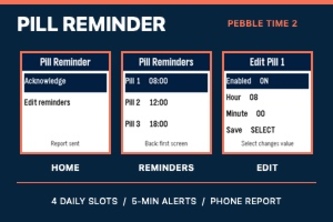
What it appears to be: A minimal, local-first medication reminder application built for the Pebble Time 2 smartwatch, designed around explicit user actions (Taken/Skipped/No response) and physical button interaction. It is not a medical system, nor does it connect to any backend or analytics service.
What changed: The project was developed as a hackathon submission under GPT-5.6-Sol controller using t3 code harness, with deployment via a forkflow to the pebble app store. No prior version or evolution is described.
Single most important open question: Is there any evidence of real-world usage or user feedback beyond the author’s own account?
What The Product Actually Is
- The description states that Pebble Pills is a medication reminder application for the Pebble Time 2 smartwatch, written in C and JavaScript.
- It supports up to four daily reminders, with follow-up vibrations at 60, 90, and 120 minutes if not responded to.
- The watch app uses Pebble SDK targeting the Pebble Time 2 emery platform.
- The phone side uses PebbleKit JS and TypeScript, transferring data through AppMessage.
- It includes local-only reporting (today, 7-day, 30-day history) without backend or analytics services.
- Outcomes are self-reported: Taken, Skipped, or No response; no medical advice or dosage record is provided.
Note: The author states this is a hackathon project built in a short timeframe. There is no evidence of commercial product, ongoing development, or user adoption beyond the submission.
Positioning & Claim Evolution
- The author positions Pebble Pills as a reminder that stays useful without pretending to be a medical system.
- It emphasizes explicitness, reliability, and privacy: users explicitly choose Taken/Skipped/No response, and outcomes are not shared or analyzed.
- The app is described as intentionally narrow in scope — not a full health platform.
- The author claims the product was designed to avoid phone notification fatigue by leveraging the always-available physical buttons of the Pebble watch.
Inference: The positioning reflects an intent to build a lightweight, privacy-preserving tool for personal use rather than a commercial or scalable solution. No evidence of prior positioning or evolution in messaging is provided.
Target Customer & ICP
- The description states that the app targets users who want reliable medication reminders that do not rely on phone notifications.
- It is designed for people who may be on-the-go, where a watch is more accessible than a phone.
- The product is built for Pebble Time 2 users, implying a niche audience with specific hardware.
Note: No evidence of customer segmentation, user personas, or target market size is provided. The author does not describe any actual users beyond themselves.
Business Model & Pricing Evidence
- There is no evidence of a business model or pricing structure.
- The app is described as local-only, with no backend, analytics, or monetization features.
- It is built for personal use, not for sale or distribution via a marketplace or subscription.
Inference: The product appears to be a personal tool, not a commercial offering. No revenue model or pricing data is evident.
Technical & Delivery Signals
- Built in C (watch side) and JavaScript/TypeScript (phone side).
- Uses Pebble SDK, PebbleKit JS, and AppMessage for communication.
- Includes automated tests, GitHub Actions workflow, and release automation to the rePebble app store.
- The system uses persistent storage, rolling wakeups, and sequence identifiers to manage state transitions.
- The app is designed to work within hardware constraints of the Pebble Time 2.
Note: No evidence of scalability, performance metrics, or production-grade infrastructure is provided. This is a hackathon project with no commercial deployment history.
Traction & Maturity Signals
- The project is described as a hackathon submission, not a product in active use.
- There is no evidence of downloads, user feedback, or adoption beyond the author’s own account.
- No mention of any user testing, feedback loops, or product iteration.
Inference: The app has no traction. It is a prototype, not a mature product.
Competitive Context
- The description does not mention competitors or similar products.
- No evidence of market analysis, competitive positioning, or differentiation from other reminder apps is provided.
- The app is built for a specific hardware platform (Pebble Time 2), which is no longer in production.
Note: No competitive landscape or market context is described. The author does not reference existing solutions or platforms.
Open Questions & Risks
- The project is a hackathon prototype, not a commercial product.
- It targets a discontinued hardware platform (Pebble Time 2), which may limit long-term viability.
- No evidence of user feedback, testing, or iteration beyond the author’s own experience.
- The app is local-only, with no backend or analytics — this limits scalability and data-driven improvements.
- The author states that the hardest part was working within hardware constraints; this suggests a limited scope and potential usability issues in real-world use.
Inference: The risk of commercial failure is high due to lack of traction, outdated platform, and no evidence of user adoption or feedback.
Questions the description leaves open
- What was the motivation for choosing the Pebble Time 2 over other platforms?
- Have you tested this app with real users beyond yourself?
- How do you plan to scale or evolve this product if it gains traction?
- Is there any intention to move away from local-only storage and add backend features?
- What is your long-term vision for the product, and how does it align with current market needs?
Overall Assessment
- Not evidenced — No financials, revenue, or customer data are provided.
- The project is a self-contained hackathon prototype, not a commercial venture.
- It lacks any evidence of traction, scalability, or product-market fit.
- The author states that the app is built for personal use and does not connect to any backend or analytics service.
Assessment: This is not a viable investment or partnership opportunity at this stage. It is a proof-of-concept with no commercial evidence or user feedback.
User Stories BotA demo video on every pull request
Get a demo video on every new feature
GitHub App that watches your pull requests and records a narrated, captioned demo.
Save time on demo prep and make informed decisions faster with a video walkthrough of every new feature.
Source
Submitted to the OpenAI 2026 hackathon on Devpost. Project home on Devpost. Back to the full gallery on Devpost.
This competitive analysis was produced by top-founders.com (opens in a new tab)
Generated by a language model from this project's public Devpost page — its tagline, the author's own write-up and any built-with tags listed there — as captured in August 2026. Short quotations are the author's words. It is an opinion on the idea as a business, not on the people behind it, and it reflects the description as published then. If the project has moved on, request a correction below. The analysis is not independent research and contains no verified traction, revenue or customer data.
An independent guide by KFG International LLC — not affiliated with, endorsed by, or connected to Devpost or OpenAI.