

Archive position — measured, not model output
0 likes on Devpost
2,263 of the 7,850 archived projects have more likes, and 5,587 share exactly 0 — so this project's #5,869 place in the like-ranked listing is a tie-break inside that group, not a ranking.
Projects (log scale)
Likes on Devpost. ▲ marks this project's group.
Show the figures
| Likes | Projects | Share of archive |
|---|---|---|
| 0 | 5,587 | 71.2% |
| 1 | 1,758 | 22.4% |
| 2 | 284 | 3.6% |
| 3–4 | 132 | 1.7% |
| 5–9 | 75 | 1.0% |
| 10+ | 14 | 0.2% |
 User Stories BotA demo video on every pull request
Get a demo video on every new feature
GitHub App that watches your pull requests and records a narrated, captioned demo.
Save time on demo prep and make informed decisions faster with a video walkthrough of every new feature.
Executive Summary
What the company appears to be
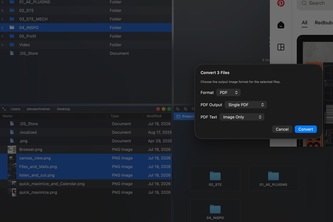
Peaker (Better Finder for Mac) is a self-reported desktop productivity tool for macOS that aims to improve file management, conversion, renaming, and project organization by integrating multiple functions into a single interface. The author describes it as an enhanced Finder with additional capabilities such as AI-powered batch renaming, video editing, browser integration, email viewing, and canvas-style moodboarding.
What changed
The project is presented as a personal tool developed over three months by one individual (Steve Schreiner), who claims to use it daily and cannot live without it. It was submitted to the OpenAI 2026 hackathon on Devpost.
Single most important open question
Is there evidence of actual user adoption or commercial traction beyond the author’s personal usage?
What The Product Actually Is
The description states that Peaker is a macOS application built using AppKit, SwiftUI, WKWebView, and PDFKit. It includes features such as:
- A customizable file window (a "highly customizable finder version")
- Browser integration for project-related links
- Canvas view for moodboards and note organization
- Previewer with video editing capabilities (cutting, LUTs, Log footage)
- Email viewer that can function as an email client or quickmail tool
- AI pane with access to browser and file views
- Calendar integration
The author claims it allows users to open different projects with specific window arrangements, convert files via right-click using ffmpeg, rename files using AI (via Ollama), and organize work across multiple tools in one place.
Evidence Self-reported by the author; no independent verification or screenshots provided.
Positioning & Claim Evolution
The author positions Peaker as a replacement for the standard macOS Finder, claiming that current OS tools feel like "quicksand" and lack functionality for users with specific needs. The tagline emphasizes finding, converting, and changing files in one place.
Key claims include:
- Solves the need to manage multiple windows and websites
- Offers batch renaming using AI without internet
- Provides a unified workspace for file management, browsing, note-taking, and email
Evidence Self-reported; no external validation or market positioning data available.
Target Customer & ICP
The description does not explicitly define target customers or ideal customer profiles (ICP). However, the author implies that Peaker is aimed at individuals who work with files regularly and need more than what the default Finder offers. The tool seems tailored for professionals or power users working on multimedia projects, content creation, or complex workflows involving multiple tools.
Evidence Inferred from self-description; no explicit customer segmentation or persona data provided.
Business Model & Pricing Evidence
There is no mention of pricing, monetization strategy, or business model in the description. The author does not state whether Peaker will be sold, offered free, or used internally.
Evidence Not evidenced.
Technical & Delivery Signals
The project was built using:
- AppKit
- macOS native frameworks
- PDFKit
- SwiftUI
- WKWebView
- ffmpeg (for file conversion)
- Ollama (for AI renaming)
It is described as being tested via Codex and personally used by the developer for three months. The author notes challenges related to debugging and maintaining design consistency.
Evidence Self-reported; no delivery timeline, release date, or technical architecture details beyond framework usage.
Traction & Maturity Signals
The author states they have been using Peaker daily for three months and cannot live without it. There is no evidence of:
- User base
- Revenue
- Customer feedback
- Product adoption metrics
- Public availability or distribution channels
Evidence Not evidenced.
Competitive Context
No information is provided about competitors or the broader market landscape. The author does not reference existing tools like Alfred, Keyboard Maestro, or other macOS productivity suites.
Evidence Not evidenced.
Open Questions & Risks
- Single-person development: Only one team member (Steve Schreiner) is mentioned.
- No commercial traction: No evidence of users, revenue, or adoption beyond personal use.
- Unverified claims: All statements are self-reported and unverifiable.
- Limited scope for scalability: The tool appears to be a personal solution rather than a scalable product.
- Dependency on local AI models: Uses Ollama, which may limit accessibility or performance.
Evidence Inferred from lack of data; no independent confirmation of these points.
Questions the description leaves open
- What specific workflows does Peaker address that existing tools do not?
- How many users are currently using Peaker beyond the founder?
- Is there a plan for monetization or distribution beyond personal use?
- What is the long-term roadmap for the product, and how does it scale beyond one developer?
- Are there any technical dependencies (e.g., Ollama) that could hinder adoption or performance?
Overall Assessment
At this stage, Peaker appears to be a personal tool developed by one individual with no evidence of commercial traction, revenue, or user base. The author's claims about functionality and utility are self-reported and unverified.
Confidence Level Low — based on minimal evidence.
Assessment Not ready for investment or partnership consideration without further proof of market demand, user adoption, or product-market fit.
User Stories BotA demo video on every pull request
Get a demo video on every new feature
GitHub App that watches your pull requests and records a narrated, captioned demo.
Save time on demo prep and make informed decisions faster with a video walkthrough of every new feature.
Source
Submitted to the OpenAI 2026 hackathon on Devpost. Project home on Devpost. Back to the full gallery on Devpost.
This competitive analysis was produced by top-founders.com (opens in a new tab)
Generated by a language model from this project's public Devpost page — its tagline, the author's own write-up and any built-with tags listed there — as captured in August 2026. Short quotations are the author's words. It is an opinion on the idea as a business, not on the people behind it, and it reflects the description as published then. If the project has moved on, request a correction below. The analysis is not independent research and contains no verified traction, revenue or customer data.
An independent guide by KFG International LLC — not affiliated with, endorsed by, or connected to Devpost or OpenAI.