

Archive position — measured, not model output
1 like on Devpost
505 of the 7,850 archived projects have more likes, and 1,758 share exactly 1 — so this project's #1,944 place in the like-ranked listing is a tie-break inside that group, not a ranking.
Projects (log scale)
Likes on Devpost. ▲ marks this project's group.
Show the figures
| Likes | Projects | Share of archive |
|---|---|---|
| 0 | 5,587 | 71.2% |
| 1 | 1,758 | 22.4% |
| 2 | 284 | 3.6% |
| 3–4 | 132 | 1.7% |
| 5–9 | 75 | 1.0% |
| 10+ | 14 | 0.2% |
 User Stories BotA demo video on every pull request
Get a demo video on every new feature
GitHub App that watches your pull requests and records a narrated, captioned demo.
Save time on demo prep and make informed decisions faster with a video walkthrough of every new feature.
Executive Summary
What the company appears to be
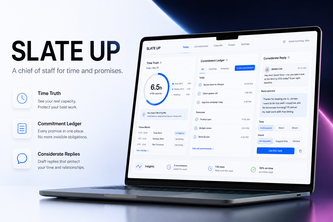
SLATE UP is a self-reported personal planning and time management tool built for individuals who want to protect commitments and avoid invisible tradeoffs in their schedules. It integrates with Google Calendar and Gmail, uses AI to assess capacity and make decisions about new requests, and ensures that actions are reviewable and reversible.
What changed
The project description indicates a focus on integrity over inbox zero, emphasizing commitment protection rather than task completion. It positions itself as an executive-level interaction tool where users can speak to the system, ask it to plan or protect time, and see changes reflected in their planner.
Single most important open question — the commercial due-diligence read
Is there evidence of a real user base or product-market fit beyond the author’s own development experience? The description does not indicate any revenue, customers, or adoption metrics. It is unclear whether this is a prototype, a proof-of-concept, or an early-stage product with traction.
What The Product Actually Is
The description states that SLATE UP:
- Captures a day from natural-language planning, Google Calendar, Gmail, or manual tasks.
- Builds “Time Truth,” which accounts for remaining work window, energy, and already committed work.
- Opens “Decision Mode” when the user asks whether a request fits, returning a clear yes, no, or conditional answer with named tradeoffs.
- Creates a reviewable Gmail draft that does not send until explicitly accepted.
- Recovers slipped work by carrying it forward instead of fabricating late-night plans.
- Learns from estimate checks to improve future planning.
It is described as a personal time management tool that uses AI for decision-making and integrates with Google services. It includes features like:
- Voice support via Gemini Live
- Text-based planning using Gemma or GPT-5.6 (via Codex)
- Server-side calendar mutations to avoid browser OAuth token issues
- Encrypted refresh-token storage for Gmail and Calendar
Inference The product appears to be a personal assistant-style tool focused on integrity in scheduling, not just task tracking.
Positioning & Claim Evolution
The description states:
- “Calendars know when we are booked. To-do lists know what exists. Neither answers the question that matters in the moment: If I say yes to this, what promise am I quietly breaking?”
- “Slate Up was built to answer that question honestly, then help the user act with care.”
- “Integrity over inbox zero: Slate protects commitments, not just task counts.”
- “No-fiction recovery: it refuses to make an impossible day look organized.”
These claims suggest a shift from traditional productivity tools toward a more ethical and transparent approach to time management — one that prioritizes honesty about capacity and commitment.
Inference SLATE UP positions itself as a tool for people who value integrity in their schedules, especially those under pressure to say yes to everything but want to avoid overcommitting.
Target Customer & ICP
The description does not explicitly name target customers or define an ideal customer profile (ICP). However, it implies:
- Users who struggle with invisible tradeoffs and overcommitment.
- People who rely heavily on Google Calendar and Gmail for planning.
- Individuals seeking a more respectful autonomy in how they manage time.
Inference The ICP likely includes professionals or students who are overwhelmed by competing demands and want to maintain control over their commitments without sacrificing honesty.
Business Model & Pricing Evidence
There is no evidence of pricing, monetization strategy, or business model in the description. The author does not mention:
- Revenue streams
- Subscription tiers
- Freemium models
- B2B vs B2C targeting
- Any commercial partnerships or sales channels
Not evidenced
Technical & Delivery Signals
The description states that SLATE UP was built with:
- React + Vite for UI
- Express.js on Vercel for backend routes
- Firebase Authentication and Firestore for identity/state
- Google OAuth with encrypted refresh tokens
- Gemini Live, Gemma, and optional NVIDIA-hosted text path for AI processing
- Server-authorized calendar mutations to prevent browser-based OAuth issues
It also mentions:
- Use of Codex (powered by GPT-5.6) during development
- Structured parsing and deterministic fallbacks for AI responses
- Demo Mode that tells the complete product story without touching real systems
Inference The technical stack suggests a modern, cloud-native SaaS-like architecture with strong emphasis on security, reliability, and user control.
Traction & Maturity Signals
There is no evidence of:
- Revenue or ARR
- Customer base or adoption metrics
- Product usage data
- Market traction or growth indicators
- Any form of monetization or paid features
The description notes that this was submitted to the OpenAI 2026 hackathon, and includes a public repository with build checks and deployment-ready configuration.
Not evidenced
Competitive Context
The description does not reference competitors or market positioning relative to existing tools. It does not mention:
- Direct competitors (e.g., Notion, Todoist, Calendly, Time Doctor)
- Market size or competitive landscape
- Differentiation from similar offerings
Not evidenced
Open Questions & Risks
Key risks and open questions based on the self-reported description:
- No evidence of traction or revenue: This is a prototype or early-stage product with no commercial validation.
- Unproven user base: No mention of users, customers, or feedback loops beyond author’s own experience.
- Unclear scalability: The tool appears to be designed for individual use; unclear if it supports team or organizational features.
- AI dependency without clear fallbacks in production: While structured parsing and deterministic fallbacks are mentioned, the risk remains that AI performance may degrade under load or edge cases.
- Limited integration depth: Integration with Google services is described but not elaborated on — how deep is the sync?
Inference This appears to be a personal project or hackathon submission with no known commercial traction. It lacks evidence of product-market fit or scalable business model.
Questions the description leaves open
- What is your current user base, if any? Have you tested this tool with real users?
- How do you plan to monetize SLATE UP? Is there a pricing model or revenue strategy in place?
- Can you walk us through how the AI decision-making works in practice — especially in edge cases?
- What are your plans for expanding beyond individual use into team or organizational settings?
- How does SLATE UP handle data privacy and compliance, particularly with Google OAuth and user data storage?
- Are there any known limitations or blind spots in the current version that could affect usability?
Overall Assessment
Assessment SLATE UP is a self-reported personal time management tool built for individuals who want to protect commitments and avoid invisible tradeoffs. It integrates with Google services, uses AI for decision-making, and emphasizes integrity and autonomy in scheduling.
However, the description provides no evidence of:
- Revenue or ARR
- Customers or adoption metrics
- Product-market fit
- Commercial viability
It is unclear whether this is a prototype, a hackathon project, or an early-stage product with traction. The author’s own account does not substantiate any commercial activity beyond personal development.
Confidence level Low — based solely on self-reported description, with no external corroboration.
Investment/Partnership recommendation
Not suitable for investment or partnership at this stage without further evidence of traction, revenue, or customer validation. The product shows potential but lacks demonstrated commercial viability.
User Stories BotA demo video on every pull request
Get a demo video on every new feature
GitHub App that watches your pull requests and records a narrated, captioned demo.
Save time on demo prep and make informed decisions faster with a video walkthrough of every new feature.
Source
Submitted to the OpenAI 2026 hackathon on Devpost. Project home on Devpost. Back to the full gallery on Devpost.
This competitive analysis was produced by top-founders.com (opens in a new tab)
Generated by a language model from this project's public Devpost page — its tagline, the author's own write-up and any built-with tags listed there — as captured in August 2026. Short quotations are the author's words. It is an opinion on the idea as a business, not on the people behind it, and it reflects the description as published then. If the project has moved on, request a correction below. The analysis is not independent research and contains no verified traction, revenue or customer data.
An independent guide by KFG International LLC — not affiliated with, endorsed by, or connected to Devpost or OpenAI.