

Archive position — measured, not model output
0 likes on Devpost
2,263 of the 7,850 archived projects have more likes, and 5,587 share exactly 0 — so this project's #5,835 place in the like-ranked listing is a tie-break inside that group, not a ranking.
Projects (log scale)
Likes on Devpost. ▲ marks this project's group.
Show the figures
| Likes | Projects | Share of archive |
|---|---|---|
| 0 | 5,587 | 71.2% |
| 1 | 1,758 | 22.4% |
| 2 | 284 | 3.6% |
| 3–4 | 132 | 1.7% |
| 5–9 | 75 | 1.0% |
| 10+ | 14 | 0.2% |
 User Stories BotA demo video on every pull request
Get a demo video on every new feature
GitHub App that watches your pull requests and records a narrated, captioned demo.
Save time on demo prep and make informed decisions faster with a video walkthrough of every new feature.
Executive Summary
What the company appears to be
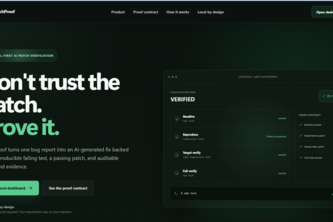
PatchProof is a self-reported local developer tool that aims to provide independent command evidence for AI-generated code repairs. It positions itself as a reliability layer around agent-generated patches by separating model work from command-backed proof, requiring repositories to prove their own repair through a series of verifiable steps.
What changed
The project description indicates a deliberate shift away from generic autonomous bug fixers toward a system that demands reproducible evidence before accepting any AI-generated patch. It introduces a structured lifecycle with four proof conditions and enforces isolation via Git worktrees and Docker containers.
Single most important open question — the commercial due-diligence read
Is there a meaningful market need for this specific type of verification tool, or is it an experimental prototype that has not yet demonstrated adoption or traction?
What The Product Actually Is
The description states that PatchProof is a local developer tool designed to turn one actionable bug report into a repair with reproducible evidence. It operates on trusted local Git repositories and uses AI (specifically GPT-5.6 Sol) for diagnosis, test design, and patch generation.
Key operational elements include:
- Use of Git worktrees for source isolation.
- Execution within Docker containers to enforce bounded environments.
- A state machine that separates lifecycle stages from proof outcomes.
- Independent verification of regression tests before and after patch application.
- Preservation of command results, logs, diffs, checksums, and structured manifests as evidence.
It does not claim universal language support or arbitrary monorepo handling; instead, it supports specific ecosystems with built-in profiles (Node.js/TypeScript, Python, Go, browser workflows) and restricts custom verification profiles to prevent arbitrary execution.
Inference The tool appears to be a developer-focused reliability layer, not an enterprise-grade CI/CD or deployment system. It is self-contained and requires local access to repositories, Docker, and Git.
Positioning & Claim Evolution
The author claims that PatchProof addresses a gap in AI coding agents: while they can produce convincing patches and explanations, those explanations come from the same system that authored the patch — not independent evidence.
They state:
- The tool treats an AI-generated repair as an untrusted candidate until the repository itself proves it.
- It deliberately rejects simpler versions of autonomous bug fixers.
- Its core value proposition is to separate model work from command-backed proof.
The positioning evolves from a general idea ("What if the patch had to prove itself?") into a concrete implementation with explicit verification conditions and architectural constraints.
Inference This is a conceptual evolution rather than a market-driven product. The author emphasizes trust boundaries and reproducibility over scalability or automation.
Target Customer & ICP
The description indicates that PatchProof targets local developers working in supported ecosystems, who want to validate AI-generated code changes before applying them.
It supports:
- Node.js/TypeScript projects using npm, pnpm, or Yarn;
- Standard Python projects using pip and pytest;
- Go modules with official container workflow;
- Browser bugs in Node applications using Playwright.
The tool requires local access to Git, Docker, and Codex authentication. It does not support:
- Arbitrary monorepos;
- Private Go modules;
- Poetry or Conda;
- CGO;
- Unbounded browser verification outside accepted Node capabilities.
Inference The ICP (Ideal Customer Profile) is likely small teams or individual developers in tech stacks with built-in support, who are concerned about the reliability of AI-generated patches and want to validate them locally before merging.
Business Model & Pricing Evidence
There is no evidence provided regarding pricing, monetization strategy, or business model. The description focuses entirely on technical architecture and functionality.
Not evidenced
Technical & Delivery Signals
The tool is built using:
- Frontend: React + Vite
- Backend: Fastify API
- Core Logic: TypeScript workspace with shared Zod contracts
- Execution Environment: Git worktrees, Docker containers
- AI Integration: GPT-5.6 Sol via OpenAI Codex SDK
Key technical signals:
- No cloud or hosted components; all verification happens locally.
- Artifacts are stored in local directories, not databases.
- Server-Sent Events stream updates to UI during execution.
- External commands never use interpolated shell strings; arguments passed separately.
- Profiles are normalized and SHA-256 hashed for security.
- Custom profiles are restricted to allowlisted runtimes and commands.
Inference The delivery model is local-first, with no cloud infrastructure or SaaS components. This suggests a developer tooling product, not a service or platform.
Traction & Maturity Signals
There is no evidence of revenue, customers, user base, or adoption metrics beyond the author's own account.
The project was submitted to the OpenAI 2026 hackathon and includes:
- A demo view with sample workflows.
- A public Vercel site as a showcase, but not a verifier.
- Development logs that record failures rather than hiding them.
Not evidenced
Competitive Context
No mention of competitors or competitive landscape is provided in the description. The author does not reference existing tools for AI code repair, verification, or developer tooling ecosystems.
Not evidenced
Open Questions & Risks
- Local-only execution: This limits scalability and adoption unless developers are willing to run it locally.
- Limited ecosystem support: Only specific languages and frameworks are supported, with custom profiles restricted.
- No monetization strategy: No indication of how the tool will be monetized or whether it’s intended for commercial use.
- High technical complexity: Requires deep understanding of Git, Docker, and CI/CD processes.
- Unproven market demand: No evidence of traction, users, or customer feedback.
Inference This is likely an experimental prototype, not a mature product with a clear path to market traction or commercial viability.
Questions the description leaves open
- What are the actual use cases driving interest in this tool? Is there any feedback from developers?
- How does PatchProof plan to expand beyond its current supported ecosystems without weakening trust boundaries?
- Are there plans for cloud-based features or integrations with CI/CD pipelines?
- What is the long-term vision for monetization or product development?
- Has the tool been tested in real-world environments, and what were the results?
Overall Assessment
The description presents PatchProof as a self-contained developer tool focused on reliability and reproducibility of AI-generated code changes. It is not evident that it has achieved any traction, revenue, or customer adoption.
It appears to be an experimental prototype, possibly developed for a hackathon, with no clear commercialization path or evidence of market demand.
Assessment Not evidenced as a viable investment or partnership opportunity at this stage. The tool lacks demonstrated traction and business model clarity. It may evolve into something valuable, but based on the provided description alone, it is not ready for due diligence beyond conceptual review.
User Stories BotA demo video on every pull request
Get a demo video on every new feature
GitHub App that watches your pull requests and records a narrated, captioned demo.
Save time on demo prep and make informed decisions faster with a video walkthrough of every new feature.
Source
Submitted to the OpenAI 2026 hackathon on Devpost. Project home on Devpost. Back to the full gallery on Devpost.
This competitive analysis was produced by top-founders.com (opens in a new tab)
Generated by a language model from this project's public Devpost page — its tagline, the author's own write-up and any built-with tags listed there — as captured in August 2026. Short quotations are the author's words. It is an opinion on the idea as a business, not on the people behind it, and it reflects the description as published then. If the project has moved on, request a correction below. The analysis is not independent research and contains no verified traction, revenue or customer data.
An independent guide by KFG International LLC — not affiliated with, endorsed by, or connected to Devpost or OpenAI.