

Archive position — measured, not model output
0 likes on Devpost
2,263 of the 7,850 archived projects have more likes, and 5,587 share exactly 0 — so this project's #5,810 place in the like-ranked listing is a tie-break inside that group, not a ranking.
Projects (log scale)
Likes on Devpost. ▲ marks this project's group.
Show the figures
| Likes | Projects | Share of archive |
|---|---|---|
| 0 | 5,587 | 71.2% |
| 1 | 1,758 | 22.4% |
| 2 | 284 | 3.6% |
| 3–4 | 132 | 1.7% |
| 5–9 | 75 | 1.0% |
| 10+ | 14 | 0.2% |
 User Stories BotA demo video on every pull request
Get a demo video on every new feature
GitHub App that watches your pull requests and records a narrated, captioned demo.
Save time on demo prep and make informed decisions faster with a video walkthrough of every new feature.
Executive Summary
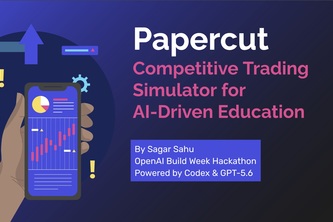
What the company appears to be: Papercut is a multiplayer trading simulator built as a self-contained web application. The product allows users to create or join private rooms with friends, compete using $1M virtual capital, and receive AI-generated debriefs after each challenge ends.
What changed: The author states that this project was submitted to the OpenAI 2026 hackathon. It is not evident whether this represents a new product launch, an iteration of prior work, or a prototype.
The single most important open question: Is there evidence of any traction, revenue, or customer adoption beyond the author's own development and self-reported use case?
What The Product Actually Is
The description states that Papercut is a multiplayer trading simulator where users compete using $1M virtual capital in private rooms. Users can:
- Create or join private trading rooms
- Invite friends with shareable codes
- Browse crypto assets and place simulated buy/sell orders
- Track holdings, performance, and compare results on a room leaderboard
After a room closes, an AI coach reviews each player’s trade history, portfolio composition, cash balance, and performance to generate a private debrief. The AI does not provide real-time signals or advice but delivers daily educational insights.
The system is built using:
- Frontend: Next.js, React, TypeScript, Tailwind CSS, Framer Motion, Recharts
- Backend: Supabase (authentication, storage), Postgres, server-side routes
- AI integration: GPT-5.6 (via codex, coingecko-api, coinmarketcap, nvidia-nim)
- Hosting: Vercel
Inference: The product is a full-stack web application designed for educational use in simulated investing environments.
Positioning & Claim Evolution
The author claims that Papercut addresses the gap between traditional investing education and experiential learning. It aims to:
- Add a feedback loop to paper-trading apps
- Make trading more social and competitive
- Turn simulated trades into concrete lessons about sizing, concentration, exits, and emotional decision-making
It positions itself as an educational tool rather than a financial advice platform.
Inference: The positioning reflects a shift from passive learning (e.g., videos or articles) to active simulation with structured reflection. It is not evident whether this was the original intent or evolved during development.
Target Customer & ICP
The description states that Papercut targets:
- Students
- Early-career professionals
- Friend groups
It is designed for people who want to experiment with investing without risking real money, and who benefit from peer competition and structured feedback.
Inference: The target customer segment appears to be individuals interested in financial literacy or beginner-level trading education. No evidence of specific personas, market segmentation, or user acquisition strategies is provided.
Business Model & Pricing Evidence
The description does not provide any information about:
- Revenue streams
- Pricing models
- Monetization strategy
- Paid features or tiers
Not evidenced: There is no indication that Papercut has a business model beyond its current prototype form.
Technical & Delivery Signals
The product is built as a full-stack Next.js application, with:
- React and TypeScript frontend
- Supabase for authentication, data storage, and multiplayer logic
- Server-side processing for trade execution, portfolio calculations, and AI debrief generation
- Structured AI prompts sent to GPT-5.6
- Deterministic fallback for AI failures
The system includes:
- Private room lifecycle management (host/member roles, invite flows)
- Simulated trades with market data integration
- Portfolio reconstruction from trade records and price snapshots
- Visualizations using Recharts
Inference: The technical architecture shows a deliberate effort to ensure data integrity and user privacy. The AI coach is designed to be non-prescriptive and grounded in actual behavior.
Traction & Maturity Signals
The description states that the project was submitted to the OpenAI 2026 hackathon, but there is no evidence of:
- Revenue
- Customers
- User adoption
- Product usage metrics
- Market traction beyond the author’s own development
Not evidenced: No data on user engagement, retention, or product maturity beyond prototype status.
Competitive Context
The description does not mention any competitors. It also does not provide context about:
- Existing paper-trading platforms
- AI-powered financial education tools
- Social trading or multiplayer investment apps
Not evidenced: No competitive landscape analysis is present in the self-reported description.
Open Questions & Risks
- No revenue or monetization model: The product appears to be a prototype with no clear path to profitability.
- Single-founder development: Only one team member (Sagar Sahu) is listed, which may limit scalability and execution capacity.
- Unverified AI claims: The description refers to GPT-5.6, but there is no evidence of model performance or validation.
- No customer data or feedback loops: No evidence of user testing, feedback, or product iteration beyond the author’s own experience.
- Limited market positioning: The product lacks clarity on how it differentiates from existing educational tools or trading simulators.
Inference: These risks are based on the absence of evidence for key commercial and technical milestones.
Questions the description leaves open
- What is the intended path to monetization?
- Have you tested the product with users outside of your own development circle?
- How do you plan to scale beyond a single developer?
- What are the specific use cases or scenarios where the AI coach adds value?
- Are there any plans for public rooms, social sharing, or gamification features beyond private challenges?
- How do you intend to source and validate real-time market data for simulations?
Overall Assessment
The description presents Papercut as a prototype built for a hackathon. It is not evident whether the project has progressed beyond this stage, nor if it has any commercial traction or revenue.
Confidence level: Low — the evidence provided is limited to self-reported claims and technical implementation details.
Assessment: There is insufficient evidence to assess whether Papercut represents a viable product or business opportunity. It appears to be an experimental educational tool with no demonstrated market adoption, revenue, or customer base. Further due diligence would require access to user data, financials, or product usage metrics — none of which are included in the provided description.
User Stories BotA demo video on every pull request
Get a demo video on every new feature
GitHub App that watches your pull requests and records a narrated, captioned demo.
Save time on demo prep and make informed decisions faster with a video walkthrough of every new feature.
Source
Submitted to the OpenAI 2026 hackathon on Devpost. Project home on Devpost. Back to the full gallery on Devpost.
This competitive analysis was produced by top-founders.com (opens in a new tab)
Generated by a language model from this project's public Devpost page — its tagline, the author's own write-up and any built-with tags listed there — as captured in August 2026. Short quotations are the author's words. It is an opinion on the idea as a business, not on the people behind it, and it reflects the description as published then. If the project has moved on, request a correction below. The analysis is not independent research and contains no verified traction, revenue or customer data.
An independent guide by KFG International LLC — not affiliated with, endorsed by, or connected to Devpost or OpenAI.