

Archive position — measured, not model output
0 likes on Devpost
2,263 of the 7,850 archived projects have more likes, and 5,587 share exactly 0 — so this project's #7,773 place in the like-ranked listing is a tie-break inside that group, not a ranking.
Projects (log scale)
Likes on Devpost. ▲ marks this project's group.
Show the figures
| Likes | Projects | Share of archive |
|---|---|---|
| 0 | 5,587 | 71.2% |
| 1 | 1,758 | 22.4% |
| 2 | 284 | 3.6% |
| 3–4 | 132 | 1.7% |
| 5–9 | 75 | 1.0% |
| 10+ | 14 | 0.2% |
 User Stories BotA demo video on every pull request
Get a demo video on every new feature
GitHub App that watches your pull requests and records a narrated, captioned demo.
Save time on demo prep and make informed decisions faster with a video walkthrough of every new feature.
Executive Summary
Company: YoloAI
Self-reported basis: The analysis is based entirely on the author’s own description of the project, submitted to the OpenAI 2026 hackathon on Devpost. No external verification or historical data are available.
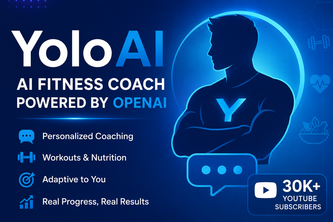
What it appears to be: A fitness platform that uses OpenAI models to offer personalized coaching, meal planning, and social features, built as a single-person hackathon project.
What changed: The author describes building the platform from scratch in a hackathon context, using React, Node.js, Supabase, Cloudflare, and OpenAI. No evidence of prior development or commercial traction is provided.
Most important open question: Is there any evidence that YoloAI has moved beyond a proof-of-concept or prototype stage, or whether it has begun to attract users or generate revenue?
What The Product Actually Is
The description states:
- YoloAI is an AI-powered fitness platform.
- It uses OpenAI models.
- It features personalized coaching, meal planning, recipe sharing, social features, and adaptive chat experiences.
- It combines coaching, meal planning, recipes, progress tracking, and social features.
Inference: The product appears to be a web-based application integrating AI for personal fitness guidance, with a focus on user engagement through social and adaptive elements.
Not evidenced: No details about the actual functionality or UI/UX design are provided. There is no evidence of whether it is a mobile app, web app, or hybrid.
Positioning & Claim Evolution
The author states:
- The inspiration was to replace five different fitness apps with one AI coach.
- The goal was to build a unique experience using great tools, not to rebuild everything from scratch.
Inference: YoloAI positions itself as an all-in-one AI fitness solution that aims to simplify the user’s journey by consolidating multiple functionalities into one platform.
Not evidenced: No evidence of market positioning or competitive differentiation beyond the author's personal motivation. No claims about user adoption, retention, or product-market fit are provided.
Target Customer & ICP
The description states:
- The platform is for fitness enthusiasts who want personalized coaching and meal planning.
- It targets users who currently use multiple apps but want a unified experience.
Inference: The target customer likely includes individuals interested in fitness, health tracking, and AI-assisted personalization, with an emphasis on those who are already active in the fitness space.
Not evidenced: No evidence of specific user personas, demographics, or segmentation. No data about actual users or their behavior is provided.
Business Model & Pricing Evidence
The description states:
- The platform features personalized coaching, meal planning, recipe sharing, social features, and adaptive chat experiences.
Inference: The business model likely involves a freemium or subscription-based approach, given the range of features and personalization offered.
Not evidenced: No pricing structure, monetization strategy, or revenue model is described. There is no indication of whether the platform is intended for free use, paid access, or advertising.
Technical & Delivery Signals
The description states:
- Built with React, Node.js, Supabase, Cloudflare, and OpenAI.
- The hardest part was making the AI remember users while keeping the app simple.
Inference: The platform is built using modern web technologies and integrates OpenAI models for AI functionality. It appears to be a full-stack application with backend services (Node.js), frontend (React), and cloud infrastructure (Cloudflare, Supabase).
Not evidenced: No information about scalability, performance, or deployment architecture is provided. There is no evidence of production readiness or technical maturity.
Traction & Maturity Signals
The description states:
- This was a hackathon project submitted to the OpenAI 2026 hackathon.
- The team size is one (Paul Saad).
- No mention of users, revenue, or adoption.
Inference: YoloAI is at an early stage — likely a prototype or proof-of-concept built in a short timeframe.
Not evidenced: No evidence of user engagement, customer acquisition, revenue, or product-market fit. No data on usage metrics, retention, or monetization is provided.
Competitive Context
The description states:
- The author wanted to replace five different fitness apps with one AI coach.
- It features coaching, meal planning, recipes, progress tracking, and social features.
Inference: YoloAI competes in the AI-powered fitness and wellness space, potentially overlapping with platforms like Fitbit, MyFitnessPal, or Apple Health, though it is positioned as a more personalized, chat-based experience.
Not evidenced: No evidence of competitive analysis, market sizing, or positioning against existing players. No mention of competitors or their offerings is provided.
Open Questions & Risks
- Single-person team: The platform was built by one person, which raises questions about scalability and long-term development capacity.
- Hackathon origin: The project is a hackathon submission, suggesting it may be in early prototype stage with limited commercial viability or user traction.
- No revenue or customer data: There is no evidence of monetization, users, or adoption.
- Unverified claims: All descriptions are self-reported and unverified.
Inference: YoloAI is a concept that has not yet demonstrated real-world traction or commercial viability. It may be a promising idea but lacks the evidence to support investment or partnership interest at this stage.
Questions the description leaves open
- What specific AI models are being used, and how are they integrated into the platform?
- Has the platform been tested with real users beyond the hackathon?
- Are there any plans for monetization or revenue generation?
- How does YoloAI differentiate itself from existing fitness platforms?
- What is the roadmap for scaling the product beyond the current prototype?
Overall Assessment
Not evidenced: No data to support a commercial due-diligence read on investment or partnership potential.
Inference: Based on the self-reported description, YoloAI appears to be an early-stage idea with no demonstrated traction. It is not ready for investment or partnership consideration without further evidence of product-market fit, user engagement, or monetization strategy.
User Stories BotA demo video on every pull request
Get a demo video on every new feature
GitHub App that watches your pull requests and records a narrated, captioned demo.
Save time on demo prep and make informed decisions faster with a video walkthrough of every new feature.
Source
Submitted to the OpenAI 2026 hackathon on Devpost. Project home on Devpost. Back to the full gallery on Devpost.
This competitive analysis was produced by top-founders.com (opens in a new tab)
Generated by a language model from this project's public Devpost page — its tagline, the author's own write-up and any built-with tags listed there — as captured in August 2026. Short quotations are the author's words. It is an opinion on the idea as a business, not on the people behind it, and it reflects the description as published then. If the project has moved on, request a correction below. The analysis is not independent research and contains no verified traction, revenue or customer data.
An independent guide by KFG International LLC — not affiliated with, endorsed by, or connected to Devpost or OpenAI.