

Archive position — measured, not model output
0 likes on Devpost
2,263 of the 7,850 archived projects have more likes, and 5,587 share exactly 0 — so this project's #3,849 place in the like-ranked listing is a tie-break inside that group, not a ranking.
Projects (log scale)
Likes on Devpost. ▲ marks this project's group.
Show the figures
| Likes | Projects | Share of archive |
|---|---|---|
| 0 | 5,587 | 71.2% |
| 1 | 1,758 | 22.4% |
| 2 | 284 | 3.6% |
| 3–4 | 132 | 1.7% |
| 5–9 | 75 | 1.0% |
| 10+ | 14 | 0.2% |
 User Stories BotA demo video on every pull request
Get a demo video on every new feature
GitHub App that watches your pull requests and records a narrated, captioned demo.
Save time on demo prep and make informed decisions faster with a video walkthrough of every new feature.
Executive Summary
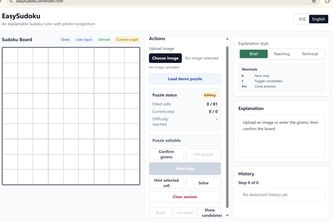
What the company appears to be: EasySudoku is a self-reported Sudoku tutor application that allows users to upload images of Sudoku puzzles, recognize them via OCR, and receive step-by-step logical deductions with explanations in either Brief, Teaching, or Technical modes. It uses deterministic solving rules combined with Z3 SMT verification for correctness.
What changed: The project was submitted as part of the OpenAI 2026 hackathon, indicating it is a prototype or early-stage development effort. There is no evidence of prior commercial activity, revenue, or customer adoption.
Single most important open question: Is there any evidence that this product has been used by learners beyond the author's own testing and demonstration?
What The Product Actually Is
The description states that EasySudoku:
- Allows users to upload a Sudoku image, load a demo puzzle, or enter givens manually.
- Detects and recognizes the Sudoku grid using local OpenCV and ONNX inference.
- Displays candidates for empty cells.
- Recommends the next logically valid move.
- Explains each deduction in Brief, Teaching, or Technical mode.
- Supports both English and Simplified Chinese.
- Records every deduction and supports history replay.
- Restores board state, settings, history, and uploaded image after refresh.
The final decisions are produced by deterministic human-style rules and Z3 SMT verification. The language model does not guess puzzle answers.
Inference: Based on the author's own description, this is a tool for learning Sudoku solving techniques through structured deduction and explanation, not a game or puzzle generator.
Positioning & Claim Evolution
The description states:
- Most Sudoku applications focus on revealing the final answer.
- EasySudoku was created for learners who want to understand the next logically justified move and improve their solving skills.
- The goal is to provide a step-by-step tutor that combines reliability of deterministic solving with clear, human-readable explanations.
Inference: The positioning is clearly defined as an educational tool focused on learning rather than entertainment or competition. It positions itself against traditional Sudoku apps that simply show solutions.
Target Customer & ICP
The description states:
- The target audience is learners who want to understand the next logically justified move and improve their solving skills.
- It supports both English and Simplified Chinese, suggesting a global or multilingual learner base.
Inference: The primary customer segment appears to be individuals seeking to learn Sudoku solving techniques, possibly students, puzzle enthusiasts, or educators. No specific ICP is defined beyond this general category.
Business Model & Pricing Evidence
The description does not contain any information about:
- Revenue streams
- Pricing models
- Monetization strategy
- Subscription plans or freemium offerings
Not evidenced
Technical & Delivery Signals
The description states:
- Built with FastAPI, OpenCV, Python, Tailwind, TypeScript, Vue.js, Z3.
- Frontend: Vue 3, TypeScript, Vite, Tailwind CSS, vue-i18n.
- Backend: FastAPI exposes structured APIs for image upload, cell hints, next-step deduction, and full solving.
- OCR handled by OpenCV and ONNX model.
- Reasoning pipeline uses human-readable techniques first, then Z3 and UNSAT Core analysis.
- Structured deduction data includes rule type, target cell, result, difficulty, verification method, candidate changes.
- Supports bilingual interface (English/Simplified Chinese).
- Automated testing and CI/CD pipelines in place.
Inference: The technical stack suggests a modern full-stack application with strong backend logic and frontend responsiveness. It is built for local processing and includes automated tooling.
Traction & Maturity Signals
The description states:
- Submitted to the OpenAI 2026 hackathon.
- Includes automated backend, API, frontend, Playwright, Docker, and CI verification.
- Accomplishments include photo-to-deduction workflow without external OCR service, solver-verified explanations, responsive bilingual interface, replayable history, structured backend responses.
Not evidenced: No evidence of actual users, revenue, customer adoption, or market traction beyond the hackathon submission.
Competitive Context
The description states:
- Most Sudoku applications focus on revealing the final answer.
- EasySudoku aims to provide a step-by-step tutor that combines reliability of deterministic solving with clear, human-readable explanations.
Inference: The competitive landscape includes existing Sudoku apps that offer only solutions. EasySudoku differentiates itself by focusing on learning and explanation over completion.
Open Questions & Risks
- No commercial traction or revenue evidence: The product is described as a hackathon submission with no signs of real-world usage.
- Single-person team: The project has only one member (fm w), which may limit scalability or long-term maintenance.
- Self-reported nature: All claims are unverified and based solely on the author’s own account.
- Limited scope: No mention of monetization, partnerships, or expansion plans beyond future feature additions.
Questions the description leaves open
- What is the actual user base for EasySudoku beyond the author's testing?
- Has there been any feedback from learners on how useful the explanations are?
- Are there any plans to monetize the product or generate revenue?
- How does the current OCR accuracy perform in real-world conditions?
- What are the long-term goals for the project, and how do they align with potential commercial viability?
Overall Assessment
Not evidenced: There is no evidence of any investment interest, partnership discussions, or commercial traction to support an investment or acquisition decision.
The product appears to be a prototype developed as part of a hackathon. It has not demonstrated any measurable user engagement, revenue, or market adoption. The author’s own description indicates that it is still in early development and lacks real-world usage data.
Confidence level: Low — based entirely on self-reported information with no external validation.
User Stories BotA demo video on every pull request
Get a demo video on every new feature
GitHub App that watches your pull requests and records a narrated, captioned demo.
Save time on demo prep and make informed decisions faster with a video walkthrough of every new feature.
Source
Submitted to the OpenAI 2026 hackathon on Devpost. Project home on Devpost. Back to the full gallery on Devpost.
This competitive analysis was produced by top-founders.com (opens in a new tab)
Generated by a language model from this project's public Devpost page — its tagline, the author's own write-up and any built-with tags listed there — as captured in August 2026. Short quotations are the author's words. It is an opinion on the idea as a business, not on the people behind it, and it reflects the description as published then. If the project has moved on, request a correction below. The analysis is not independent research and contains no verified traction, revenue or customer data.
An independent guide by KFG International LLC — not affiliated with, endorsed by, or connected to Devpost or OpenAI.