

Archive position — measured, not model output
0 likes on Devpost
2,263 of the 7,850 archived projects have more likes, and 5,587 share exactly 0 — so this project's #5,812 place in the like-ranked listing is a tie-break inside that group, not a ranking.
Projects (log scale)
Likes on Devpost. ▲ marks this project's group.
Show the figures
| Likes | Projects | Share of archive |
|---|---|---|
| 0 | 5,587 | 71.2% |
| 1 | 1,758 | 22.4% |
| 2 | 284 | 3.6% |
| 3–4 | 132 | 1.7% |
| 5–9 | 75 | 1.0% |
| 10+ | 14 | 0.2% |
 User Stories BotA demo video on every pull request
Get a demo video on every new feature
GitHub App that watches your pull requests and records a narrated, captioned demo.
Save time on demo prep and make informed decisions faster with a video walkthrough of every new feature.
Executive Summary
What the company appears to be
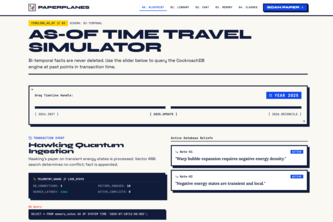
PaperPlanes is a self-reported research companion built as a personal knowledge assistant with a focus on memory architecture. The author states it parses academic papers, extracts claims, and maintains a bi-temporal memory model that remembers across sessions, flags contradictions, and allows time-travel through its own knowledge base.
What changed
The project evolved from an observation about AI assistants losing context between sessions to a system designed around memory as a core product rather than a feature. It introduces a novel architecture for managing claims with temporal semantics (valid_at/invalid_at, created_at/expired_at) and supports contradiction detection that retains conflicting beliefs instead of silently resolving them.
Single most important open question
Is there any evidence of actual usage or adoption beyond the author’s own development environment? The description makes no mention of customers, revenue, or real-world traction — only a personal project with self-reported technical implementation.
What The Product Actually Is
The description states that PaperPlanes is a system for processing academic papers (specifically arXiv papers) by parsing them into subject-predicate-object claims. These claims are embedded and stored in a bi-temporal schema within CockroachDB, enabling:
- Memory across sessions
- Linking of ideas across inputs
- Flagging of contradictory claims
- Rewinding memory to any point in time using a timeline slider
It includes four user-facing surfaces: Chat (memory-grounded conversation), Library (papers and claims), Memory Inspector (timeline/diff/graph views), and Contradictions (tensions awaiting resolution).
The system uses LangGraph pipelines, FastAPI backend, React frontend, and integrates with Amazon Bedrock for LLM calls.
Evidence
- "Upload an arXiv paper. PaperPlanes parses it, extracts subject-predicate-object claims"
- "Feed it papers, and it remembers across sessions, links ideas that connect, flags claims that conflict"
- "Drag it backward and the agent's knowledge reverts to its earlier state"
- "Every fact carries both event time (valid_at / invalid_at) and transaction time (created_at / expired_at)"
- Built with LangGraph, FastAPI, React, CockroachDB, Amazon Bedrock
Inference The system appears to be a prototype or proof-of-concept built for personal use or demonstration purposes. There is no evidence of commercial deployment or customer-facing infrastructure beyond the author’s own development stack.
Positioning & Claim Evolution
The description states that PaperPlanes was created in response to the author's frustration with AI assistants that lose memory between sessions and fail to handle contradictions properly. The core positioning is:
- Memory is the product, not a feature
- Human-like memory: consolidates, supersedes, decays, holds conflicting beliefs
It positions itself as solving a gap in current AI tools — those that treat memory as append-only logs rather than dynamic, evolving knowledge structures.
Evidence
- "Human memory isn't an append-only log. It consolidates, it supersedes, it decays when neglected"
- "The 'memory' features I tried were a vector store bolted onto a chat loop — retrieval, not memory"
- "Feed it papers; it links ideas across sessions, flags contradictions, and lets you rewind its memory"
Inference This is a self-described solution to a problem the author experienced personally. The positioning implies a niche market for advanced research assistants but does not indicate any commercial traction or target audience beyond personal use.
Target Customer & ICP
The description does not identify specific customer segments or personas. It focuses on the author’s own experience and technical implementation, without mentioning:
- Who uses this product
- What industries or roles it targets
- Whether there is a defined ideal customer profile (ICP)
Evidence
- No mention of target users beyond "researchers"
- No indication of user types, job functions, or organizational needs
Inference The project seems to be aimed at individuals working with academic research or knowledge-intensive tasks. However, the lack of explicit targeting makes it unclear whether this is a personal tool or intended for broader adoption.
Business Model & Pricing Evidence
There is no evidence in the description of any business model or pricing structure. The author describes a technical implementation but does not discuss monetization, licensing, or customer acquisition strategies.
Evidence
- No mention of revenue streams
- No indication of pricing plans or subscription models
- No reference to paid features or enterprise offerings
Inference The project is likely a personal or experimental endeavor. If it has any commercial intent, it is not evident from the provided description.
Technical & Delivery Signals
The system uses:
- LangGraph pipelines (for chat and ingestion)
- FastAPI + Python 3.12
- React 19 + Vite frontend
- CockroachDB for memory storage with bi-temporal schema
- Amazon Bedrock (Nova Pro, Nova Lite) for LLM inference
- Titan Text Embeddings V2 for vectorization
- Dockerized deployment
It implements:
- Bi-temporal facts (valid_at/invalid_at, created_at/expired_at)
- Memory consolidation via ADD/UPDATE/INVALIDATE operations
- Ebbinghaus decay model for memory strength
- Async reflection via background workers
- Multi-tiered memory architecture (episodic, semantic, procedural)
Evidence
- "Two compiled LangGraph pipelines (chat and ingestion) on FastAPI / Python 3.12"
- "CockroachDB as the memory substrate"
- "SERIALIZABLE isolation, so concurrent consolidation can't silently lose writes"
- "Bi-temporal schema + recursive-CTE traversal for the memory graph"
Inference The architecture is sophisticated and appears to be built with correctness and concurrency in mind. However, it remains unclear whether this is production-ready or intended for wider use.
Traction & Maturity Signals
There is no evidence of traction, customers, or real-world usage beyond the author’s own development and testing. The project is described as:
- A personal solution to a problem
- A hackathon submission
- Deployed in production but not used by others
Evidence
- "It's running in production right now on HTTPS with a real database behind it"
- "The memory engine is the moat: any team shipping a research or knowledge assistant needs exactly this layer"
- No mention of users, customers, or revenue
- No data on adoption or engagement metrics
Inference This is a solo-built prototype. There is no indication that it has been adopted by others or scaled beyond the author’s own use.
Competitive Context
The description does not provide information about competitors or how PaperPlanes compares to existing tools in the space. It only states:
- Current AI assistants fail to maintain memory across sessions
- Memory is treated as append-only rather than dynamic
- The system aims to solve a gap in current tools
Evidence
- "The 'memory' features I tried were a vector store bolted onto a chat loop — retrieval, not memory"
- "Human memory isn't an append-only log"
Inference It positions itself as addressing a lack of proper memory management in AI assistants. However, without knowing the competitive landscape or existing solutions, it's impossible to assess its differentiation.
Open Questions & Risks
Key risks and open questions include:
- No commercial traction: No evidence of users, customers, or revenue
- Unproven market demand: The author’s own experience is the only data point
- Limited scalability assumptions: While built with concurrency in mind, no real-world scale testing is reported
- Self-contained architecture: No mention of integrations, APIs, or ecosystem support
- Personal project nature: Likely not designed for enterprise or multi-user environments
Evidence
- "No revenue, customer or traction data is available beyond what they state"
- "It's running in production right now on HTTPS with a real database behind it" (but no users)
- "This project was submitted to the OpenAI 2026 hackathon"
Inference The system is likely a prototype or proof-of-concept. Its maturity and viability as a product are unproven.
Questions the description leaves open
- What is your actual use case for this tool? Is it personal, or are you planning to deploy it for others?
- Have you tested the system with multiple users or teams?
- How do you plan to monetize or scale this product if you intend to go beyond a personal prototype?
- What are the limitations of your contradiction detection mechanism that you're aware of?
- Are there any known performance bottlenecks at larger scales (e.g., more than 10,000 claims)?
- How do you handle data privacy and access control for multi-user scenarios?
- What is the long-term vision for this product beyond the current implementation?
Overall Assessment
Not evidenced.
There is no evidence of revenue, customers, or traction to support an investment or partnership decision. The project is described as a personal prototype built for self-use, submitted to a hackathon, and deployed in production but without any indication of adoption or commercial viability.
The technical architecture is impressive and shows deep understanding of memory systems and concurrency. However, the lack of real-world usage, market validation, or business model makes it difficult to assess whether this represents a viable product opportunity or just an interesting experiment.
Confidence Level Low This analysis is based entirely on self-reported information with no external corroboration. Any conclusions drawn are speculative and should not be taken as indicative of actual commercial potential.
User Stories BotA demo video on every pull request
Get a demo video on every new feature
GitHub App that watches your pull requests and records a narrated, captioned demo.
Save time on demo prep and make informed decisions faster with a video walkthrough of every new feature.
Source
Submitted to the OpenAI 2026 hackathon on Devpost. Project home on Devpost. Back to the full gallery on Devpost.
This competitive analysis was produced by top-founders.com (opens in a new tab)
Generated by a language model from this project's public Devpost page — its tagline, the author's own write-up and any built-with tags listed there — as captured in August 2026. Short quotations are the author's words. It is an opinion on the idea as a business, not on the people behind it, and it reflects the description as published then. If the project has moved on, request a correction below. The analysis is not independent research and contains no verified traction, revenue or customer data.
An independent guide by KFG International LLC — not affiliated with, endorsed by, or connected to Devpost or OpenAI.