

Archive position — measured, not model output
0 likes on Devpost
2,263 of the 7,850 archived projects have more likes, and 5,587 share exactly 0 — so this project's #5,811 place in the like-ranked listing is a tie-break inside that group, not a ranking.
Projects (log scale)
Likes on Devpost. ▲ marks this project's group.
Show the figures
| Likes | Projects | Share of archive |
|---|---|---|
| 0 | 5,587 | 71.2% |
| 1 | 1,758 | 22.4% |
| 2 | 284 | 3.6% |
| 3–4 | 132 | 1.7% |
| 5–9 | 75 | 1.0% |
| 10+ | 14 | 0.2% |
 User Stories BotA demo video on every pull request
Get a demo video on every new feature
GitHub App that watches your pull requests and records a narrated, captioned demo.
Save time on demo prep and make informed decisions faster with a video walkthrough of every new feature.
Executive Summary
What the company appears to be
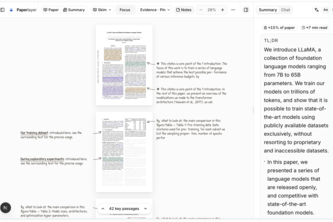
PaperLayer is a self-reported PDF reader tool for academic papers that overlays AI-generated highlights, notes, and summaries on top of original arXiv documents. It claims to offer goal-aware reading modes, evidence-backed annotations, and a layer-based interface where users can toggle between source and AI-enhanced content.
What changed
The project is presented as an open-source tool submitted to the OpenAI 2026 hackathon. No prior version or product history is described; this appears to be a new development effort.
Single most important open question
Is there any evidence of actual user adoption, revenue, or traction beyond the author's own description?
What The Product Actually Is
The description states that PaperLayer is a tool that renders original PDFs untouched and overlays AI-generated content — such as highlights, notes, summaries — on top of them. It supports toggling this layer on/off. Every claim in the overlay links back to its exact source passage via an "Evidence Walk" feature.
- Claimed functionality: Goal-aware reading modes (Skim, Understand Method, Reviewer), margin notes, and cached reading layers.
- Technology stack: Built with codex, next.js, and python.
- Not evidenced Any actual product interface, user base, or performance metrics.
The description states: "Paperlayer renders the original PDF untouched and draws everything else — highlights, notes, summaries — on top, as a layer you can turn off."
Positioning & Claim Evolution
The author positions PaperLayer as a solution to the problem of information overload in fast-moving AI and CS fields. It attempts to resolve the "trust problem" with AI summaries by grounding them in source material.
- Core claim: Avoids replacing the paper; instead, guides attention over it.
- Evolution of claims: The author frames this as a response to the limitations of existing AI summarization tools — specifically, that they lack traceability and can mislead users.
- Not evidenced Any prior positioning or evolution in market perception, nor evidence of how this differs from other tools like Zotero, Mendeley, or existing PDF annotation tools.
The description states: "AI summaries seem like the answer, but they have a trust problem... So you're stuck with a bad choice — read everything linearly and fall behind, or trust summaries and lose touch with the source."
Target Customer & ICP
The author describes the tool as intended for researchers dealing with large volumes of arXiv papers in fast-moving fields.
- Target customer: Researchers, particularly those in AI and computer science.
- ICP (Ideal Customer Profile): Users who read dense academic PDFs regularly and need to quickly grasp key points while maintaining access to source evidence.
- Not evidenced Any specific customer segments, personas, or user feedback beyond the author’s own claims.
The description states: "AI and CS move too fast to read everything. Hundreds of new papers land on arXiv every day..."
Business Model & Pricing Evidence
There is no mention of pricing, monetization strategy, or business model in the provided description.
- Not evidenced Any revenue streams, pricing tiers, subscription models, or commercial use cases.
- Inference (not fact): If this were to scale, it might be monetized through a freemium model or enterprise licensing for research institutions.
The description does not state anything about how the tool would generate revenue or who pays for it.
Technical & Delivery Signals
The project is described as built with codex, next.js, and Python. It includes features like caching of reading layers, evidence walk functionality, and goal-aware modes.
- Technology stack: codex, next.js, python.
- Delivery signals: The tool is presented as a hackathon submission, suggesting early-stage development.
- Not evidenced Any production deployment, scalability data, or technical architecture details beyond the stack.
The description states: "Built with (author-declared): codex, next.js, python."
Traction & Maturity Signals
No evidence of traction is provided. The project is described as a hackathon submission and lacks any mention of users, downloads, or adoption.
- Not evidenced Any user base, customer data, usage statistics, or product maturity beyond the initial concept.
- Inference (not fact): As a hackathon project, it likely has limited real-world testing or deployment.
The description states: "This project was submitted to the OpenAI 2026 hackathon on Devpost."
Competitive Context
The author implies that current AI summarization tools are inadequate due to lack of traceability. However, no direct competitors are named or described.
- Not evidenced Any competitive landscape analysis, competitor names, or market positioning relative to existing tools.
- Inference (not fact): The tool may compete with PDF readers, citation managers, or AI summarizers like ChatGPT, but this is not stated.
The description states: "AI summaries seem like the answer, but they have a trust problem."
Open Questions & Risks
Several risks and open questions emerge from the lack of evidence:
- No revenue or traction: No data on users, monetization, or adoption.
- Single founder: Only one team member is listed.
- Hackathon project: Suggests early-stage development with no proven market fit.
- Unverified claims: All features and benefits are self-reported without external validation.
The description states: "Team size: 1", which raises concerns about execution capacity.
Questions the description leaves open
- What is the actual user feedback or testing done so far?
- How does PaperLayer handle edge cases in PDF formatting or complex equations?
- Are there any plans for monetization or commercial use beyond the hackathon?
- Has the tool been tested with real researchers or academic institutions?
- What are the technical limitations of the current implementation?
Overall Assessment
Not evidenced No basis to assess investment or partnership viability.
- Confidence level: Very low.
- Reasoning: The description is entirely self-reported and lacks any evidence of traction, revenue, or user engagement. It appears to be a concept or prototype submitted for a hackathon.
- Inference (not fact): If the tool were to gain traction, it could have potential in academic research or AI-assisted reading workflows.
The description states: "Everything above is the authors' own account. It is not independently verified, and no revenue, customer or traction data is available beyond what they state."
User Stories BotA demo video on every pull request
Get a demo video on every new feature
GitHub App that watches your pull requests and records a narrated, captioned demo.
Save time on demo prep and make informed decisions faster with a video walkthrough of every new feature.
Source
Submitted to the OpenAI 2026 hackathon on Devpost. Project home on Devpost. Back to the full gallery on Devpost.
This competitive analysis was produced by top-founders.com (opens in a new tab)
Generated by a language model from this project's public Devpost page — its tagline, the author's own write-up and any built-with tags listed there — as captured in August 2026. Short quotations are the author's words. It is an opinion on the idea as a business, not on the people behind it, and it reflects the description as published then. If the project has moved on, request a correction below. The analysis is not independent research and contains no verified traction, revenue or customer data.
An independent guide by KFG International LLC — not affiliated with, endorsed by, or connected to Devpost or OpenAI.