

Archive position — measured, not model output
1 like on Devpost
505 of the 7,850 archived projects have more likes, and 1,758 share exactly 1 — so this project's #1,596 place in the like-ranked listing is a tie-break inside that group, not a ranking.
Projects (log scale)
Likes on Devpost. ▲ marks this project's group.
Show the figures
| Likes | Projects | Share of archive |
|---|---|---|
| 0 | 5,587 | 71.2% |
| 1 | 1,758 | 22.4% |
| 2 | 284 | 3.6% |
| 3–4 | 132 | 1.7% |
| 5–9 | 75 | 1.0% |
| 10+ | 14 | 0.2% |
 User Stories BotA demo video on every pull request
Get a demo video on every new feature
GitHub App that watches your pull requests and records a narrated, captioned demo.
Save time on demo prep and make informed decisions faster with a video walkthrough of every new feature.
Executive Summary
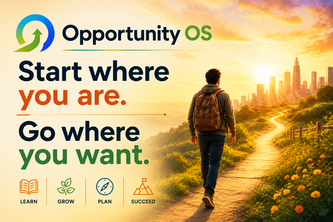
Opportunity OS is an AI-guided platform described by its author as a tool to help people—especially those without a GED or early-career builders—navigate education and career opportunities. The platform uses AI (specifically GPT-5.6 and Codex) to create personalized plans that connect users' goals with relevant learning, credentials, internships, jobs, and other support resources.
The author states the product is designed for individuals seeking a structured path toward better livelihoods, with features including GED prep, digital literacy training, resume building, job search guidance, financial literacy lessons, and mentorship. It is built as an AI-powered navigator that turns user inputs into prioritized action plans.
What changed: The project was submitted to the OpenAI 2026 hackathon, indicating it is in early development or prototype stage. No evidence of revenue, customers, or product-market fit exists beyond self-reporting.
Single most important open question: Is there a viable market need for this type of AI-guided career and education navigation tool, and does the author have sufficient domain expertise to execute on their vision?
What The Product Actually Is
The description states that Opportunity OS is an AI-guided growth platform. It helps users move from their current situation toward desired life and career outcomes.
Key functional elements described:
- AI-guided navigator
- Personalized plan creation based on user goals, skills, constraints, and interests
- Integration of learning pathways, credentials, career preparation, and real opportunities
- Explanation of why each next step matters
- Support for GED prep, digital literacy training, resume building, job search guidance, interview coaching, financial literacy, skill certifications, career exploration, mentorship, and progress tracking
The platform is described as “designed to make progress feel concrete rather than overwhelming”.
It is built using OpenAI technologies, specifically:
- GPT-5.6 (for reasoning and personalized guidance)
- Codex (for implementation acceleration)
Inference: The product appears to be a prototype or early-stage platform focused on personalization and AI-driven decision-making for career and education navigation.
Positioning & Claim Evolution
The author positions Opportunity OS as:
- A tool that brings scattered educational and career opportunities into one place
- A supportive, personalized experience for people without a GED or early-career builders
- An AI-powered navigator that explains why each step matters and helps users build momentum over time
It is described as starting with support for GED and workforce development but being designed to grow into a broader platform for:
- AI literacy
- Career coaching
- Financial education
- Workforce development
- Lifelong learning
Claim: The platform aims to help people "see a path forward—and give them the tools to take it."
Inference: This is a self-positioned, aspirational vision. No evidence of actual market traction or product adoption exists.
Target Customer & ICP
The description states that Opportunity OS targets people who are:
- Preparing for a GED
- Entering the workforce
- Improving digital confidence
- Changing careers
These users are described as:
- Early-career builders
- People without a GED
- Individuals seeking better livelihoods
Inference: The target customer segment appears to be low-income or under-resourced individuals who lack access to structured career guidance and educational support.
No further segmentation or persona details are provided in the description.
Business Model & Pricing Evidence
There is no evidence of a business model or pricing structure in the self-reported description.
The author does not state:
- How the platform will generate revenue
- Whether it will be free, subscription-based, or pay-per-use
- If there are any monetization strategies beyond the AI tools themselves
Inference: The product is likely in early development and has not yet defined its commercial approach.
Technical & Delivery Signals
The platform is described as being built with OpenAI technologies, specifically:
- GPT-5.6 (used for reasoning and personalized guidance)
- Codex (used for implementation and iteration)
It is also tagged with:
- ai, career, codex, demo, education, gpt-5.6, learning, openai, personalization, productivity, responses
Inference: The platform uses AI as a core component of its functionality, but no details are given about technical architecture, scalability, or delivery mechanisms beyond the use of OpenAI APIs.
Traction & Maturity Signals
There is no evidence of traction or maturity in the description:
- No revenue data
- No customer base
- No product usage metrics
- No launch date or version history
- No user feedback or testimonials
The project was submitted to a hackathon, suggesting it may be in an early prototype phase.
Inference: The platform is likely in early development and has not yet achieved any measurable traction or market validation.
Competitive Context
There is no evidence of competitive analysis or awareness of existing players in the space.
The description does not mention:
- Competitors
- Market size
- Existing solutions for career guidance, GED prep, or workforce development
- How Opportunity OS differentiates from similar tools
Inference: No information is available to assess how this product fits into the broader competitive landscape.
Open Questions & Risks
Key risks and open questions based on the self-reported description:
- No revenue or customer data: The platform has no demonstrated traction.
- Unproven market need: There is no evidence that users actually want or will pay for this solution.
- Founder expertise: Only one team member (Nakia Russell) is mentioned; no background in education, career services, or AI product development is stated.
- Overambitious vision: The platform is described as starting with GED support but growing into a broad lifelong learning platform—this may be premature without early validation.
- Lack of business model clarity: No indication of how the platform will monetize or sustain itself.
Questions the description leaves open
- What specific problems are you solving, and how do you know people have these problems?
- Who are your early users or test subjects, if any?
- How do you plan to validate demand for this product before scaling?
- What is your path to monetization?
- Have you spoken with potential partners in education, workforce development, or career services?
- What makes you believe this platform will be effective at helping people achieve their goals?
- How do you intend to scale beyond a single developer working on it?
Overall Assessment
Not evidenced.
The description provides no data to support an investment or partnership decision. It is unclear whether:
- The product has real market demand
- The founder team has the right skills and experience
- The platform can be scaled or monetized
This is a self-reported, early-stage idea, submitted to a hackathon, with no evidence of traction, revenue, or customer validation.
Confidence level: Very low. This analysis is based entirely on self-reporting and lacks any independent corroboration.
User Stories BotA demo video on every pull request
Get a demo video on every new feature
GitHub App that watches your pull requests and records a narrated, captioned demo.
Save time on demo prep and make informed decisions faster with a video walkthrough of every new feature.
Source
Submitted to the OpenAI 2026 hackathon on Devpost. Project home on Devpost. Back to the full gallery on Devpost.
This competitive analysis was produced by top-founders.com (opens in a new tab)
Generated by a language model from this project's public Devpost page — its tagline, the author's own write-up and any built-with tags listed there — as captured in August 2026. Short quotations are the author's words. It is an opinion on the idea as a business, not on the people behind it, and it reflects the description as published then. If the project has moved on, request a correction below. The analysis is not independent research and contains no verified traction, revenue or customer data.
An independent guide by KFG International LLC — not affiliated with, endorsed by, or connected to Devpost or OpenAI.