

Archive position — measured, not model output
1 like on Devpost
505 of the 7,850 archived projects have more likes, and 1,758 share exactly 1 — so this project's #1,597 place in the like-ranked listing is a tie-break inside that group, not a ranking.
Projects (log scale)
Likes on Devpost. ▲ marks this project's group.
Show the figures
| Likes | Projects | Share of archive |
|---|---|---|
| 0 | 5,587 | 71.2% |
| 1 | 1,758 | 22.4% |
| 2 | 284 | 3.6% |
| 3–4 | 132 | 1.7% |
| 5–9 | 75 | 1.0% |
| 10+ | 14 | 0.2% |
 User Stories BotA demo video on every pull request
Get a demo video on every new feature
GitHub App that watches your pull requests and records a narrated, captioned demo.
Save time on demo prep and make informed decisions faster with a video walkthrough of every new feature.
Executive Summary
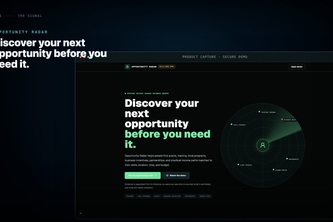
Opportunity Radar is a self-reported AI-powered platform that claims to help individuals discover life-changing opportunities (grants, careers, training, etc.) before they become urgent. It is described as an AI assistant that surfaces relevant opportunities and provides transparent reasoning for its recommendations.
The author states the product was built in a short timeframe using modern web technologies and AI tools like GPT-5.6 and Codex. The platform distinguishes between verified evidence and AI inference, aiming to build user trust through transparency.
Key commercial due-diligence read: There is no evidence of revenue, customers, or adoption. The description is entirely self-reported and unverified — it does not demonstrate traction, market validation, or a proven business model. The single most important open question is whether the author has validated demand for this product among target users.
What The Product Actually Is
The description states that Opportunity Radar is an AI-powered opportunity discovery platform. It claims to analyze a person’s goals and surface relevant opportunities such as:
- Grants
- Business incentives
- Training programs
- Career opportunities
- Local programs
- Partnerships
- Income pathways
It also generates:
- Opportunity scores
- Future outlooks
- Transition plans
- Recommended next actions
The platform is described as distinguishing between verified evidence (facts from sources) and AI inference (reasoned suggestions), with the goal of helping users make informed decisions.
Inference: The product appears to be a prototype or MVP built for a hackathon, not yet a commercial offering. It is not evidenced that it has been released to users beyond the author’s own use.
Positioning & Claim Evolution
The description states that Opportunity Radar aims to help people find opportunities before they become urgent — addressing a problem of missed life-changing opportunities due to information fragmentation.
It positions itself as an AI assistant that doesn’t just answer questions, but actively helps users discover opportunities. The platform emphasizes:
- Transparency in AI reasoning
- Separation of verified facts and AI inference
- Personalized opportunity scoring and planning
The author also mentions that the product is built with modern web technologies and AI tools like GPT-5.6 and Codex.
Inference: The positioning is aspirational — it claims to solve a problem but does not provide evidence of market demand or user validation. The evolution from idea to prototype is described as rapid, using AI-assisted development.
Target Customer & ICP
The description states that Opportunity Radar helps people find opportunities related to:
- Grants
- Careers
- Training
- Business incentives
- Local programs
- Partnerships
- Income pathways
It is implied that the platform targets individuals seeking personal or professional development, but no specific customer segments are named.
There is no evidence of a defined Ideal Customer Profile (ICP), nor any indication of whether the product is aimed at individuals, institutions, or organizations.
Inference: The target audience appears to be broad — individuals seeking opportunities in various life domains. However, without further segmentation or user research, it's unclear if there’s a coherent ICP.
Business Model & Pricing Evidence
The description does not provide any information about:
- Revenue model
- Pricing strategy
- Monetization approach
- Customer acquisition costs
It is stated that the platform is built for a hackathon and has not yet been released to users beyond the author’s own use.
Inference: No business model or pricing evidence is provided. The product appears to be in an early stage, with no commercial implementation evidenced.
Technical & Delivery Signals
The project was built using:
- Frontend: React, TypeScript, Vite, Tailwind CSS
- Backend / AI: OpenAI GPT-5.6, Codex
- Deployment: Vercel
- Other tools: GitHub, Remotion
The author states that GPT-5.6 and Codex were used to accelerate development, including:
- Feature building
- Refactoring
- Code validation
- Demo asset creation
A demo video was also produced entirely with an AI-assisted workflow.
Inference: The technical stack is modern and aligned with current web development trends. However, no evidence of scalability, performance, or production deployment is provided.
Traction & Maturity Signals
The description states that this project was submitted to the OpenAI 2026 hackathon, and it is not evident that it has been released beyond that context.
There is no evidence of:
- Revenue
- Customers
- User adoption
- Product-market fit
- Iteration history or feedback loops
The author mentions future versions will include continuous monitoring, notifications, collaboration tools, and enterprise integrations — but these are not yet implemented.
Inference: The product is at a very early stage (likely MVP or prototype) and lacks any traction or maturity signals. It has not been validated in the market.
Competitive Context
The description does not mention any competitors or direct comparisons to existing platforms that help people find grants, careers, training, etc.
It is not evident whether there are similar tools or platforms already solving this problem — no competitive analysis or differentiation strategy is provided.
Inference: No competitive context is evidenced. The author does not appear to have conducted a market or competitive review.
Open Questions & Risks
- No revenue, customers, or adoption: The product is described as a hackathon submission with no commercial traction.
- Unverified claims: All features and functionality are self-reported and unverified.
- Lack of business model clarity: No monetization strategy or pricing approach is evident.
- Limited target audience definition: No clear ICP or user segmentation.
- AI dependency without validation: The platform relies heavily on AI tools (GPT-5.6, Codex), but no evidence of how well these tools perform in practice or whether they are scalable.
- No product-market fit evidence: There is no indication that users have validated the need for this solution.
Inference: The project is a concept or prototype with no commercial viability or market validation.
Questions the description leaves open
- Have you conducted any user research or interviews to validate demand for this product?
- What specific problems are users facing that Opportunity Radar aims to solve, and how do you know?
- How will the platform monetize its services — is there a pricing model or revenue strategy in place?
- Are there existing platforms solving similar problems? If so, how does Opportunity Radar differentiate?
- What is the plan for scaling beyond the current prototype?
- How are you planning to build trust with users when presenting AI-generated recommendations?
Overall Assessment
Not evidenced.
The description provides no evidence of:
- Revenue
- Customers
- Product-market fit
- Traction or adoption
- Business model
- Market validation
It is a self-reported, unverified account of a hackathon project. The author states that the product was built quickly using AI tools and submitted to a hackathon — there is no indication it has been released or tested in a real-world environment.
Inference: This is not a viable investment or partnership opportunity at this stage. It is an early-stage idea with no demonstrated commercial potential.
User Stories BotA demo video on every pull request
Get a demo video on every new feature
GitHub App that watches your pull requests and records a narrated, captioned demo.
Save time on demo prep and make informed decisions faster with a video walkthrough of every new feature.
Source
Submitted to the OpenAI 2026 hackathon on Devpost. Project home on Devpost. Back to the full gallery on Devpost.
This competitive analysis was produced by top-founders.com (opens in a new tab)
Generated by a language model from this project's public Devpost page — its tagline, the author's own write-up and any built-with tags listed there — as captured in August 2026. Short quotations are the author's words. It is an opinion on the idea as a business, not on the people behind it, and it reflects the description as published then. If the project has moved on, request a correction below. The analysis is not independent research and contains no verified traction, revenue or customer data.
An independent guide by KFG International LLC — not affiliated with, endorsed by, or connected to Devpost or OpenAI.