

Archive position — measured, not model output
1 like on Devpost
505 of the 7,850 archived projects have more likes, and 1,758 share exactly 1 — so this project's #1,598 place in the like-ranked listing is a tie-break inside that group, not a ranking.
Projects (log scale)
Likes on Devpost. ▲ marks this project's group.
Show the figures
| Likes | Projects | Share of archive |
|---|---|---|
| 0 | 5,587 | 71.2% |
| 1 | 1,758 | 22.4% |
| 2 | 284 | 3.6% |
| 3–4 | 132 | 1.7% |
| 5–9 | 75 | 1.0% |
| 10+ | 14 | 0.2% |
 User Stories BotA demo video on every pull request
Get a demo video on every new feature
GitHub App that watches your pull requests and records a narrated, captioned demo.
Save time on demo prep and make informed decisions faster with a video walkthrough of every new feature.
Executive Summary
What the company appears to be
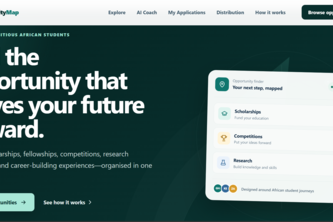
OpportunityMap is a self-reported browser-based platform designed to help African students discover, evaluate, and plan applications for educational opportunities such as scholarships, fellowships, internships, and research programmes. It claims to offer an explainable matching system that ranks opportunities based on student profiles stored locally in the browser.
What changed
The project evolved from a simple searchable directory into a structured workflow supporting discovery → understanding → saving → preparing → tracking → applying for opportunities. It includes features like profile-based matching, eligibility guidance, application planning tools, and local storage of user data.
The single most important open question
Is there any evidence that this platform has been adopted or used by students beyond the author’s own development and demonstration?
Note: This analysis is based entirely on the self-reported project description provided by the author. No independent verification, traction data, revenue figures, customer base, or third-party sources are available.
What The Product Actually Is
The description states that OpportunityMap is:
- A browser-based educational opportunity discovery and application-planning platform.
- Designed around African student journeys.
- Built using HTML, CSS, JavaScript, JSON, browser local storage, GitHub, and Vercel.
- Modular in architecture with separate modules for profile creation, opportunity data, matching, eligibility guidance, saved opportunities, application planning, and UI behavior.
- Deployed via Vercel.
It is described as a single-developer project (team size: 1) built over three Build Week phases.
Inference: The platform functions entirely within the browser without backend services or API integrations. It uses deterministic scoring logic rather than machine learning models for matching.
Positioning & Claim Evolution
The author claims that OpportunityMap was created to address a problem where talented African students miss opportunities due to fragmentation and difficulty in evaluation.
It positions itself as:
- An explainable opportunity discovery tool.
- A platform that helps students turn matches into actionable application plans.
- A tool that supports the full student journey from discovery to submission.
- A privacy-preserving solution that stores data locally in the browser.
The evolution of its positioning appears to be from a basic directory to a more structured workflow supporting planning and tracking.
Inference: The platform emphasizes transparency, privacy, and responsible design. It separates profile alignment from eligibility checks and avoids making unsupported claims about admission or funding probabilities.
Target Customer & ICP
The description states that OpportunityMap is designed for:
- African students seeking educational opportunities.
- Students who are looking to find verified programs and turn matches into actionable application plans.
It does not specify age ranges, education levels, or geographic scope beyond "Ghana and Africa."
Inference: The ICP likely includes high school and university-level students in sub-Saharan Africa who are navigating complex opportunity landscapes but lack access to centralized, curated information.
Business Model & Pricing Evidence
There is no evidence of a business model or pricing structure in the description. The platform is described as:
- Not requiring an account.
- Storing all data locally in the browser.
- Having no runtime OpenAI API calls.
- Being open-source (MIT license).
Claim: The author states that the project was built for the OpenAI 2026 hackathon and does not indicate any monetization strategy or paid features.
Technical & Delivery Signals
The platform is described as:
- A modular browser application using HTML, CSS, JavaScript, JSON, and local storage.
- Developed in three Build Week phases with Git branching, pull requests, documentation, and testing.
- Includes automated test suite (93 passing tests).
- Supports keyboard navigation, focus indicators, accessible labels, responsive layouts, reduced-motion support, validation summaries, confirmation dialogs, and clear status messaging.
Inference: The delivery approach shows disciplined development practices including version control, modular architecture, testing, and accessibility compliance. However, it lacks cloud infrastructure or scalable deployment mechanisms.
Traction & Maturity Signals
The description states:
- The current demonstration contains nine carefully structured opportunities.
- It includes a functional prototype with full workflow support (discover → understand → save → prepare → track → apply).
- The application is deployed and publicly accessible via Vercel.
- There are no mentions of users, usage metrics, or adoption beyond the author’s own development.
Claim: No evidence of user engagement, customer acquisition, or market traction is provided. The project remains in a prototype phase with no indication of real-world usage.
Competitive Context
No explicit competitors are named in the description. However, it implies a space where:
- Students seek educational opportunities.
- Platforms exist to aggregate and present such opportunities.
- Some platforms may offer recommendation engines or application tracking tools.
Inference: OpportunityMap competes indirectly with general opportunity directories, student support tools, and possibly AI-powered matching systems, though none are explicitly mentioned.
Open Questions & Risks
Key risks and open questions include:
- No verified users or adoption — the platform exists only as a prototype.
- Single developer — limited capacity for scaling or maintenance.
- Local storage only — no cross-device sync, which may limit utility.
- No monetization strategy — unclear path to sustainability.
- Self-reported data only — no independent validation of claims or performance.
Inference: The platform is not yet proven in the market. Its long-term viability depends on whether it can attract users and scale beyond a single developer’s effort.
Questions the description leaves open
- Has the platform been tested with actual African students? If so, how?
- What mechanisms are in place to verify or curate the opportunities listed?
- How will the platform evolve if it transitions from local storage to cloud-based accounts?
- Are there any plans for partnerships with schools, NGOs, or opportunity providers?
- What is the roadmap for expanding the opportunity database beyond the current 9 items?
- How does the author plan to sustain development and maintenance without funding?
Overall Assessment
Not evidenced.
Claim: There is no evidence of revenue, customers, traction, or financial viability. The project remains a prototype built by one person for a hackathon. No commercial due-diligence signals are present beyond the author’s self-description.
User Stories BotA demo video on every pull request
Get a demo video on every new feature
GitHub App that watches your pull requests and records a narrated, captioned demo.
Save time on demo prep and make informed decisions faster with a video walkthrough of every new feature.
Source
Submitted to the OpenAI 2026 hackathon on Devpost. Project home on Devpost. Back to the full gallery on Devpost.
This competitive analysis was produced by top-founders.com (opens in a new tab)
Generated by a language model from this project's public Devpost page — its tagline, the author's own write-up and any built-with tags listed there — as captured in August 2026. Short quotations are the author's words. It is an opinion on the idea as a business, not on the people behind it, and it reflects the description as published then. If the project has moved on, request a correction below. The analysis is not independent research and contains no verified traction, revenue or customer data.
An independent guide by KFG International LLC — not affiliated with, endorsed by, or connected to Devpost or OpenAI.