

Archive position — measured, not model output
0 likes on Devpost
2,263 of the 7,850 archived projects have more likes, and 5,587 share exactly 0 — so this project's #5,524 place in the like-ranked listing is a tie-break inside that group, not a ranking.
Projects (log scale)
Likes on Devpost. ▲ marks this project's group.
Show the figures
| Likes | Projects | Share of archive |
|---|---|---|
| 0 | 5,587 | 71.2% |
| 1 | 1,758 | 22.4% |
| 2 | 284 | 3.6% |
| 3–4 | 132 | 1.7% |
| 5–9 | 75 | 1.0% |
| 10+ | 14 | 0.2% |
 User Stories BotA demo video on every pull request
Get a demo video on every new feature
GitHub App that watches your pull requests and records a narrated, captioned demo.
Save time on demo prep and make informed decisions faster with a video walkthrough of every new feature.
Executive Summary
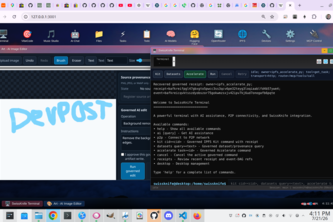
The description states that the project is a "Neurosymbolic AI Operating System + MCP++ protocol", which the author describes as an AI operating system using a decentralized architecture with P2P networking, DiD authentication, theorem provers, and event DAGs. The author claims to be building a system for formal legal reasoning and computational law, with a goal of making an AI lawyer accessible to everyone.
The project appears to be a self-funded, solo effort by one individual (Benjamin Barber) that has been in development for two years. It is positioned as a foundational infrastructure layer for AI systems, particularly focused on legal applications.
The single most important open question is: What specific commercial use cases or value propositions does this system enable today, and how does it differ from existing AI infrastructure platforms?
This analysis is based entirely on self-reported information from the project description. There is no evidence of revenue, customers, traction, or independent validation.
What The Product Actually Is
The description states that the product is a "Neurosymbolic AI Operating System + MCP++ protocol". It includes:
- A virtual desktop
- A decentralized virtual filesystem layer with connectors to multiple remote filesystem backends, adaptive replacement cache, write ahead logs, and graphrag indexing
- A decentralized dataset query, manipulation, ETL library with a common crawl search engine, formal logic theorem provers custom made for legal reasoning, and a decentralized knowledge graph database
- Ability to convert any document into a knowledge graph and theorem prover set
- A decentralized model server, containerization, and agent supervisor with scheduler for bulk computation
The author states this is built using OpenAI technologies.
This is described as an operating system that extends the MCP protocol with P2P networking, DiD authentication, theorem provers, and event DAGs.
Inference: The product appears to be a foundational AI infrastructure platform aimed at enabling decentralized, formal reasoning systems for legal applications. However, it's unclear what specific functionality or interfaces are available to users beyond what is described in the author's own account.
Positioning & Claim Evolution
The description states that this is an "AI operating system" that was originally proposed two years ago at the Cloud Native Computing Foundation and self-funded by the author.
The author claims:
- The system enables formal legal reasoning
- It aims to make an AI lawyer accessible to everyone for free
- It converts all of the legal corpus into formal logic to make it computationally usable
- It is designed to be maintained by the Linux Foundation
Inference: The positioning has evolved from a conceptual proposal at CNCF to a self-funded implementation that focuses on computational law. The claim evolution shows increasing specificity around legal applications, but no evidence of market traction or adoption.
Target Customer & ICP
The description states:
- The system aims to make an AI lawyer accessible to everyone for free
- It is focused on converting the legal corpus into formal logic
No specific customer segments or personas are identified in the description.
Inference: The target appears to be general users seeking legal assistance, but there's no evidence of specific buyer personas, use cases, or market segmentation. The author's stated goal is broad access rather than targeting specific professional or enterprise customers.
Business Model & Pricing Evidence
The description states:
- The author aims to make an AI lawyer accessible to everyone for free
- The system is self-funded by the author
- It was originally proposed at CNCF and later self-funded
There is no evidence of pricing structures, monetization strategies, or revenue models.
Inference: The business model appears to be based on free access to the AI lawyer functionality, but there's no indication of how this would scale or generate revenue. No commercialization strategy beyond "free access" is evident.
Technical & Delivery Signals
The description states:
- Built with OpenAI
- Uses MCP++ protocol which extends MCP protocol with P2P network, DiD authentication, theorem provers, event DAG
- Includes decentralized virtual filesystem layer, dataset query library, model server, containerization, agent supervisor, scheduler
- Implements formal logic theorem provers custom made for legal reasoning
- Has graphrag indexing and knowledge graph database capabilities
Inference: The technical stack appears to be highly specialized and complex, incorporating multiple advanced concepts including P2P networks, decentralized identity, theorem proving, and distributed computing. However, there's no evidence of actual delivery or working components beyond the author's own account.
Traction & Maturity Signals
The description states:
- Self-funded project
- Started 2 years ago at CNCF
- Built by one person (Benjamin Barber)
- Has been in development for two years
- The author is converting all of the legal corpus to formal logic
No evidence of customers, revenue, usage metrics, or product maturity beyond the author's own claims.
Inference: The project shows sustained effort over two years but lacks any measurable traction or market validation. The author's own account indicates ongoing development rather than a completed product.
Competitive Context
The description does not provide information about competitive landscape or existing alternatives.
No evidence of competitors, market positioning, or differentiation from other AI infrastructure platforms is available.
Inference: There is no evidence of the competitive environment or how this system would compare to existing AI operating systems, legal tech platforms, or distributed computing solutions. The author's own account provides no context for competition.
Open Questions & Risks
- Solo development effort with no team or external validation
- Self-funded project with no revenue or customer evidence
- No demonstrated product delivery or working components
- Highly technical and complex architecture without proven implementation
- No pricing, monetization, or business model clarity
- No evidence of traction, customers, or market adoption
- The author's own account indicates 2 years of challenges building from scratch
Inference: The primary risk is that this remains an unproven concept with no demonstrated value proposition or commercial viability. The lack of team, funding, and measurable progress raises significant concerns about execution capability.
Questions the description leaves open
- What specific legal use cases does the system enable today?
- How does it differ from existing AI legal platforms or legal tech tools?
- What are the concrete technical milestones achieved so far?
- How is the formal logic conversion of legal documents actually implemented?
- What is the path to monetization beyond "free access"?
- Are there any early adopters or pilot users?
- What specific challenges have prevented progress beyond the current state?
- How does the P2P network and DiD authentication work in practice?
Overall Assessment
The description states that this is a self-funded project by one individual (Benjamin Barber) that has been in development for two years, originally proposed at CNCF.
There is no evidence of revenue, customers, traction, or commercial viability beyond the author's own claims. The system appears to be conceptual rather than operational, with no demonstrated product delivery or market validation.
Inference: Based on the self-reported information alone, there is insufficient evidence to support a positive investment or partnership assessment. The project lacks measurable progress, customer evidence, or clear commercialization strategy. The technical complexity combined with solo development raises significant execution risks without additional evidence of traction or validation.
User Stories BotA demo video on every pull request
Get a demo video on every new feature
GitHub App that watches your pull requests and records a narrated, captioned demo.
Save time on demo prep and make informed decisions faster with a video walkthrough of every new feature.
Source
Submitted to the OpenAI 2026 hackathon on Devpost. Project home on Devpost. Back to the full gallery on Devpost.
This competitive analysis was produced by top-founders.com (opens in a new tab)
Generated by a language model from this project's public Devpost page — its tagline, the author's own write-up and any built-with tags listed there — as captured in August 2026. Short quotations are the author's words. It is an opinion on the idea as a business, not on the people behind it, and it reflects the description as published then. If the project has moved on, request a correction below. The analysis is not independent research and contains no verified traction, revenue or customer data.
An independent guide by KFG International LLC — not affiliated with, endorsed by, or connected to Devpost or OpenAI.