

Archive position — measured, not model output
0 likes on Devpost
2,263 of the 7,850 archived projects have more likes, and 5,587 share exactly 0 — so this project's #5,525 place in the like-ranked listing is a tie-break inside that group, not a ranking.
Projects (log scale)
Likes on Devpost. ▲ marks this project's group.
Show the figures
| Likes | Projects | Share of archive |
|---|---|---|
| 0 | 5,587 | 71.2% |
| 1 | 1,758 | 22.4% |
| 2 | 284 | 3.6% |
| 3–4 | 132 | 1.7% |
| 5–9 | 75 | 1.0% |
| 10+ | 14 | 0.2% |
 User Stories BotA demo video on every pull request
Get a demo video on every new feature
GitHub App that watches your pull requests and records a narrated, captioned demo.
Save time on demo prep and make informed decisions faster with a video walkthrough of every new feature.
Executive Summary
What the company appears to be
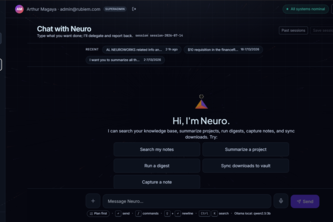
NeuroWorks is a self-reported project that describes itself as a secure, local-first AI digital worker platform designed for institutional use in compliance-heavy environments. It claims to enable organizations to define and govern AI agents using plain-language instructions, with human-in-the-loop governance as a core feature.
What changed
The author states that the project emerged from an observed capacity crisis in institutions across Zimbabwe and the broader region, particularly around compliance reporting and operational coordination. The solution is described as a local-first architecture built on open-source tools, with emphasis on data sovereignty, safety through governance layers, and minimal reliance on cloud inference.
Single most important open question
Is there evidence of real-world usage or institutional adoption beyond the author’s own development work?
What The Product Actually Is
The description states that NeuroWorks is a secure, local-first AI digital worker platform, built with a three-layer architecture:
- Layer 1 (Infrastructure): Built using Node.js/Express, Next.js 14, PostgreSQL, Redis, Qdrant, and Ollama for local inference.
- Layer 2 (HERMES Governance Layer): A Model Context Protocol (MCP) tool-governance layer with ~90 allowlisted primitives across 12 namespaces to restrict agent actions.
- Layer 3 (Orchestration): LangGraph multi-agent workflows that plan execution, call permitted tools via HERMES, and halt at a Human-in-the-Loop (HITL) gate before executing consequential actions.
The system is designed to run inference locally by default, using consumer-grade hardware like RTX 3060 GPUs. It supports optional cloud escalation through APIs such as OpenRouter and Anthropic’s Claude.
Inference: The product is described as a platform for deploying AI agents in regulated or sensitive environments where local data control and governance are critical.
Positioning & Claim Evolution
The author positions NeuroWorks as:
- A digital worker platform that turns job descriptions into operational capacity.
- A secure, local-first solution that avoids cloud-based inference to protect institutional data sovereignty.
- A system that enables human-in-the-loop governance, where humans authorize actions before execution.
- A tool for institutional use, particularly in public sector departments and NGOs dealing with compliance-heavy tasks.
The project evolved from a response to a "structural capacity crisis" in institutions, suggesting a shift from generic AI tools toward domain-specific, human-centric automation.
Claim: The platform is built to avoid the inefficiencies of traditional software configuration and LLM overuse by combining deterministic operations with LLMs for planning and synthesis.
Target Customer & ICP
The description states that NeuroWorks targets:
- Institutions such as public sector departments (e.g., PRAZ, MOHCC).
- NGOs and financial desks.
- Organizations overwhelmed by compliance, reporting, and coordination tasks.
It is implied that the platform is intended for non-technical users, who should not need to become “prompt engineers” to operate it. The system is meant to translate raw language or scanned guidelines into operational rules.
Inference: The target customer is likely a mid-to-large institutional user with compliance needs and limited technical capacity to manage complex AI systems.
Business Model & Pricing Evidence
Not evidenced.
The description does not mention pricing, licensing, revenue models, or monetization strategies. It only describes the architecture and use case.
Technical & Delivery Signals
- Stack: Built with open-source technologies including Node.js, Next.js, PostgreSQL, Redis, Qdrant, Ollama.
- Local-first approach: Inference runs locally by default; cloud escalation is optional.
- Governance layer (HERMES): A MCP-based tool-governance system with ~90 allowlisted primitives across 12 namespaces.
- Human-in-the-loop (HITL) gate: Required before any consequential action.
- Multi-agent orchestration: Powered by LangGraph workflows.
- Security practices:
- Use of sandboxes (E2B).
- Origin-guard middleware.
- Immediate credential revocation after exposure.
Inference: The technical stack and architecture suggest a focus on secure, local deployment with strong governance. However, no evidence of production deployment or scalability beyond the author’s own development environment.
Traction & Maturity Signals
Not evidenced.
There is no mention of customers, revenue, usage metrics, or any form of traction. The project is described as a hackathon submission and self-reported development effort.
Competitive Context
Not evidenced.
The description does not reference competitors, market size, or competitive positioning beyond the general context of AI digital workers and local-first platforms.
Open Questions & Risks
- No evidence of traction or real-world usage: The project is described as a hackathon submission with no external validation.
- Single-person team: Only one member (Mark Chindudzi) is listed, raising questions about scalability and operational capacity.
- Unverified claims: The description contains self-reported claims about performance, security, and governance without independent corroboration.
- Limited deployment context: No evidence of how the system would scale or integrate into existing institutional workflows.
Questions the description leaves open
- What specific institutions have expressed interest in using NeuroWorks?
- How is the HITL gate implemented in practice, and what are the human oversight mechanisms?
- Has the HERMES governance layer been tested with real-world policy violations or edge cases?
- Are there any known limitations of local inference on consumer-grade hardware that affect performance or reliability?
- What is the roadmap for moving beyond a proof-of-concept to production deployment?
Overall Assessment
Not evidenced.
There is no evidence of funding, partnerships, or investment interest. The project is described as a hackathon submission with no indication of commercial traction or investor engagement.
User Stories BotA demo video on every pull request
Get a demo video on every new feature
GitHub App that watches your pull requests and records a narrated, captioned demo.
Save time on demo prep and make informed decisions faster with a video walkthrough of every new feature.
Source
Submitted to the OpenAI 2026 hackathon on Devpost. Project home on Devpost. Back to the full gallery on Devpost.
This competitive analysis was produced by top-founders.com (opens in a new tab)
Generated by a language model from this project's public Devpost page — its tagline, the author's own write-up and any built-with tags listed there — as captured in August 2026. Short quotations are the author's words. It is an opinion on the idea as a business, not on the people behind it, and it reflects the description as published then. If the project has moved on, request a correction below. The analysis is not independent research and contains no verified traction, revenue or customer data.
An independent guide by KFG International LLC — not affiliated with, endorsed by, or connected to Devpost or OpenAI.