

Archive position — measured, not model output
0 likes on Devpost
2,263 of the 7,850 archived projects have more likes, and 5,587 share exactly 0 — so this project's #5,526 place in the like-ranked listing is a tie-break inside that group, not a ranking.
Projects (log scale)
Likes on Devpost. ▲ marks this project's group.
Show the figures
| Likes | Projects | Share of archive |
|---|---|---|
| 0 | 5,587 | 71.2% |
| 1 | 1,758 | 22.4% |
| 2 | 284 | 3.6% |
| 3–4 | 132 | 1.7% |
| 5–9 | 75 | 1.0% |
| 10+ | 14 | 0.2% |
 User Stories BotA demo video on every pull request
Get a demo video on every new feature
GitHub App that watches your pull requests and records a narrated, captioned demo.
Save time on demo prep and make informed decisions faster with a video walkthrough of every new feature.
Executive Summary
What the company appears to be
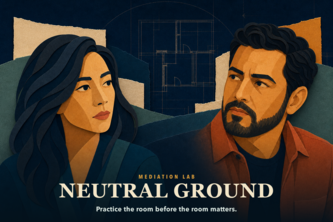
Neutral Ground is a self-reported educational tool built for law students to practice mediation using AI actors. The system allows two AI parties (Maya and Sam) to argue with each other in real time, while an AI director manages the session flow. It is described as a "practice room" where students can simulate live disputes without needing human actors.
What changed
The project was built as part of the OpenAI 2026 hackathon. The author states that it leverages GPT-Realtime-2.1 and other AI tools to create an interactive mediation experience, with a focus on overcoming limitations of previous AI models like lack of realism or latency.
Single most important open question
Is there any evidence of traction, revenue, or customer adoption beyond the author’s own development effort?
Analysis basis: This report is based entirely on the self-reported project description provided by the author. No external verification, archived data, or third-party sources are available. All claims are treated as stated by the author and not verified.
What The Product Actually Is
The description states that Neutral Ground is a "practice room" where law students mediate live disputes between two AI parties who argue out loud, while an AI director works behind the scenes to keep the session on track. It uses technologies such as GPT-Realtime-2.1, Codex, and WebRTC.
- The system includes two AI actors (Maya and Sam) that engage in dialogue.
- An AI "Room Director" (based on GPT-5.6 Luna) controls turn-taking and script generation.
- The interface supports voice interaction via WebRTC and integrates with OpenAI APIs.
- It is designed to be used remotely and can be assigned by professors, potentially integrated into platforms like Canvas.
Evidence: Based on the author’s own write-up. No independent confirmation or demonstration of functionality exists outside this description.
Positioning & Claim Evolution
The author positions Neutral Ground as a solution to a perceived lack of experiential learning in law school, particularly for mediation skills. The product is framed as an alternative to hiring actors, which they describe as costly and inconsistent.
- The project evolved from the idea that students need more realistic practice opportunities.
- It was inspired by OpenAI’s GPT-Live-1 announcement, suggesting a shift toward real-time voice AI capabilities.
- The author emphasizes that this version uses GPT-Realtime-2.1 due to lack of access to GPT-Live-1.
Claim: This is an educational tool aimed at improving mediation training for law students through AI simulation.
Inference: The evolution reflects a trend toward using AI in education, especially for skill-based learning.
Evidence: Self-reported by the author; no external validation or market positioning data.
Target Customer & ICP
The description states that the primary users are law students who want to practice mediation skills. Professors may also assign it as part of coursework, and integration with Canvas is mentioned as a future goal.
- Law students seeking hands-on experience.
- Educators looking for scalable tools to supplement classroom instruction.
- Remote learners who cannot access physical practice sessions.
Evidence: Based on the author’s own account. No data on actual user base or customer segmentation.
Business Model & Pricing Evidence
There is no mention of pricing, monetization strategy, or business model in the description.
Not evidenced. The author does not describe any revenue streams or commercial plans beyond personal development and potential academic integration.
Technical & Delivery Signals
The system is built using:
- Next.js, React, TypeScript
- OpenAI APIs (GPT-Realtime-2.1, GPT-5.6 Luna)
- Codex for code generation
- WebRTC for voice communication
- Node.js and CSS3
Key technical features include:
- Separate memory and voice sessions for each AI actor.
- A hidden "Room Director" that decides turn order and validates dialogue.
- Fallback mechanisms when the AI fails to respond appropriately.
- Latency optimization through reduced data processing per turn.
Evidence: Self-reported by the author. No evidence of production deployment or scalability beyond prototype status.
Traction & Maturity Signals
There is no evidence of traction, revenue, customers, or adoption beyond the author’s own development effort.
Not evidenced. The project was submitted to a hackathon and has not been commercialized or scaled.
Competitive Context
The description does not provide any information about competitors or existing solutions in the space of AI-mediated mediation training for law students.
Not evidenced. No competitive landscape or market analysis is included.
Open Questions & Risks
- Unproven commercial viability: The product has no demonstrated traction, revenue, or customer base.
- Dependency on AI API availability: Relies heavily on OpenAI APIs which may change or become unavailable.
- Limited scope and maturity: Built as a hackathon project; no indication of long-term development or scalability.
- Unclear user feedback loop: No mention of how the system adapts or improves based on student use.
Inference: The lack of real-world usage, funding, or product-market fit raises concerns about viability beyond prototype stage.
Questions the description leaves open
- What specific educational outcomes have you observed from using this tool?
- Are there any plans to integrate with existing LMS platforms like Canvas or Blackboard?
- How do you plan to scale beyond a single developer’s effort?
- Have you tested the system with actual law students, and what were their reactions?
- What are your thoughts on privacy and data handling for sensitive legal simulations?
Note: These questions aim to uncover whether the self-reported claims reflect real-world usage or just conceptual design.
Overall Assessment
There is insufficient evidence to support a commercial due-diligence read beyond the initial concept. The project appears to be a hackathon prototype with no demonstrated traction, revenue, or customer adoption.
Assessment: Not ready for investment or partnership consideration at this time.
Confidence level: Low — based on minimal self-reported evidence and lack of external validation.
User Stories BotA demo video on every pull request
Get a demo video on every new feature
GitHub App that watches your pull requests and records a narrated, captioned demo.
Save time on demo prep and make informed decisions faster with a video walkthrough of every new feature.
Source
Submitted to the OpenAI 2026 hackathon on Devpost. Project home on Devpost. Back to the full gallery on Devpost.
This competitive analysis was produced by top-founders.com (opens in a new tab)
Generated by a language model from this project's public Devpost page — its tagline, the author's own write-up and any built-with tags listed there — as captured in August 2026. Short quotations are the author's words. It is an opinion on the idea as a business, not on the people behind it, and it reflects the description as published then. If the project has moved on, request a correction below. The analysis is not independent research and contains no verified traction, revenue or customer data.
An independent guide by KFG International LLC — not affiliated with, endorsed by, or connected to Devpost or OpenAI.