

Archive position — measured, not model output
0 likes on Devpost
2,263 of the 7,850 archived projects have more likes, and 5,587 share exactly 0 — so this project's #5,528 place in the like-ranked listing is a tie-break inside that group, not a ranking.
Projects (log scale)
Likes on Devpost. ▲ marks this project's group.
Show the figures
| Likes | Projects | Share of archive |
|---|---|---|
| 0 | 5,587 | 71.2% |
| 1 | 1,758 | 22.4% |
| 2 | 284 | 3.6% |
| 3–4 | 132 | 1.7% |
| 5–9 | 75 | 1.0% |
| 10+ | 14 | 0.2% |
 User Stories BotA demo video on every pull request
Get a demo video on every new feature
GitHub App that watches your pull requests and records a narrated, captioned demo.
Save time on demo prep and make informed decisions faster with a video walkthrough of every new feature.
Executive Summary
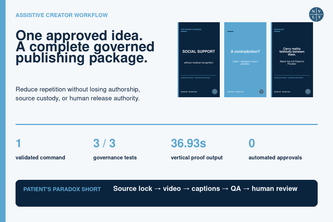
The description states that Neverlost Capacity-Aware Publishing Workflow is a self-contained, creator-controlled publishing system designed to reduce mechanical burden for disabled or energy-limited creators. It uses JSON manifests to govern media production steps, including narration, captions, rendering, and QA checks — but stops short of automating final approval or publication. The author, Jeff Summerhays, built it as a prototype using Python, FFmpeg, GPT-5.6 Sol, Pillow, Kokoro, and JSON.
Key commercial due-diligence read:
The project is described as a prototype, not a product with customers or revenue. It is self-reported and lacks evidence of traction, pricing, or adoption. The author claims the system preserves human authority over content, but does not demonstrate how this would scale or integrate into existing workflows.
Most important open question:
Is there a real-world use case or market need for such a workflow, and if so, what is the path to productization?
What The Product Actually Is
The description states that the project is a capacity-aware publishing workflow. It turns approved source material into accessible media using:
- A JSON manifest to record:
- Approved source and its SHA-256 hash;
- Authorized narration;
- Narration audio and asset custody;
- Scene and caption timing;
- Branding instructions;
- Review status.
It performs tasks such as:
- Vertical visual creation;
- Narration assembly;
- Caption generation;
- Video rendering;
- Media probing;
- QA contact sheet generation;
- Hashed build report writing.
The system stops at REVIEW_ONLY — it does not publish or approve outputs automatically. It also includes a Recovery-Aware Mode, which allows creators to set an active-minute budget and resumes interrupted sessions with exact next steps.
This is described as a prototype, not a production-ready product.
Claim: The system is a governed, accessible media package creator.
Evidence: Described in the "What it does" section.
Positioning & Claim Evolution
The author states that this project was built after producing videos during OpenAI Build Week. It emerged from a personal need to reduce mechanical burden for disabled creators, especially those with limited physical capacity.
It is positioned as a tool that:
- Reduces the technical handling required in publishing;
- Preserves creator authority and meaning;
- Supports accessibility through reduced cognitive and physical effort.
The project is described as not a medical or work-capacity assessment, but a creator-controlled planning tool to reduce prolonged computer use, context switching, and session reconstruction.
It also explicitly states that this is not the same as the first Neverlost project, which dealt with healthcare, education, and benefits systems. This one addresses publishing workflows specifically.
Claim: The system preserves human authority while reducing mechanical burden.
Evidence: From “Inspiration” and “What it does” sections.
Target Customer & ICP
The description states that the tool is designed for disabled or energy-limited creators, who may face physical barriers to repeated technical handling during publishing.
It is not described as targeting a broader audience, nor does it claim to be used by mainstream content creators.
Claim: The target user is disabled or energy-limited creators.
Evidence: From “Inspiration” and “How this differs from the first Neverlost project”.
Business Model & Pricing Evidence
There is no evidence of a business model, pricing structure, or monetization strategy in the description. It is described as a prototype, not a product with customers or revenue.
Claim: No pricing or business model stated.
Evidence: Not evidenced.
Technical & Delivery Signals
The author states that the prototype was built using:
- Python;
- Pillow;
- JSON manifests;
- FFmpeg, FFprobe;
- Kokoro narration;
- GPT-5.6 Sol (for code generation and testing);
- Standard-library tests.
It includes:
- Two governed cases;
- Sixteen source-bound caption cues;
- Two capacity plans;
- Two resume checkpoints;
- Fifteen passing tests;
- Zero automated release decisions.
Claim: The system is built with specific tech stack and includes test coverage.
Evidence: From “How I built it” and “What I learned” sections.
Traction & Maturity Signals
The description states that this is a prototype. It has not been tested in real publishing sessions, nor does it include any evidence of:
- Customers;
- Revenue;
- Adoption;
- Product-market fit.
It includes no data on usage, performance, or feedback from users beyond the author’s own experience.
Claim: The system is a prototype with no traction.
Evidence: From “What’s next” and “How this differs from the first Neverlost project”.
Competitive Context
There is no mention of competitors in the description. It does not reference existing tools for content creation, publishing workflows, or accessibility.
Claim: No competitive context provided.
Evidence: Not evidenced.
Open Questions & Risks
- The system is described as a prototype, not a product with customers or revenue.
- It is self-reported and lacks independent verification.
- There is no evidence of:
- Market demand;
- Product-market fit;
- Adoption;
- Revenue or pricing.
- The author’s claim that it reduces mechanical burden may be difficult to validate without real-world usage data.
Inference: Without traction, the system may not have a viable commercial path.
Evidence: From “What’s next” and “Traction & Maturity Signals”.
Questions the description leaves open
- What specific mechanical burdens does this workflow aim to reduce, and how are they quantified or measured?
- Have you tested the system with real users (disabled creators) in actual publishing workflows?
- How would you scale this beyond a single-person prototype?
- Are there any existing tools that already solve similar problems? If so, what is your differentiation?
- What is the path to monetization or productization?
Overall Assessment
The description states that this is a prototype built by one person (Jeff Summerhays) for a hackathon submission. It is not evidenced to have:
- Revenue;
- Customers;
- Product-market fit;
- A defined business model.
It is described as a self-contained, creator-controlled system, but lacks evidence of traction or scalability.
Inference: Not ready for investment or partnership at this stage.
Evidence: From “Traction & Maturity Signals” and “Business Model & Pricing Evidence”.
User Stories BotA demo video on every pull request
Get a demo video on every new feature
GitHub App that watches your pull requests and records a narrated, captioned demo.
Save time on demo prep and make informed decisions faster with a video walkthrough of every new feature.
Source
Submitted to the OpenAI 2026 hackathon on Devpost. Project home on Devpost. Back to the full gallery on Devpost.
This competitive analysis was produced by top-founders.com (opens in a new tab)
Generated by a language model from this project's public Devpost page — its tagline, the author's own write-up and any built-with tags listed there — as captured in August 2026. Short quotations are the author's words. It is an opinion on the idea as a business, not on the people behind it, and it reflects the description as published then. If the project has moved on, request a correction below. The analysis is not independent research and contains no verified traction, revenue or customer data.
An independent guide by KFG International LLC — not affiliated with, endorsed by, or connected to Devpost or OpenAI.