

Archive position — measured, not model output
0 likes on Devpost
2,263 of the 7,850 archived projects have more likes, and 5,587 share exactly 0 — so this project's #5,529 place in the like-ranked listing is a tie-break inside that group, not a ranking.
Projects (log scale)
Likes on Devpost. ▲ marks this project's group.
Show the figures
| Likes | Projects | Share of archive |
|---|---|---|
| 0 | 5,587 | 71.2% |
| 1 | 1,758 | 22.4% |
| 2 | 284 | 3.6% |
| 3–4 | 132 | 1.7% |
| 5–9 | 75 | 1.0% |
| 10+ | 14 | 0.2% |
 User Stories BotA demo video on every pull request
Get a demo video on every new feature
GitHub App that watches your pull requests and records a narrated, captioned demo.
Save time on demo prep and make informed decisions faster with a video walkthrough of every new feature.
Executive Summary
What the company appears to be
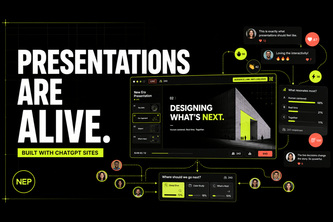
New Era Presentation (NEP) is a self-reported presentation tool that enables live, interactive participation during presentations through real-time comments, voting, and branching narratives. It uses AI tools like Codex, GPT-5.6, ChatGPT Sites, and Cloudflare for development.
What changed
The author states that NEP aims to counter "AI presentation fatigue" by turning static slides into collaborative experiences where audience interaction is embedded in the narrative flow of a presentation. It introduces features such as real-time voting, branching paths, and post-event follow-up communication.
Single most important open question
Is there any evidence of actual use or traction beyond the author’s own development and demonstration?
Note: This analysis is based entirely on the self-reported project description provided by the author. No external verification or historical data are available. All claims are treated as stated by the author, not confirmed.
What The Product Actually Is
The description states that NEP is a tool that allows participants to join presentations via QR code and interact in real time through stamps, comments, questions, and voting on four-way branches. It supports two modes:
- PRESENT mode: Full-width stage for speaker; audience joins via
/join. - WEB mode: Self-paced reading with branching paths that later rejoin.
It also includes:
- Slide-bound comments that follow transitions.
- Verified participant identities using email, Google, or ChatGPT authentication.
- A personal post-presentation timeline showing where users reacted and what they wrote.
- Admin control room for managing participants, comments, segmentation, and follow-up campaigns.
Inference: The product appears to be a hybrid of interactive storytelling and real-time collaboration software built using AI-assisted development tools. However, no evidence exists that this has been deployed or used beyond the author’s own demonstration.
Positioning & Claim Evolution
The author positions NEP as an antidote to "AI presentation fatigue", suggesting that while AI helps generate slides quickly, it also makes them easily ignored. The core claim is that NEP transforms presentations from passive delivery into active co-creation.
Key claims:
- It turns presentations into “live spaces” where speaker and audience create content together.
- Interaction history becomes an interest signal for follow-up communication.
- The tool supports both live and self-paced modes, with branching logic integrated into the narrative flow.
Inference: NEP positions itself as a platform that enhances engagement and relationship-building beyond traditional slide decks. However, there is no evidence of market testing or adoption to support these claims.
Target Customer & ICP
The description does not clearly define target customers or ideal customer profiles (ICPs). It implies that the tool is for presenters who want more audience engagement and for audiences who wish to participate actively in presentations. The system supports:
- Speakers
- Audience members
- Admins managing events
Inference: The likely ICP includes educators, corporate trainers, event organizers, or content creators looking to increase interactivity in their talks. But no explicit segmentation or customer data is provided.
Business Model & Pricing Evidence
There is no mention of pricing models, monetization strategies, or business model details in the description. The author does not state whether NEP will be offered as a SaaS product, freemium, enterprise license, or other structure.
Inference: No evidence exists to determine how the company intends to make money from this tool. The lack of pricing or commercial strategy is notable.
Technical & Delivery Signals
The author reports building the entire experience using:
- Codex
- GPT-5.6
- ChatGPT Sites
- Cloudflare (D1, Email Service)
They describe:
- Multi-route application with UI, server routes, persistent data storage.
- Use of AI for reasoning across system components: narrative, interaction model, UI, branching logic, database schema, access control, testing, deployment.
- Integration of GPT Image 2 for visual direction and creative design.
- Deployment via Codex’s cloudflare-deploy skill.
Inference: The tool was built rapidly using AI-assisted workflows. However, no evidence exists regarding scalability, performance, or production readiness beyond the hackathon prototype.
Traction & Maturity Signals
There is no evidence of traction, revenue, users, or adoption beyond the author’s own development and demonstration. The project was submitted to a hackathon, and no mention of prior usage, customer feedback, or market validation is present.
Inference: No signs of product-market fit or real-world usage are evident. The tool remains in early-stage prototype form.
Competitive Context
The description does not reference existing competitors or similar tools in the marketplace. It focuses on how NEP differs from traditional slide tools like PowerPoint or Google Slides, but does not name or compare against any specific platforms or solutions.
Inference: No competitive landscape is described, which makes it difficult to assess positioning or differentiation in the market.
Open Questions & Risks
- No traction or revenue data — This is a major open question for due diligence.
- Unverified claims — All assertions about product value and impact are self-reported without external validation.
- Limited team size — Only one member (George Yoshida) is listed, raising questions about execution capability.
- Lack of commercial strategy — No pricing, monetization, or go-to-market plan is described.
- Prototype nature — The tool was built for a hackathon and lacks evidence of production deployment or user testing.
Inference: Without traction, team capacity, or business model clarity, NEP appears to be an experimental idea rather than a viable product or business.
Questions the description leaves open
- Has the tool been tested with real users beyond the author’s own experience?
- What is the intended pricing strategy and monetization approach?
- Are there any plans for scaling beyond the current prototype?
- How does NEP handle data privacy, consent, and user control in follow-up communications?
- What are the technical limitations or scalability concerns of the current implementation?
- Is there any feedback from potential customers or users about the value proposition?
Overall Assessment
Not evidenced — There is no evidence to support a commercial due-diligence read beyond the author’s own description. No revenue, traction, team size beyond one person, or business model are provided.
Confidence Level: Very low
Assessment: This project appears to be an experimental prototype submitted for a hackathon. It lacks any evidence of commercial viability, market traction, or sustainable business model. Any investment or partnership consideration would require further validation and evidence of real-world usage or demand.
User Stories BotA demo video on every pull request
Get a demo video on every new feature
GitHub App that watches your pull requests and records a narrated, captioned demo.
Save time on demo prep and make informed decisions faster with a video walkthrough of every new feature.
Source
Submitted to the OpenAI 2026 hackathon on Devpost. Project home on Devpost. Back to the full gallery on Devpost.
This competitive analysis was produced by top-founders.com (opens in a new tab)
Generated by a language model from this project's public Devpost page — its tagline, the author's own write-up and any built-with tags listed there — as captured in August 2026. Short quotations are the author's words. It is an opinion on the idea as a business, not on the people behind it, and it reflects the description as published then. If the project has moved on, request a correction below. The analysis is not independent research and contains no verified traction, revenue or customer data.
An independent guide by KFG International LLC — not affiliated with, endorsed by, or connected to Devpost or OpenAI.