

Archive position — measured, not model output
1 like on Devpost
505 of the 7,850 archived projects have more likes, and 1,758 share exactly 1 — so this project's #1,601 place in the like-ranked listing is a tie-break inside that group, not a ranking.
Projects (log scale)
Likes on Devpost. ▲ marks this project's group.
Show the figures
| Likes | Projects | Share of archive |
|---|---|---|
| 0 | 5,587 | 71.2% |
| 1 | 1,758 | 22.4% |
| 2 | 284 | 3.6% |
| 3–4 | 132 | 1.7% |
| 5–9 | 75 | 1.0% |
| 10+ | 14 | 0.2% |
 User Stories BotA demo video on every pull request
Get a demo video on every new feature
GitHub App that watches your pull requests and records a narrated, captioned demo.
Save time on demo prep and make informed decisions faster with a video walkthrough of every new feature.
Executive Summary
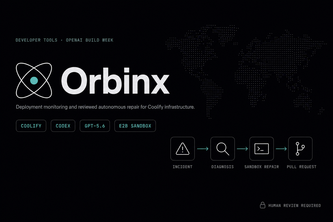
What the company appears to be: Orbinx is a self-reported tool that connects to Coolify-based infrastructure, monitors deployments, and attempts automated repairs for certain build and import failures using AI agents (Codex, GPT-5.6) in isolated sandboxes. It operates within strict safety boundaries: it does not merge pull requests automatically, does not modify production infrastructure, and keeps all repair actions under human review.
What changed: The project evolved from a personal hackathon solution into a self-described operational dashboard with an AI-powered repair system. It is described as a TypeScript monorepo built on Next.js, PostgreSQL, Redis, and BullMQ, integrating with Coolify, E2B, GitHub API, and OpenAI services.
Single most important open question: Does Orbinx have any real-world usage or traction beyond the hackathon demo? The description states no revenue, customers, or adoption data are available — only a self-reported demonstration of an end-to-end repair workflow in a replayed scenario.
What The Product Actually Is
The description states that Orbinx is a deployment and uptime console for Coolify-based infrastructure. It connects to Coolify environments, discovers servers and resources, and watches public URLs. When a deployment fails, it opens an incident with redacted evidence and diagnosis.
For certain types of build or import failures, Orbinx attempts repairs by:
- Using an isolated E2B sandbox
- Having Codex inspect and edit the repository
- Validating the diff
- Running static verification
- Opening a GitHub pull request for human review
The system is described as not merging on its own, not modifying production infrastructure, and operating within strict boundaries: one configured repository, one branch, one source-file scope.
Evidence: The author describes Orbinx as a TypeScript monorepo built with Next.js, PostgreSQL, Redis, BullMQ, integrating with Coolify, E2B, GitHub API, and OpenAI services. It includes both dashboard (operational UI) and worker components.
Inference: The product appears to be an operational tool for DevOps teams managing deployments via Coolify, with AI-assisted repair capabilities.
Positioning & Claim Evolution
The author states that Orbinx started as an attempt to keep answers to common deployment questions in one place, such as "what changed", "which service is affected", and "where the actual pull request is".
It positions itself as a deployment and uptime console for Coolify-based infrastructure, with a narrow, reviewable path for automated repairs.
The claim evolution shows:
- From personal frustration (troubleshooting failed deployments)
- To a tool that centralizes deployment monitoring
- To an AI-powered repair system with safety controls
Evidence: The author describes the inspiration as needing to jump between multiple tools when troubleshooting deployment failures. The product evolved into a unified dashboard and automated repair system.
Inference: Orbinx is positioned as a niche DevOps tool for teams using Coolify, aiming to reduce time spent on deployment issues through automation with human oversight.
Target Customer & ICP
The description states that Orbinx targets users who build and deploy projects on VPS infrastructure, particularly those using Coolify. It is described as a tool for DevOps or development teams managing deployments.
It is not clear if there is a specific customer segment beyond this general category, but the focus is on Coolify-based environments.
Evidence: The author mentions building and deploying projects on VPS infrastructure, using Coolify, and needing to jump between tools when troubleshooting deployment failures.
Inference: The ICP likely includes developers or DevOps engineers working with Coolify, especially those who experience frequent build or import failures and want a centralized way to monitor deployments and get automated fixes under human review.
Business Model & Pricing Evidence
The description does not provide any information about pricing, monetization, or business model. It is self-reported that Orbinx will be continued as an open-source project.
Evidence: No mention of revenue, customers, pricing tiers, subscriptions, or monetization strategy.
Inference: The product appears to be in early development and likely not yet commercialized. If it becomes a product, it may follow an open-source model with optional paid support or enterprise features, but this is speculative.
Technical & Delivery Signals
The author describes Orbinx as a TypeScript monorepo built using:
- Next.js (dashboard)
- PostgreSQL with Drizzle ORM
- Redis-backed workers running on BullMQ
- Integration with Coolify API, E2B sandbox, GitHub API, and OpenAI services
It uses Codex and GPT-5.6 for repair workflows, and includes a replayable demo of an end-to-end run.
Evidence: The author lists technologies used (bullmq, codex, coolify, docker, drizzle-orm, e2b, github-api, gpt-5.6, next.js, node.js, openai, openai-api, postgresql, react, redis, tailwand-css, typescript, vitest).
Inference: The architecture suggests a modern, scalable backend with event-driven processing and sandboxed AI execution. The use of E2B for isolation indicates a focus on safety.
Traction & Maturity Signals
The description states that Orbinx was built during a hackathon, and the author ran a real, private, end-to-end repair in a replayed scenario. It includes a public pull request (#2) from the demo.
There is no evidence of:
- Revenue
- Customers
- Adoption
- Product usage beyond the demo
Evidence: The only traction mentioned is a recorded demo and a public pull request (#2).
Inference: The product has not yet demonstrated real-world traction or adoption. It remains in early development, likely as a proof-of-concept.
Competitive Context
The description does not mention any competitors directly. However, it implies Orbinx operates in the DevOps and deployment automation space, particularly for users of Coolify.
It is described as a tool that monitors deployments, diagnoses failures, and attempts repairs — similar to tools like:
- Deployment monitoring platforms
- CI/CD automation tools with AI features
- Infrastructure observability tools
But it is not clear if there are direct competitors in this specific niche.
Evidence: No mention of competitors or market positioning relative to existing tools.
Inference: Orbinx likely competes in the broader DevOps and deployment automation space, but its niche focus on Coolify with AI-assisted repair sets it apart. It is not clear how it compares to other tools.
Open Questions & Risks
- No traction or revenue: The product has no evidence of real-world usage or monetization.
- Unproven safety controls: While described as having strict boundaries, the actual robustness of these controls is unverified.
- Limited scope: Repair capabilities are restricted to a narrow set of failure types and environments (Coolify).
- Open-source focus: The author plans to continue it as open source — this may limit commercial viability unless there’s a clear monetization path.
- AI dependency: Reliance on Codex and GPT-5.6 for repairs introduces risk if those tools change or become unavailable.
Evidence: No real-world usage, no revenue, no customer data, and no evidence of safety controls being tested in production.
Inference: The product is unproven in a commercial context and may face challenges scaling beyond the hackathon demo.
Questions the description leaves open
- What specific types of deployment failures does Orbinx currently attempt to repair?
- How are the safety boundaries enforced — what prevents an agent from exceeding its scope?
- Has Orbinx been tested in real-world environments beyond the hackathon demo?
- Are there any plans for monetization or commercial use beyond open-source?
- What is the current status of the GitHub App integration and repository installation flow?
- How does Orbinx handle edge cases or failures in the E2B sandbox or AI agent workflows?
- What are the key assumptions behind the repair policies, and how were they validated?
Overall Assessment
Not evidenced: There is no evidence of revenue, customers, traction, or commercial viability beyond a hackathon demo.
Confidence level: Low. The description is self-reported, unverified, and lacks any data on product-market fit, adoption, or financials.
Assessment: Orbinx appears to be an early-stage, hackathon-based concept with a strong technical foundation and clear safety design. However, it has no demonstrated traction or commercial viability. It may be worth exploring further if the founder intends to build out a more mature product, but as of now, it is not ready for investment or partnership.
User Stories BotA demo video on every pull request
Get a demo video on every new feature
GitHub App that watches your pull requests and records a narrated, captioned demo.
Save time on demo prep and make informed decisions faster with a video walkthrough of every new feature.
Source
Submitted to the OpenAI 2026 hackathon on Devpost. Project home on Devpost. Back to the full gallery on Devpost.
This competitive analysis was produced by top-founders.com (opens in a new tab)
Generated by a language model from this project's public Devpost page — its tagline, the author's own write-up and any built-with tags listed there — as captured in August 2026. Short quotations are the author's words. It is an opinion on the idea as a business, not on the people behind it, and it reflects the description as published then. If the project has moved on, request a correction below. The analysis is not independent research and contains no verified traction, revenue or customer data.
An independent guide by KFG International LLC — not affiliated with, endorsed by, or connected to Devpost or OpenAI.