

Archive position — measured, not model output
1 like on Devpost
505 of the 7,850 archived projects have more likes, and 1,758 share exactly 1 — so this project's #1,603 place in the like-ranked listing is a tie-break inside that group, not a ranking.
Projects (log scale)
Likes on Devpost. ▲ marks this project's group.
Show the figures
| Likes | Projects | Share of archive |
|---|---|---|
| 0 | 5,587 | 71.2% |
| 1 | 1,758 | 22.4% |
| 2 | 284 | 3.6% |
| 3–4 | 132 | 1.7% |
| 5–9 | 75 | 1.0% |
| 10+ | 14 | 0.2% |
 User Stories BotA demo video on every pull request
Get a demo video on every new feature
GitHub App that watches your pull requests and records a narrated, captioned demo.
Save time on demo prep and make informed decisions faster with a video walkthrough of every new feature.
Executive Summary
OrbitOS AI is a self-reported AI-powered project management tool built as a full-stack SaaS application by a single founder, Yash Baraiya. The product claims to transform meeting notes into structured execution plans using LLMs and AI prompt engineering. It is positioned as an "AI Chief of Staff" that automates task generation, risk analysis, and team execution from meetings.
The author states OrbitOS AI was built for the OpenAI 2026 hackathon and has no evidence of revenue, customers or traction beyond its own description. The product appears to be a prototype or early-stage MVP with no verified market adoption.
Key open question
Is there any evidence that OrbitOS AI has moved beyond a hackathon project into actual team usage or commercial viability?
What The Product Actually Is
The description states OrbitOS AI is an intelligent project workspace that transforms meeting notes into actionable work. It claims to:
- Generate executive summaries
- Extract key decisions, risks, and next steps
- Break large ideas into structured engineering tasks
- Allow managers to review, select, and assign tasks
- Convert AI-generated action items into trackable project tasks
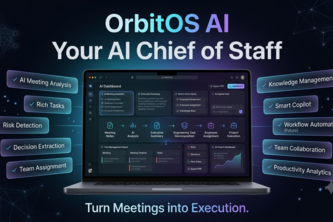
- Manage meetings, knowledge, tasks, and workflows from one unified dashboard
- Provide an AI Copilot to answer questions using workspace context
The author describes it as a full-stack AI application built with React 19, Node.js, Express 5, Supabase, PostgreSQL, Groq, OpenAI-compatible APIs, and TypeScript.
Not evidenced What the actual product interface looks like, how it integrates with existing tools, or whether any of these features are implemented in a working system.
Positioning & Claim Evolution
The author positions OrbitOS AI as an AI Chief of Staff that turns meetings into actionable project plans. The tagline states: "OrbitOS AI is an AI Chief of Staff that turns meetings into actionable project plans, rich engineering tasks, risk analysis, and team execution—all in one intelligent workspace."
The write-up describes a vision to evolve OrbitOS AI into a complete AI Operating System for modern teams, where meetings automatically become organized, trackable, and executable work.
Inferred The positioning suggests an ambition to move beyond simple meeting summarization toward full project lifecycle automation. However, this is not evidenced by any demonstrated functionality or user feedback.
Target Customer & ICP
The description does not clearly identify a specific customer segment or ideal customer profile (ICP). It mentions:
- Teams that spend hours in meetings
- Managers who need to organize action items
- Engineering teams needing structured tasks from discussions
Not evidenced No explicit targeting of verticals, company sizes, roles, or use cases beyond general team productivity.
Business Model & Pricing Evidence
The description does not contain any information about pricing models, monetization strategies, or business model assumptions. It only describes the technical architecture and features.
Not evidenced No evidence of revenue streams, subscription tiers, or commercial viability.
Technical & Delivery Signals
The author states OrbitOS AI was built as a full-stack AI application with:
- Frontend: React 19, TypeScript, Vite, Tailwind CSS v4, Zustand
- Backend: Node.js, Express 5, TypeScript, Zod Validation
- Database & Auth: Supabase, PostgreSQL, Row Level Security, Supabase Auth
- AI: Groq (OpenAI-compatible), structured prompt engineering
The system is described as processing meeting notes through LLMs, normalizing outputs into structured data, and generating engineering tasks.
Inferred The architecture suggests a production-ready MVP but lacks evidence of actual deployment or performance metrics.
Traction & Maturity Signals
There is no evidence of traction, customers, revenue, or adoption beyond the author's own description. The project was submitted to a hackathon and has no archived history or independent verification.
Not evidenced No user base, usage statistics, customer testimonials, or product maturity indicators.
Competitive Context
The description does not mention any competitors or competitive positioning. It focuses on its own features rather than how it compares to existing tools in the market.
Not evidenced No information about existing solutions in AI-powered project management or meeting automation.
Open Questions & Risks
- Single-founder build: The entire product is attributed to one person, raising questions about scalability and team capacity.
- Hackathon origin: The project was built for a hackathon, suggesting it may not have been designed for long-term commercial viability.
- Unverified claims: All features are self-reported without evidence of functionality or user validation.
- No traction or revenue: No data on adoption, usage, or monetization exists.
- AI reliability concerns: The system relies heavily on LLMs and prompt engineering, which may not be deterministic enough for project management.
Questions the description leaves open
- What specific meeting tools does OrbitOS AI integrate with?
- Has the product been tested with real teams or is it still in prototype phase?
- How does the system handle ambiguity or unclear inputs from meetings?
- Are there any existing users or pilot programs?
- What are the key assumptions about user behavior and adoption?
- How does OrbitOS AI ensure data privacy and security for enterprise clients?
- What is the roadmap for monetization and go-to-market strategy?
Overall Assessment
Not evidenced: There is no evidence of commercial traction, revenue, or customer validation to support an investment or partnership decision.
The product is described as a self-reported hackathon project with no verified market presence. While the technical architecture appears functional, there is no indication that OrbitOS AI has moved beyond prototype status or gained any meaningful adoption.
Confidence level: Low — based entirely on self-reporting and unverified claims.
User Stories BotA demo video on every pull request
Get a demo video on every new feature
GitHub App that watches your pull requests and records a narrated, captioned demo.
Save time on demo prep and make informed decisions faster with a video walkthrough of every new feature.
Source
Submitted to the OpenAI 2026 hackathon on Devpost. Project home on Devpost. Back to the full gallery on Devpost.
This competitive analysis was produced by top-founders.com (opens in a new tab)
Generated by a language model from this project's public Devpost page — its tagline, the author's own write-up and any built-with tags listed there — as captured in August 2026. Short quotations are the author's words. It is an opinion on the idea as a business, not on the people behind it, and it reflects the description as published then. If the project has moved on, request a correction below. The analysis is not independent research and contains no verified traction, revenue or customer data.
An independent guide by KFG International LLC — not affiliated with, endorsed by, or connected to Devpost or OpenAI.