

Archive position — measured, not model output
0 likes on Devpost
2,263 of the 7,850 archived projects have more likes, and 5,587 share exactly 0 — so this project's #3,564 place in the like-ranked listing is a tie-break inside that group, not a ranking.
Projects (log scale)
Likes on Devpost. ▲ marks this project's group.
Show the figures
| Likes | Projects | Share of archive |
|---|---|---|
| 0 | 5,587 | 71.2% |
| 1 | 1,758 | 22.4% |
| 2 | 284 | 3.6% |
| 3–4 | 132 | 1.7% |
| 5–9 | 75 | 1.0% |
| 10+ | 14 | 0.2% |
 User Stories BotA demo video on every pull request
Get a demo video on every new feature
GitHub App that watches your pull requests and records a narrated, captioned demo.
Save time on demo prep and make informed decisions faster with a video walkthrough of every new feature.
Executive Summary
What the company appears to be
CreatorCompass is a self-reported tool that takes a brand’s public website and generates an evidence-backed report to guide strategic decisions in creator marketing. It aims to help brands understand where they should go in the creator economy before selecting specific creators.
What changed
The product was built as part of a hackathon submission, with a focus on solving early-stage decision-making in creator sponsorships — specifically, helping brands determine whether and how to enter the creator economy using their own website as input.
Single most important open question
Does CreatorCompass provide actionable strategic clarity for real-world brand teams, or does it offer only a polished but ultimately vague framework?
Note: This analysis is based entirely on the self-reported project description provided by the author. No independent verification, traction data, revenue figures, customer names, or third-party evidence are included.
What The Product Actually Is
The description states that CreatorCompass is a tool that:
- Takes a public brand website URL as input
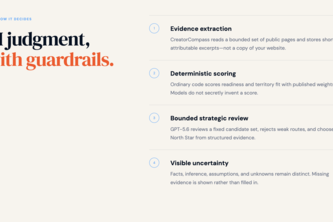
- Reviews a bounded set of public pages from that site
- Generates an evidence-backed report containing:
- A structured snapshot of the brand, product, audience, and use cases
- A sponsorship-readiness assessment
- Creator territories where the brand most naturally belongs
- Adjacent and experimental directions worth testing
- Tempting but strategically weak directions to avoid
- Campaign concepts, creator profiles, formats, and search phrases
- One recommended North Star route
- A five-step plan the brand can begin using immediately
It is described as a TypeScript application with a React/Vite frontend, Hono API backend, and Cloudflare infrastructure.
Inference: The tool separates questions of readiness from territory fit. It does not simply score or rank creators; it attempts to map a brand’s digital presence to strategic paths in the creator economy.
Positioning & Claim Evolution
The author states that CreatorCompass started with a problem they observed from the agency side of creator sponsorships:
- Most platforms begin by asking brands to search through thousands of creators, assuming the brand already knows what it is looking for.
- Instead, CreatorCompass works one step earlier — helping brands understand where they should go before choosing creators.
The guiding idea: “Do not give a brand more names until it understands where it should go.”
Claim: The product positions itself as a pre-creator-database tool that helps brands make better strategic decisions before entering the creator economy.
Inference: It is positioned to serve early-stage decision-making, not execution or campaign management.
Target Customer & ICP
The description states:
- CreatorCompass is intended for brands considering creator sponsorships.
- It assumes the brand already has a website and wants to explore strategic directions in the creator economy.
- It helps answer basic questions like:
- Does creator sponsorship make sense?
- What kinds of audiences should we reach?
- Are we ready to pay for outreach?
Claim: The target customer is a brand or marketing team exploring creator sponsorships, not yet committed to a specific creator or campaign.
Inference: The ICP likely includes B2B SaaS brands, tech products, and software companies that may be new to influencer marketing but have digital assets to analyze.
Business Model & Pricing Evidence
Not evidenced. No mention of pricing, monetization strategy, or business model in the description.
Finding: No evidence provided about how CreatorCompass intends to make money or whether it is a freemium, SaaS, or one-time tool.
Technical & Delivery Signals
The product is built with:
- Cloudflare Workers (API and frontend)
- Cloudflare D1 (database)
- Cloudflare KV (caching)
- Cloudflare Queues (asynchronous processing)
- AI providers: GPT-5.6, Mistral, Cloudflare Workers AI
- Frontend: React, Vite
- Backend: Hono
- Tools used: Codex for scaffolding, testing, debugging
Claim: The system uses a bounded approach to avoid over-generating or hallucinating recommendations.
Inference: It separates deterministic logic from model-based inference and allows for abstention when evidence is insufficient.
Traction & Maturity Signals
Not evidenced. No mention of users, customers, revenue, usage metrics, or product adoption.
Finding: No traction data or maturity indicators are provided in the description.
Competitive Context
The description does not reference competitors or market positioning beyond stating that most creator-marketing platforms begin with a search function and assume brand decisions have already been made.
Inference: CreatorCompass appears to aim at filling a gap between generic creator databases and strategic planning tools, but no specific competitive landscape is described.
Open Questions & Risks
- Unclear value proposition for real brands: The tool does not appear to have been tested with actual users or in real-world settings.
- Over-reliance on AI without clear validation: While it separates deterministic logic from model use, the extent to which models are used for final decisions is unclear.
- No pricing or monetization strategy: This raises questions about long-term viability and scalability.
- Self-reported maturity: The tool was built for a hackathon; there is no indication of production-grade features or user feedback loops.
Inference: Without real-world testing, the product may be more of a proof-of-concept than a launchable solution.
Questions the description leaves open
- What specific feedback have you received from early users or test brands?
- How do you validate that the recommendations are actionable and not just vague suggestions?
- Have you tested the tool with real brands in different industries, or is it still in conceptual/early-stage use?
- What is your plan for scaling beyond a single-user, single-brand input?
- How do you handle cases where a brand’s website lacks sufficient information to generate a meaningful report?
- Is there any integration with existing creator platforms or agency workflows?
Overall Assessment
Not evidenced.
Finding: No evidence of traction, revenue, customer base, or financials is available. The product is described as a hackathon submission and lacks commercial due-diligence signals such as user engagement, conversion rates, or market fit validation.
Inference: At this stage, CreatorCompass appears to be an early-stage idea with potential but no demonstrated commercial viability or strategic clarity for investment or partnership.
User Stories BotA demo video on every pull request
Get a demo video on every new feature
GitHub App that watches your pull requests and records a narrated, captioned demo.
Save time on demo prep and make informed decisions faster with a video walkthrough of every new feature.
Source
Submitted to the OpenAI 2026 hackathon on Devpost. Project home on Devpost. Back to the full gallery on Devpost.
This competitive analysis was produced by top-founders.com (opens in a new tab)
Generated by a language model from this project's public Devpost page — its tagline, the author's own write-up and any built-with tags listed there — as captured in August 2026. Short quotations are the author's words. It is an opinion on the idea as a business, not on the people behind it, and it reflects the description as published then. If the project has moved on, request a correction below. The analysis is not independent research and contains no verified traction, revenue or customer data.
An independent guide by KFG International LLC — not affiliated with, endorsed by, or connected to Devpost or OpenAI.