

Archive position — measured, not model output
1 like on Devpost
505 of the 7,850 archived projects have more likes, and 1,758 share exactly 1 — so this project's #1,600 place in the like-ranked listing is a tie-break inside that group, not a ranking.
Projects (log scale)
Likes on Devpost. ▲ marks this project's group.
Show the figures
| Likes | Projects | Share of archive |
|---|---|---|
| 0 | 5,587 | 71.2% |
| 1 | 1,758 | 22.4% |
| 2 | 284 | 3.6% |
| 3–4 | 132 | 1.7% |
| 5–9 | 75 | 1.0% |
| 10+ | 14 | 0.2% |
 User Stories BotA demo video on every pull request
Get a demo video on every new feature
GitHub App that watches your pull requests and records a narrated, captioned demo.
Save time on demo prep and make informed decisions faster with a video walkthrough of every new feature.
Executive Summary
What the company appears to be
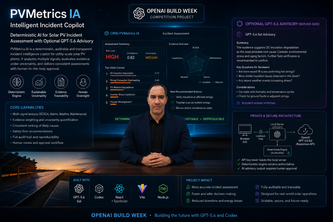
ORBI PVMetrics IA — Incident Intelligence Copilot is a human-in-the-loop decision-support prototype for photovoltaic (PV) and battery energy storage system (BESS) operations and maintenance. It is described as a tool that analyzes synthetic incident scenarios, generates structured assessments with evidence-linked facts and hypotheses, and supports O&M engineers in making uncertainty-aware decisions.
What changed
The project was developed during OpenAI Build Week 2026, resulting in a prototype focused on four fixed synthetic PV and BESS incident scenarios. It includes a deterministic evidence-analysis engine and an optional server-side GPT-5.6 advisory component. The system does not control equipment or perform SCADA operations; it is designed to assist engineers while preserving human authority.
The single most important open question
Is there any evidence of real-world adoption, traction, or commercial use beyond the Build Week prototype? The description states that ORBI PVMetrics IA existed as a private demonstration before Build Week but does not indicate whether this has evolved into a product used by customers or deployed in production.
What The Product Actually Is
The description states that ORBI PVMetrics IA is an Incident Intelligence Copilot — a human-in-the-loop decision-support system for solar plant operations and maintenance. It analyzes four fixed, synthetic incident scenarios:
- PV inverter-block derating
- Ambiguous PV underperformance
- BESS EMS-versus-meter mismatch
- Hybrid communication loss and stale data
For each scenario, the tool generates a structured assessment including:
- Prioritized incidents
- Evidence-linked confirmed facts
- Technical hypotheses
- Supporting and conflicting evidence
- Missing information
- Confidence and uncertainty levels
- Operational and bounded energy risk
- Ordered field-verification steps
- Advisory O&M actions
- Executive summary
The system does not control equipment or perform SCADA operations. It requires human review before any action is taken.
Evidence
- The author describes the tool as a "human-in-the-loop decision-support prototype"
- It includes a deterministic evidence-analysis engine and optional GPT-5.6 advisory interpretation
- Four synthetic scenarios are explicitly listed
Inference The system is built for use in renewable energy operations, particularly solar plants and BESS systems.
Positioning & Claim Evolution
The author positions ORBI PVMetrics IA as a tool that helps O&M engineers reason from evidence rather than simply presenting disconnected data. The goal is to convert fragmented information into clear, traceable, uncertainty-aware decisions.
Key claims
- “Turn solar plant evidence into clear, uncertainty-aware, human-reviewed O&M decisions.”
- “Not another dashboard filled with disconnected values, but a system that converts evidence into clear, traceable, uncertainty-aware decisions.”
The project evolved from a private, sanitized demonstration to a prototype built during OpenAI Build Week. The author emphasizes that the tool is not intended for operational control but for decision support.
Evidence
- Tagline and description state the tool's purpose
- The system is described as a "human-in-the-loop" solution
- It explicitly avoids operational control or SCADA interaction
Inference The positioning reflects an intent to address information overload in O&M environments by structuring data into actionable insights with transparency about uncertainty.
Target Customer & ICP
The description indicates that the primary users are O&M engineers working in solar photovoltaic and BESS operations. The system is designed for technical teams who need to interpret complex situations quickly and safely, especially when evidence is fragmented or ambiguous.
Evidence
- The tool is described as being built "from the perspective of an O&M engineer"
- It targets "solar plant" and "BESS operations and maintenance"
- The scenarios are based on real-world patterns in these domains
Inference The ICP likely includes engineers or teams managing renewable energy assets, particularly those with access to SCADA systems, weather data, and maintenance reports.
Business Model & Pricing Evidence
There is no evidence of a business model or pricing structure in the description. The project is described as a prototype built during a hackathon event.
Evidence
- No mention of revenue streams, pricing tiers, or monetization strategy
- The system is presented as a demonstration and not yet commercialized
Inference The tool has not reached a point where it can be monetized or sold to customers. It remains in early-stage development.
Technical & Delivery Signals
The application is built using:
- Frontend: React, TypeScript, Vite
- Backend: Node.js
- AI components: GPT-5.6 Sol (server-side only), Codex
- Architecture: Deterministic local engine with optional GPT advisory
- Security and safety features: Read-only access, synthetic data, no real credentials or plant connections
The system uses a deterministic evidence engine for core analysis and an optional GPT-5.6 advisory that runs separately and cannot modify confirmed facts or human review states.
Evidence
- Technology stack is listed in the author’s write-up
- The deterministic mode is required for reproducible evaluation
- GPT integration is described as server-side, fail-closed, and supplemental
Inference The architecture reflects a cautious approach to AI integration, prioritizing determinism and human oversight over automation.
Traction & Maturity Signals
There is no evidence of traction or maturity beyond the Build Week prototype. The project is described as a demonstration that existed before Build Week but was not fully developed during it.
Evidence
- The system exists only as a prototype
- No customer base, revenue, or usage data are mentioned
- The pre-existing application included dashboards and forecasting demonstrations, but no indication of deployment or adoption
Inference The project is in an early stage of development and lacks any commercial traction.
Competitive Context
No competitive landscape is described. The author does not reference existing tools or platforms in the solar O&M space.
Evidence
- No mention of competitors or market positioning
- No indication of how ORBI PVMetrics IA compares to other solutions
Inference The competitive context is unknown, but it likely operates within the broader domain of renewable energy operations and maintenance software.
Open Questions & Risks
- No commercial traction or adoption: The system is described only as a prototype.
- Limited scope: Only four synthetic scenarios are implemented; no real-world data integration.
- AI dependency without operational control: While GPT-5.6 is used, it does not affect decisions or operations.
- Founder-only team: The project was built by one person (Victor Marcel Leon Pacheco).
- No evidence of scalability or production readiness: The system uses synthetic data and lacks real-world validation.
Evidence
- No customers, revenue, or usage metrics
- Only one developer involved
- Synthetic scenarios only
Inference The risk of commercial failure is high if the prototype does not evolve into a scalable product with real-world use cases.
Questions the description leaves open
- What are the key assumptions underlying the four synthetic scenarios, and how were they validated?
- Has there been any feedback from actual O&M engineers or solar plant operators?
- Are there plans to integrate real data sources beyond synthetic ones?
- How is the deterministic engine being tested for accuracy and reliability?
- What are the next steps in product development after Build Week?
- Is there a plan to test the system with real-world incidents or pilot users?
- How does the team intend to scale this solution beyond a single developer?
Overall Assessment
Not evidenced
There is no evidence of revenue, customers, traction, or commercial viability beyond the Build Week prototype. The project is described as a proof-of-concept with limited scope and no indication of future development plans or market readiness.
The system is built around deterministic principles and human review, which may be valuable in safety-critical environments, but without real-world deployment or adoption, it cannot be evaluated for investment potential.
Confidence level Low
Reasoning
The description is self-reported and unverified. No data on performance, users, or business model exists. The project remains in early-stage development with no evidence of traction or commercialization.
User Stories BotA demo video on every pull request
Get a demo video on every new feature
GitHub App that watches your pull requests and records a narrated, captioned demo.
Save time on demo prep and make informed decisions faster with a video walkthrough of every new feature.
Source
Submitted to the OpenAI 2026 hackathon on Devpost. Project home on Devpost. Back to the full gallery on Devpost.
This competitive analysis was produced by top-founders.com (opens in a new tab)
Generated by a language model from this project's public Devpost page — its tagline, the author's own write-up and any built-with tags listed there — as captured in August 2026. Short quotations are the author's words. It is an opinion on the idea as a business, not on the people behind it, and it reflects the description as published then. If the project has moved on, request a correction below. The analysis is not independent research and contains no verified traction, revenue or customer data.
An independent guide by KFG International LLC — not affiliated with, endorsed by, or connected to Devpost or OpenAI.