

Archive position — measured, not model output
0 likes on Devpost
2,263 of the 7,850 archived projects have more likes, and 5,587 share exactly 0 — so this project's #3,559 place in the like-ranked listing is a tie-break inside that group, not a ranking.
Projects (log scale)
Likes on Devpost. ▲ marks this project's group.
Show the figures
| Likes | Projects | Share of archive |
|---|---|---|
| 0 | 5,587 | 71.2% |
| 1 | 1,758 | 22.4% |
| 2 | 284 | 3.6% |
| 3–4 | 132 | 1.7% |
| 5–9 | 75 | 1.0% |
| 10+ | 14 | 0.2% |
 User Stories BotA demo video on every pull request
Get a demo video on every new feature
GitHub App that watches your pull requests and records a narrated, captioned demo.
Save time on demo prep and make informed decisions faster with a video walkthrough of every new feature.
Executive Summary
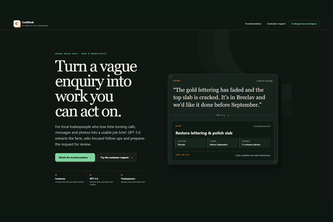
CraftDesk is a self-reported AI-powered intake tool for local trade businesses. The author states it allows trade businesses to create a shareable AI intake link that turns vague customer messages into structured job briefs before the first call. It uses GPT-5.6 and OpenAI Responses API, with a focus on preserving uncertainty rather than guessing missing information.
The project is described as a functional prototype built during a hackathon. No revenue, customers or traction data are provided. The business model, pricing, and go-to-market strategy are not evident. The author claims the tool preserves uncertainty instead of inventing facts, which may be a key differentiator.
The single most important open question
Is there evidence that local trade businesses actually need this type of intake system, or that they would pay for it?
What The Product Actually Is
The description states CraftDesk is an AI intake system for local trades. It allows business owners to set up a public intake link that customers can use to describe jobs.
Key features described:
- Business owners describe their services in plain language
- GPT-5.6 proposes a tailored public profile, service list, and follow-up questions
- Customers choose work type, describe job naturally, attach photos
- CraftDesk extracts known facts, identifies missing information, asks only relevant next questions
- Submitted requests appear in a tradesperson dashboard with:
- Concise title
- Original customer message
- Contact details
- Photos
- Field provenance
- Missing information
- Recommended next action
- Business can review brief, edit draft reply, update workflow status, export request
The system uses GPT-5.6 and the OpenAI Responses API, with structured outputs to avoid guessing missing facts.
Not evidenced The actual technical architecture beyond API usage, data flow, or integration points. No mention of database schema, UI components, or backend infrastructure details beyond "server-side persistence" and "photo uploads".
Positioning & Claim Evolution
The author states CraftDesk is an AI intake tool for local trades that turns vague customer messages into clear, job-ready briefs before the first call.
Key claims:
- Local trade businesses often receive incomplete customer requests through phone calls, text messages, and messaging apps
- Before quoting or making a useful first call, they have to chase basic details like location, measurements, timing, and photos
- CraftDesk uses GPT-5.6 to convert unstructured descriptions into structured data
- The system preserves uncertainty instead of guessing missing information
- Customers can describe jobs naturally and attach photos
- The tool avoids inventing facts by reporting only visible photo facts
Inference The positioning appears to be a solution for local trade businesses dealing with poor-quality customer intake, using AI to structure requests and reduce follow-up work.
Not evidenced No evidence of prior market research or customer validation. No mention of competitors or how this differs from existing tools like Google Forms, WhatsApp integrations, or CRM systems.
Target Customer & ICP
The description states the target is local trade businesses, which receive incomplete customer requests through phone calls, text messages, and messaging apps.
The author claims these businesses often have to chase basic details such as:
- Location
- Measurements
- Timing
- Photos
Inference The ICP appears to be small-to-medium local trade businesses (e.g., plumbers, electricians, painters) that rely on phone or text-based intake and struggle with incomplete information.
Not evidenced No evidence of customer personas, segmentation, or specific industry targeting. No mention of business size, geographic scope, or typical revenue per job.
Business Model & Pricing Evidence
The description does not state a business model or pricing strategy.
The author mentions:
- The tool is built as a prototype
- Next steps include production authentication, durable database hosting, rate limiting, messaging integrations, and testing with trade businesses outside the demo scenario
Not evidenced No information on monetization, subscription tiers, per-use fees, or licensing models. No mention of whether it's SaaS, freemium, or one-time purchase.
Technical & Delivery Signals
The author states CraftDesk was built using:
- GPT-5.6
- OpenAI Responses API
- Codex for development
- Express.js, Node.js, JavaScript, HTML5, CSS3
Key technical claims:
- Uses strict structured outputs to avoid guessing missing facts
- Converts unstructured customer descriptions into a reliable schema
- Identifies missing fields and generates relevant follow-up questions
- Reports only visible photo facts
- Prepares editable replies
The prototype includes:
- Business onboarding
- Public customer intake
- Server-side persistence
- Photo uploads
- Tradesperson dashboard
- Reply drafting
- Workflow states
- Backups
- Portable data export
Inference The tool is built with a modern stack and uses AI for structured data extraction. It's described as functional end-to-end, not just a mockup.
Not evidenced No details on hosting platform, scalability, or integration with existing tools. No mention of security, compliance, or data privacy measures.
Traction & Maturity Signals
The description states:
- CraftDesk is a functional end-to-end prototype
- The complete request flow works from business setup to dashboard and export
- An automated test suite passes all six tests
- It was built during a hackathon (OpenAI 2026)
Not evidenced No revenue, customers, or usage metrics. No evidence of user feedback, adoption, or retention. No mention of beta users or pilot programs.
Competitive Context
The description does not provide any information on competitive landscape.
Not evidenced No mention of existing tools for local trade intake, CRM systems, or messaging platforms that might serve similar functions.
Open Questions & Risks
- No traction evidence: The project is described as a prototype with no revenue, customers, or usage data.
- Unproven market need: No evidence of customer validation or market research.
- AI dependency risk: Heavy reliance on GPT-5.6 and OpenAI APIs may create vendor lock-in or performance issues.
- Limited scope: Only one team member (Zbynek Ben Smal) is listed, suggesting limited development capacity.
- Unclear monetization: No business model or pricing strategy provided.
Questions the description leaves open
- What specific local trade businesses have you spoken to about this tool? Did they express interest or willingness to pay?
- How do you plan to scale beyond the hackathon prototype?
- Are there any existing tools in this space, and how does CraftDesk differ from them?
- What is your go-to-market strategy for reaching local trade businesses?
- How do you plan to monetize this tool? Is it SaaS, freemium, or another model?
- What are the main technical challenges you expect to face in production deployment?
Overall Assessment
Not evidenced: No data on financials, traction, or market opportunity is available.
The project is described as a functional prototype built during a hackathon. It uses AI for intake and structured output but lacks evidence of:
- Revenue
- Customers
- Market validation
- Business model
- Go-to-market strategy
Confidence level: Low — based on self-reported, unverified information only.
Assessment: The project shows potential as an idea but is not ready for investment or partnership consideration without further evidence of traction, market need, or business viability.
User Stories BotA demo video on every pull request
Get a demo video on every new feature
GitHub App that watches your pull requests and records a narrated, captioned demo.
Save time on demo prep and make informed decisions faster with a video walkthrough of every new feature.
Source
Submitted to the OpenAI 2026 hackathon on Devpost. Project home on Devpost. Back to the full gallery on Devpost.
This competitive analysis was produced by top-founders.com (opens in a new tab)
Generated by a language model from this project's public Devpost page — its tagline, the author's own write-up and any built-with tags listed there — as captured in August 2026. Short quotations are the author's words. It is an opinion on the idea as a business, not on the people behind it, and it reflects the description as published then. If the project has moved on, request a correction below. The analysis is not independent research and contains no verified traction, revenue or customer data.
An independent guide by KFG International LLC — not affiliated with, endorsed by, or connected to Devpost or OpenAI.