

Archive position — measured, not model output
0 likes on Devpost
2,263 of the 7,850 archived projects have more likes, and 5,587 share exactly 0 — so this project's #5,677 place in the like-ranked listing is a tie-break inside that group, not a ranking.
Projects (log scale)
Likes on Devpost. ▲ marks this project's group.
Show the figures
| Likes | Projects | Share of archive |
|---|---|---|
| 0 | 5,587 | 71.2% |
| 1 | 1,758 | 22.4% |
| 2 | 284 | 3.6% |
| 3–4 | 132 | 1.7% |
| 5–9 | 75 | 1.0% |
| 10+ | 14 | 0.2% |
 User Stories BotA demo video on every pull request
Get a demo video on every new feature
GitHub App that watches your pull requests and records a narrated, captioned demo.
Save time on demo prep and make informed decisions faster with a video walkthrough of every new feature.
Executive Summary
What the company appears to be
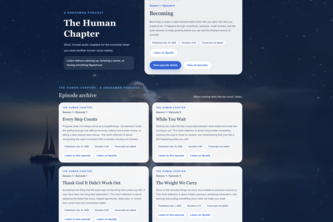
OneHuman is a self-reported human-centered platform built by one developer (Brandon Blackmore) that offers an AI-powered reflection experience called The Perspective Room. It is described as a space for personal journeys, reflection, and hope, where users can explore their own experiences without being prescribed solutions.
What changed
The project evolved from a concept rooted in the belief that "one human story can help another human keep going" into a live product with AI integration, privacy-focused design, and layered abuse protections. It was built incrementally over OpenAI Build Week using AI tools like Codex.
Single most important open question
Is there evidence of user engagement or adoption beyond the author's own use case? The description does not provide any data on users, traction, or commercial viability.
What The Product Actually Is
The description states that OneHuman is a human-centered platform focused on real journeys, reflection, and hope. Its core offering is The Perspective Room, an AI-powered experience designed to help individuals reflect on their current life chapter without being given answers.
- The Perspective Room:
- Begins with the question: What chapter are you in?
- Allows users to write about what feels useful to name.
- Does not diagnose, define meaning, or prescribe next steps.
- Reflects what it heard.
- Identifies a central emotional theme.
- Offers exactly three possible perspectives.
- Provides an open-ended question to sit with.
- May recommend a trusted OneHuman journey or episode of The Human Chapter.
- The system is built using:
- Next.js, React, TypeScript, Tailwind CSS, Supabase, Vercel
- OpenAI integration for reflection pipeline
- Moderation before generation, structured outputs, runtime validation
- Redis-backed anonymous sessions and abuse protections
- Notably, the product is described as not therapy, diagnosis, counseling, or emergency support.
This is a self-reported product description. No evidence of actual users, revenue, or customer data exists beyond the author’s account.
Positioning & Claim Evolution
The author states that OneHuman was built on the principle of “Proof, not performance.”
- The platform positions itself as:
- A place centered on real human journeys
- Not built around performance, popularity, or pretending everything is perfect
- Designed for people in the middle of their chapter — before breakthroughs or clarity
- Key claims include:
- “Most AI products try to give you an answer.”
- “We built one designed to help you hear your own.”
- “AI becomes the mirror, not the answer.”
These reflect a deliberate positioning away from traditional AI advice tools toward a more reflective and non-prescriptive model.
There is no evidence of prior versions or evolution in positioning beyond this single iteration described by the author.
Target Customer & ICP
The description states that OneHuman targets people who are:
- In the middle of their chapter
- Before breakthroughs, lessons make sense, or they know what comes next
- Looking for space to put words around what they're carrying and see it from a different angle
It is described as not targeting:
- People needing therapy, diagnosis, counseling, or emergency support
There is no evidence of segmentation, personas, or specific customer types beyond the general idea of someone seeking reflection.
No data on demographics, usage patterns, or target market size is provided.
Business Model & Pricing Evidence
The description does not contain any information about:
- Revenue streams
- Pricing models
- Monetization strategies
- Paid features or subscriptions
It only says that OneHuman is a human-centered platform with the goal of helping people move through life chapters, and that The Perspective Room is part of a larger vision including short-form audio (The Human Chapter) and tools for reflection.
No indication exists whether this will be monetized, how, or if it has any commercial structure at all.
Technical & Delivery Signals
The author reports building the product with:
- Next.js, React, TypeScript, Tailwind CSS, Supabase, Vercel
- OpenAI integration into a server-side pipeline with moderation and structured outputs
- Layered abuse protections including Redis-backed sessions, IP controls, circuit breakers, fail-closed behavior
- Server-side resolution of recommendations to trusted content only
Key technical elements:
- Anonymous session handling via Redis
- Hourly/daily quotas and cooldowns
- Fail-closed deployment strategy
- No persistent storage of reflections or responses in product database or Redis
- Active draft/result remain in page memory, not browser-local history
The author notes that the system was deployed in a controlled manner:
- First disabled in production
- Verified disabled state
- Enabled via configuration
- One smoke test before freezing feature development
This suggests a cautious, privacy-conscious approach to delivery.
Traction & Maturity Signals
There is no evidence of user traction, adoption, or engagement beyond the author's own use case. The description does not mention:
- Number of users
- Usage metrics
- Customer feedback
- Retention rates
- Product growth or iteration history
The project was submitted as a hackathon entry and is described as being live but without any indication of scale or ongoing user interaction.
Competitive Context
The author states that most AI products try to give you an answer, while OneHuman builds one designed to help you hear your own. This implies a differentiation from typical AI advice or coaching platforms.
However, there is no evidence of:
- Competitor analysis
- Market positioning relative to existing tools
- Benchmarking against similar offerings
The author does not reference any comparable products or services in the market.
Open Questions & Risks
Several risks and open questions are evident from the self-reported description:
- No traction or user data: The lack of any evidence for users, adoption, or engagement raises questions about viability.
- Single-person development: The team size is listed as one (Brandon Blackmore), which may limit scalability, maintenance, and long-term sustainability.
- Unclear commercial model: No indication of how the platform will generate revenue or sustain itself.
- Privacy vs. utility tension: While privacy boundaries are emphasized, there’s no clarity on whether this approach will attract users or meet their needs.
- Lack of external validation: The entire project is self-reported and unverified — no third-party audits, reviews, or customer testimonials exist.
Questions the description leaves open
- What is the actual user base? How many people are using The Perspective Room?
- Are there any metrics on how often users return or engage with the platform?
- How do you plan to monetize this product and scale it beyond a single developer?
- What are your plans for content curation and moderation of The Human Chapter episodes?
- Have you tested the AI prompts with real users, or is the experience based solely on internal assumptions?
- What kind of support or safety nets exist for users who may be in distress during reflection?
- How do you intend to build trust and credibility without traditional marketing or branding?
Overall Assessment
There is no evidence that OneHuman has achieved any level of traction, revenue, or customer adoption beyond the author’s own use case.
The project is described as a personal vision realized through AI assistance during a hackathon. It lacks:
- Revenue data
- Customer base
- Product-market fit validation
- Commercial scalability
Given the lack of evidence for commercial viability or user engagement, and the fact that it was built by one person, this appears to be an early-stage concept rather than a developed business.
Assessment: Not evidenced. No clear commercial due-diligence signal.
User Stories BotA demo video on every pull request
Get a demo video on every new feature
GitHub App that watches your pull requests and records a narrated, captioned demo.
Save time on demo prep and make informed decisions faster with a video walkthrough of every new feature.
Source
Submitted to the OpenAI 2026 hackathon on Devpost. Project home on Devpost. Back to the full gallery on Devpost.
This competitive analysis was produced by top-founders.com (opens in a new tab)
Generated by a language model from this project's public Devpost page — its tagline, the author's own write-up and any built-with tags listed there — as captured in August 2026. Short quotations are the author's words. It is an opinion on the idea as a business, not on the people behind it, and it reflects the description as published then. If the project has moved on, request a correction below. The analysis is not independent research and contains no verified traction, revenue or customer data.
An independent guide by KFG International LLC — not affiliated with, endorsed by, or connected to Devpost or OpenAI.